
What OPEC+ Decided Yesterday — June 7, 2026
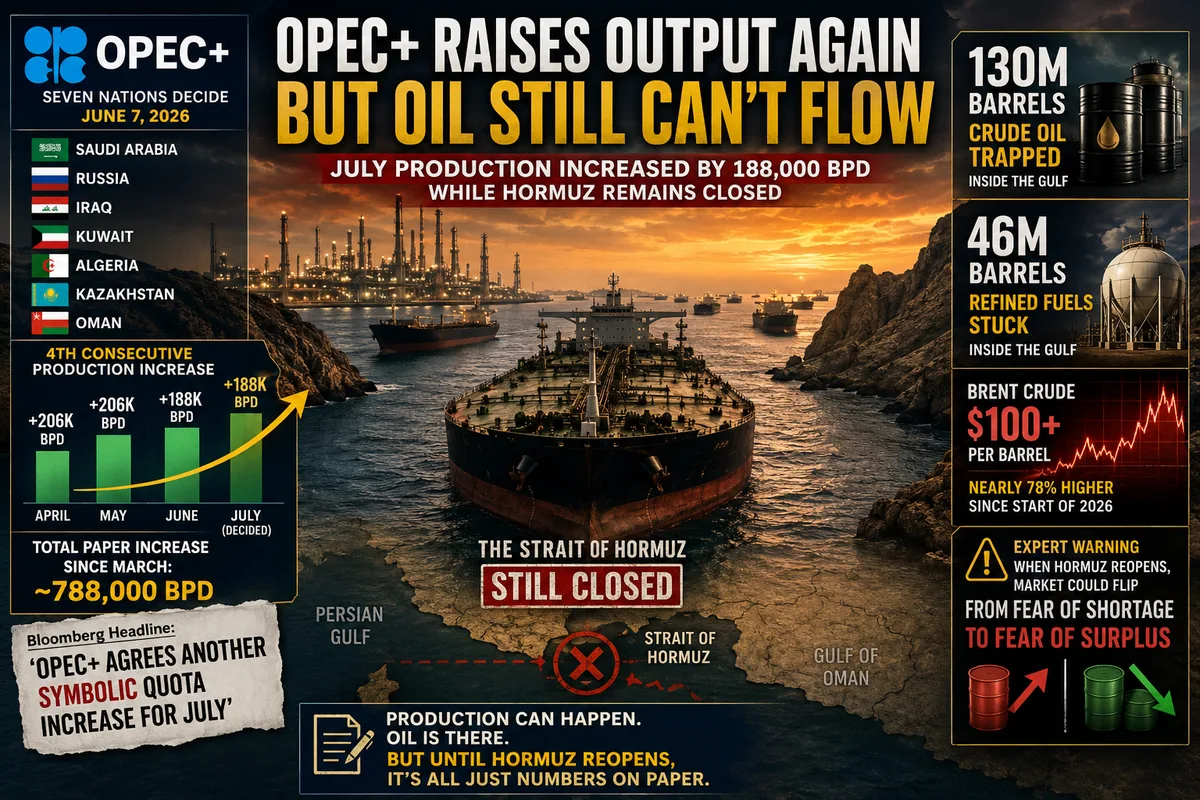
On Sunday June 7, 2026, seven core members of OPEC+ held a video conference and made their decision for July oil production.
Seven nations led by Saudi Arabia and Russia agreed to raise their collective production target by 188,000 barrels per day for July — continuing the process of restarting production that was halted several years ago.
The seven countries that met were: Saudi Arabia, Iraq, Kuwait, Algeria, Kazakhstan, Russia, and Oman.
This is the fourth consecutive monthly production increase since the Strait of Hormuz closed in late February 2026. Here is the running total of increases since the war began:
- April increase: 206,000 bpd
- May increase: 206,000 bpd
- June increase: 188,000 bpd (adjusted down after UAE left OPEC)
- July increase: 188,000 bpd (decided yesterday)
- Total paper increase since March: ~788,000 bpd
That sounds like a lot of extra oil coming to market. But here is the problem.
The Shocking Truth — It Is All "On Paper"
Bloomberg immediately put the decision in context with a brutal headline: "OPEC+ Agrees Another Symbolic Quota Increase for July."
The word "symbolic" is key. And the reason is simple: the Strait of Hormuz is still closed.
Think about it this way. Saudi Arabia, Iraq, Kuwait, and Oman are all Gulf nations. Their oil terminals — the places where tankers fill up to carry oil to the world — are inside the Persian Gulf. To get oil from inside the Gulf to the rest of the world, tankers have to pass through the Strait of Hormuz.
The Strait is still effectively closed. So it does not matter how much Saudi Arabia or Iraq agrees to produce — they physically cannot get the oil out to sell it.
In reality, OPEC+'s production has collapsed due to export cuts by Gulf members, with production averaging 33.19 million barrels per day in April — down from 42.77 million in February.
That is a loss of nearly 10 million barrels per day — every single day — since the Hormuz closure began. To understand the scale: before the Iran war, these countries were pumping 42.77 million bpd. Now they are pumping 33.19 million bpd. The gap is not because they chose to cut. It is because they physically cannot export.
The Expert Warning That Should Alarm Every Logistics Professional
Here is where the story becomes truly important for the shipping and freight industry.
Jorge Leon, an analyst at Rystad Energy and a former OPEC official, said something that should make every freight professional stop and think:
"An OPEC+ production increase means very little while the Strait of Hormuz remains closed. When the Strait of Hormuz reopens, the market could move very quickly from fear of shortage to fear of surplus."
Read that again: from fear of shortage to fear of surplus.
What does this mean in practice? Right now, the world is terrified of running out of oil. That fear is what has pushed Brent crude from around $70/barrel before the war to nearly $100-$109/barrel today — prices are nearly 78% higher since the start of 2026.
But here is what happens the moment Hormuz reopens:
- 130 million barrels of crude oil trapped on tankers inside the Gulf will suddenly start flowing to world markets
- 46 million barrels of refined fuels also trapped inside will be released
- Saudi Arabia, Iraq, Kuwait and others will immediately restore their export volumes
- Iran will resume oil sales (if the peace deal includes sanctions relief)
- All those paper quota increases — 788,000 bpd added since March — will suddenly become real barrels hitting the market
The result? A massive, rapid flood of oil entering world markets at the same time. That could crash oil prices sharply — potentially back to $70-$80/barrel or even lower within weeks. The world goes from worrying about not enough oil to worrying about too much oil — very fast.
The UAE Is Gone — And That Makes Everything Harder
There is another major development inside this OPEC+ story that the shipping industry needs to understand.
The crisis for OPEC+ deepened when the United Arab Emirates left the Organization of the Petroleum Exporting Countries after almost 60 years.
The UAE left OPEC on May 1, 2026. This is a historic event — the UAE had been a member for nearly six decades. Why did it leave? Because the UAE has significant spare production capacity that it wants to use freely, and OPEC's quota system was restricting it.
For the shipping industry, the UAE's departure matters because:
- The UAE was one of the only OPEC members with real spare capacity — meaning it could actually pump more oil quickly when the world needed it. Without the UAE inside OPEC, the group has less ability to respond to supply emergencies.
- The UAE's Fujairah port — located on the Gulf of Oman outside the Strait of Hormuz — has become one of the most important alternative oil export points during the Hormuz crisis. The UAE is effectively charting its own course.
- OPEC's internal unity is fracturing — when major members start leaving, the organization's ability to collectively manage oil markets weakens. This adds uncertainty to future oil price forecasting.
What Does All This Mean for Freight Costs?
The connection from OPEC+ decisions to your freight invoice is direct and real. Here is how it works:
Scenario 1: Hormuz stays closed through summer (most likely right now)
- Oil stays near $90-$105/barrel
- Emergency fuel surcharges remain at current levels — adding $800-$1,500/FEU to ocean freight costs
- Trucking and air freight fuel costs remain elevated
- No relief for logistics budgets until at least Q4 2026
Scenario 2: US-Iran deal signed and Hormuz reopens (waiting for Trump's signature)
- Oil drops sharply on announcement day — potentially 10-15% in one session
- The trapped oil inside the Gulf starts flowing — could push Brent toward $75-$80/barrel within weeks
- Carriers face commercial pressure to reduce fuel surcharges — expect announcements within 2-4 weeks of reopening
- Gulf cargo routing (UAE, Kuwait, Qatar) starts returning to direct port calls — saving on expensive overland alternatives
- Total freight cost reduction for shippers: potentially $600-$1,200/FEU within 4-8 weeks of Hormuz reopening
What Should Shippers and Freight Forwarders Do Right Now?
- Watch oil prices as your key signal. A drop of more than 5% in Brent crude in a single trading session is your strongest signal that the US-Iran deal has been signed or is imminent. Set a price alert right now on any financial app.
- Do not lock in long-term freight contracts at current fuel surcharge levels. If Hormuz reopens and oil crashes, locking in today's fuel surcharge rates for 6-12 months would be a costly mistake. Keep contracts short and flexible where possible.
- Plan for a rapid rate adjustment period. When Hormuz reopens, rates will not fall overnight. Mine clearing, insurance reassessment, and carrier schedule adjustments take time. Budget 4-8 weeks from reopening to meaningful surcharge relief.
- Have a plan for both scenarios. Your logistics budget should be stress-tested for Hormuz staying closed through Q3 (higher costs) AND for a sudden reopening (rapidly changing rates and routing). Both are realistic outcomes in the next 30-60 days.
Key Takeaways — June 8, 2026
- OPEC+ agreed June 7 to raise July production by 188,000 bpd — the 4th consecutive increase.
- Bloomberg called it "symbolic" — because Gulf oil cannot physically reach markets with Hormuz closed.
- Production has collapsed from 42.77 million bpd in February to 33.19 million bpd in April — a 10 million bpd daily loss.
- Expert warning: when Hormuz reopens, market could flip quickly from "fear of shortage" to "fear of surplus."
- 130 million barrels of crude and 46 million barrels of refined products are trapped inside the Gulf on tankers.
- UAE left OPEC after nearly 60 years — major structural shift in global oil governance.
- Oil prices are 78% higher since the start of 2026 — all feeding into shipping cost surcharges.
- US-Iran deal still unsigned — watching for Trump's final signature is the single most important signal for logistics professionals right now.
OPEC+ met yesterday and raised targets. The oil is there. The production can happen. But until the Strait of Hormuz reopens, it is all just numbers on paper — and the world keeps paying $100/barrel for oil that is sitting in tankers going nowhere inside the Persian Gulf.


Comments
No comments yet. Be the first to share your thoughts!