The Breakthrough — What Happened on June 21
Four days ago, we reported that the Strait of Hormuz deal was collapsing. Iran had announced a closure just 72 hours after opening the strait. Negotiations were stalled. The deal looked dead.
Then something remarkable happened.
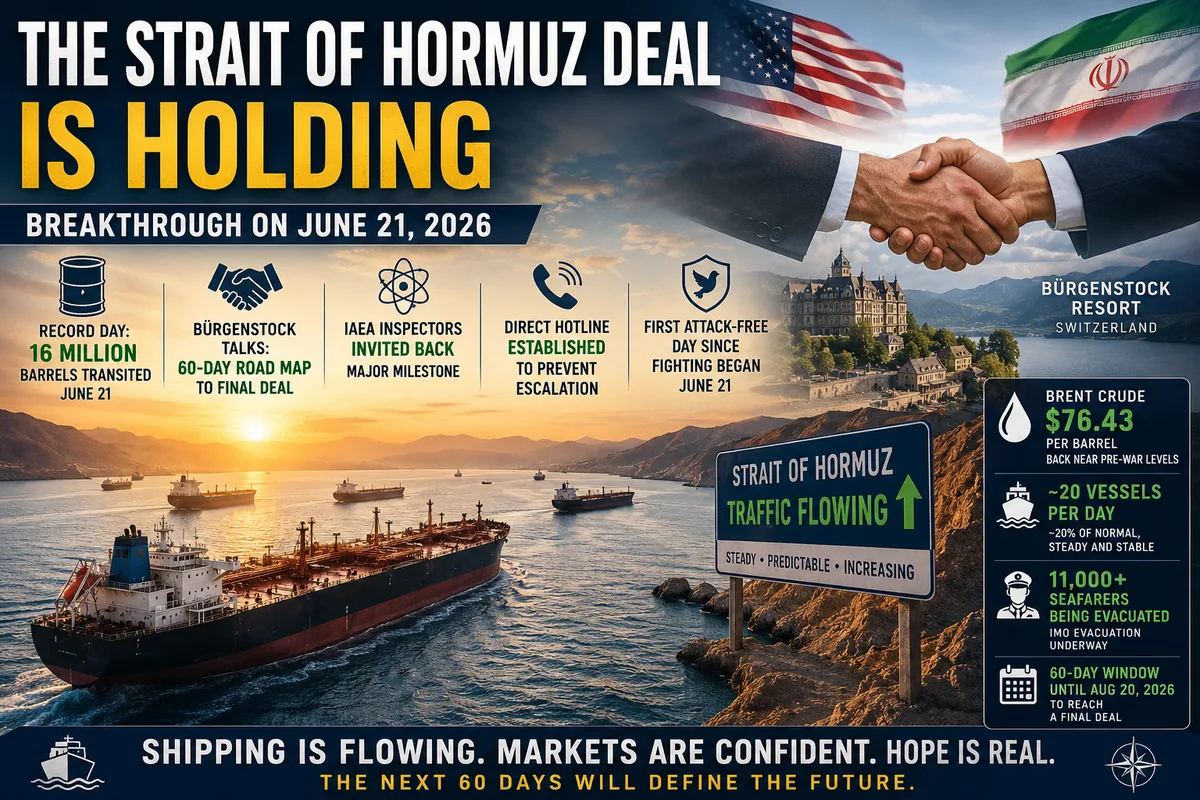
High-level US-Iran negotiations were held at the Bürgenstock resort overlooking Lake Lucerne in Switzerland. The first round of negotiations concluded with both sides agreeing to "a road map" to reach a final deal within 60 days.
And more importantly — the numbers started moving.
The Record That Changes Everything — June 21, 2026
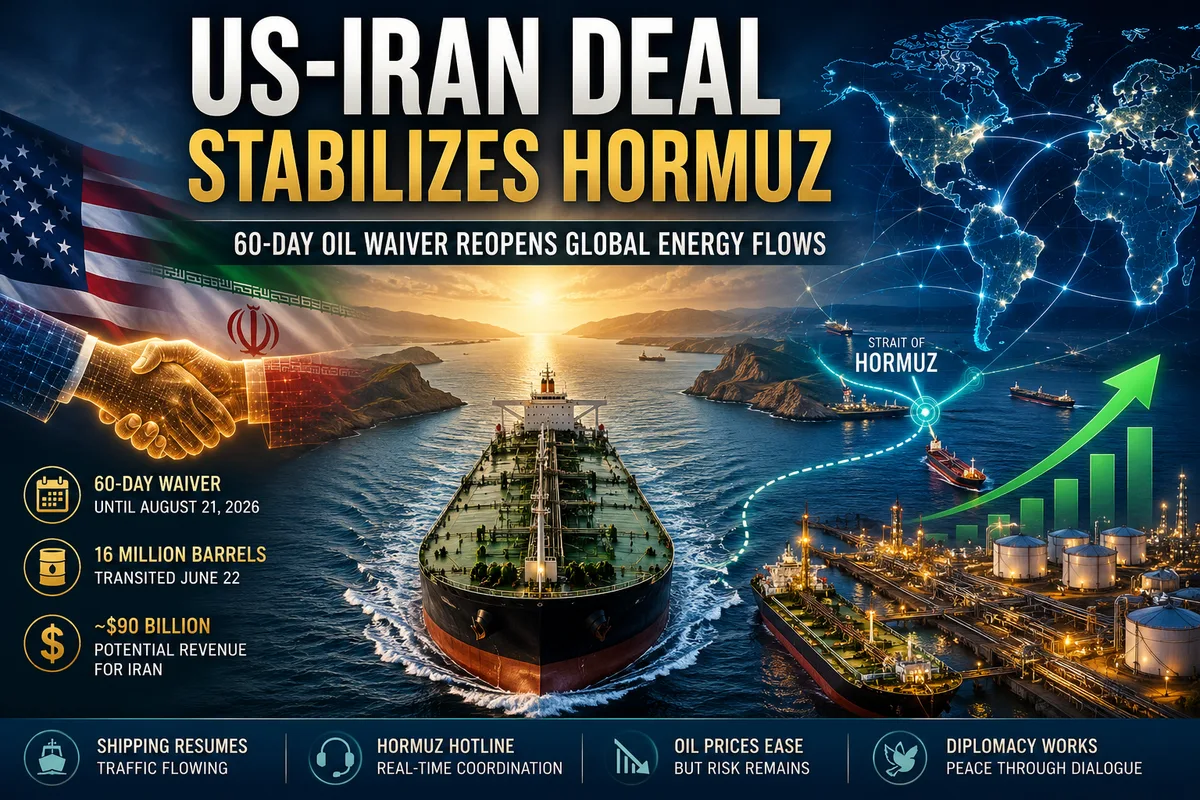
Vice President Vance confirmed that 16 million barrels of oil transited the Strait of Hormuz on June 21 — a single-day record surpassing even pre-war volumes. "That is a record going back to even before the conflict started," Vance told Fox News.
Let that sink in: a single day of Strait of Hormuz traffic just exceeded anything that happened in the 5+ years before the war.
This is not just recovery. This is over-recovery. Ships are flooding through because shippers, traders, and oil exporters are:
- Trying to move pent-up cargo that has been stranded for 4 months
- Testing the waters to confirm the strait is genuinely safe
- Rushing to clear inventory before another closure happens
- Taking advantage of windows when confidence is high
The 16-million-barrel day is not sustainable — it is a spike driven by pent-up supply. But the fact that it happened proves the strait CAN function at full capacity when political conditions allow it.
What Happened at Bürgenstock — The Real Breakthrough
While oil markets were celebrating the 16-million-barrel transit record, something more important was happening in Switzerland.
Both sides agreed to "a road map" to reach a final deal within 60 days. Qatar and Pakistan mediators announced "encouraging progress" and "immediate commencement of technical talks."
More critically:
- Iran agrees to invite IAEA inspectors back. Iran agrees to invite IAEA inspectors back into the country — Vance calls it "a major milestone and the first step in permanently ending a nuclear weapons programme." This is huge. The nuclear issue was the original trigger for all of this.
- A direct communication hotline established. A direct communication hotline is established between US and Iranian delegations "to avoid incidents and miscommunication with the aim of safe passage for commercial vessels through the Strait of Hormuz." This means if something goes wrong, both sides can talk directly instead of escalating.
- Road map to permanent deal in 60 days. The talks created a structured plan, not just vague promises. Both sides have committed to negotiations that will either succeed or fail by August 20, 2026.
This is completely different from the chaos of June 20-21 when Iran was announcing closures and the US was denying them.
The First Attack-Free Day Since Fighting Started
Another extraordinary detail from June 21: The UN peacekeeping force in Lebanon records no attacks from either side on June 21 — the first attack-free day since the Israel-Hezbollah conflict.
This matters because the Lebanon ceasefire was the thing that was falling apart. Now it is actually holding.
What About the Stranded Seafarers — Are They Getting Out?
Yes. And this is the human side of the story that matters.
The International Maritime Organization (IMO) announced it is launching an evacuation of thousands of stranded seafarers following easing of restrictions on the Strait of Hormuz. "After months of hardship and distress for thousands of innocent seafarers, and negative impact for the whole world, I welcome with deep satisfaction the peace agreement," IMO Secretary-General Arsenio Dominguez said.
The IMO "will begin the implementation of the evacuation plan for over 11,000 seafarers still stranded in the region. This large-scale operation will be carried out in close cooperation with Iran, Oman, all other coastal States in the region, the United States and the maritime industry."
Oman has announced it is creating a "temporary maritime corridor" in the Strait of Hormuz. The notice says the usual traffic separation scheme is "not safe for use at this time," but ships may be routed via two temporary outbound lanes — one north of the existing route and one south.
This means shipping is being managed. Routes are being controlled. But traffic IS moving.
What Are Oil Prices Doing?
This is the clearest signal that the market believes the deal is holding.
Brent crude has fallen significantly. Brent crude fell -2.19% over 24 hours to $76.43 as of the latest data.
To put this in context:
- Pre-war (late February 2026): ~$70/barrel
- War peak (May 2026): ~$126/barrel
- June 20 (when Iran announced closure): ~$95/barrel
- June 23 (today): $76.43/barrel
Oil is now back near pre-war levels. The market is pricing in a successful, lasting deal. That tells you everything about trader confidence.
What Does This Mean for Shipping Rates?
This is where it gets good for shippers.
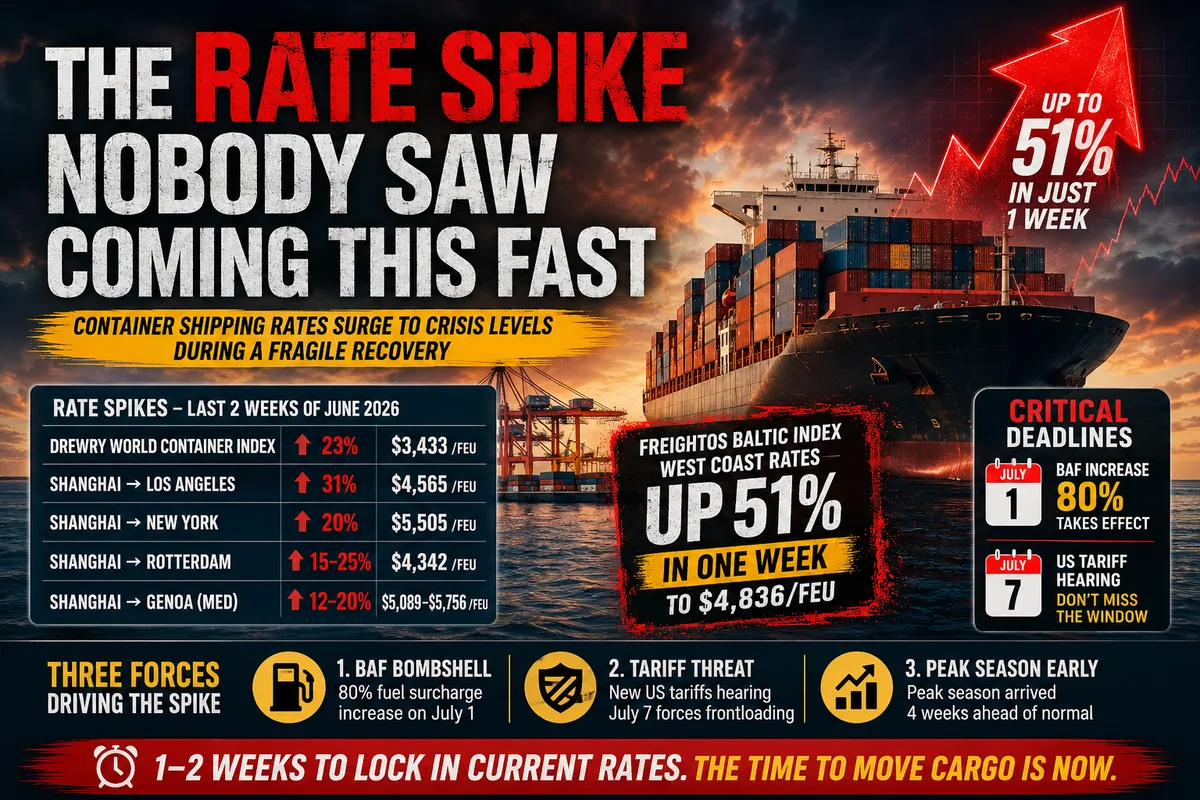
If oil stays below $80/barrel and the Strait of Hormuz remains open, Emergency Fuel Surcharges should begin declining significantly within the next 2-3 weeks.
Here is the likely timeline:
- This week (June 23-27): Carriers monitor oil prices and Hormuz traffic. If oil stays stable below $80, they begin discussing PSS (Peak Season Surcharge) reductions.
- Next week (June 30-July 7): First carriers announce EFS reductions — expect 5-10% cuts as bunker costs begin to ease.
- July-August: Cascading rate reductions as more carriers reprices and as Gulf routing (direct Jebel Ali calls) fully resumes, reducing transit times by 10-14 days.
- August onwards: Ocean freight rates converge toward more normal summer levels if the deal holds and no new escalation occurs.
But — and this is critical — this all depends on the 60-day window holding. If the nuclear negotiations fail, or if Israel escalates in Lebanon again, the deal could collapse and Hormuz could close once more.
The Current Status — June 24, 2026
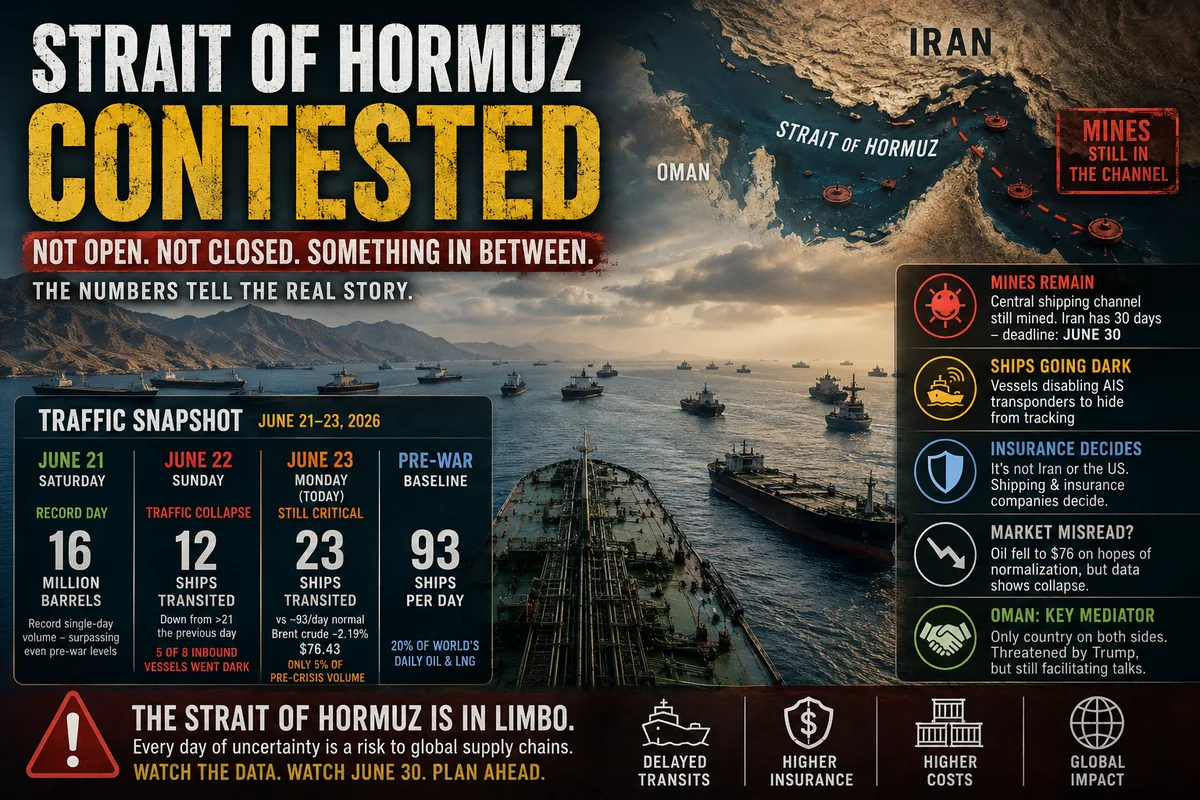
Iran has re-declared the Strait of Hormuz closed, but US tracking and ship-movement data dispute the closure, leaving transit status actively contested.
In other words: the legal/political status is still disputed, but actual traffic is flowing. In the past 24 hours, nearly two dozen vessels transited the strait that connects the Persian Gulf and the Gulf of Oman. At least seven cargo ships and seven tankers exited into the Gulf of Oman, and six cargo ships crossed into the Persian Gulf.
Before the war, an average of 110 vessels transited daily. At 2 dozen per day, traffic is about 20% of normal — but crucially, it is steady and predictable traffic, not the chaotic, contested status of a week ago.
What Should Shippers Do Now?
- Begin planning Hormuz routing for August onwards. Do not switch yet — wait another week for continued confirmation that traffic flows. But start internal planning for how to return to direct Jebel Ali calls and Hormuz routing when confidence is high.
- Watch Brent crude closely. If it rises back above $85/barrel, it signals confidence is declining. If it stays below $80/barrel for a full week, it signals the market believes the deal will hold.
- Prepare for rate reductions. Expect carriers to announce EFS reductions by June 30-July 7. Budget conservatively — assume reductions happen, but do not rely on them until they are announced.
- Monitor the 60-day window.** August 20, 2026 is the deadline for a final nuclear deal. If negotiations stall or fail — the deal could collapse. But for now, the trend is positive.
- Celebrate the stranded seafarers being evacuated. Over 11,000 crew members have been trapped in the Gulf for months. The IMO evacuation means they are finally going home. That alone makes this deal worth supporting.
Key Takeaways — June 24, 2026
- June 21: Record 16 million barrels of oil transited Strait of Hormuz in a single day — exceeding pre-war levels.
- Bürgenstock talks concluded with "encouraging progress" and agreement on 60-day road map to final deal.
- Iran agrees to invite IAEA nuclear inspectors back into the country.
- Direct US-Iran communication hotline established to prevent escalation.
- June 21 was the first attack-free day since Israel-Hezbollah conflict began.
- IMO launching evacuation of 11,000+ stranded seafarers from the Persian Gulf.
- Brent crude at $76.43/barrel — back near pre-war levels, signaling market confidence in deal.
- Traffic through Hormuz: ~20 vessels per day, steady and increasing.
- EFS reductions expected to begin within 2-3 weeks if current trajectory holds.
The Strait of Hormuz deal is holding. The numbers prove it. Oil markets believe it. Shipping is flowing. Seafarers are being evacuated. And for the first time in 140 days, there is genuine optimism that the logistics world is returning to normal. The next 60 days will determine whether this optimism is justified — but for now, the trend is undeniably positive.

Comments
No comments yet. Be the first to share your thoughts!