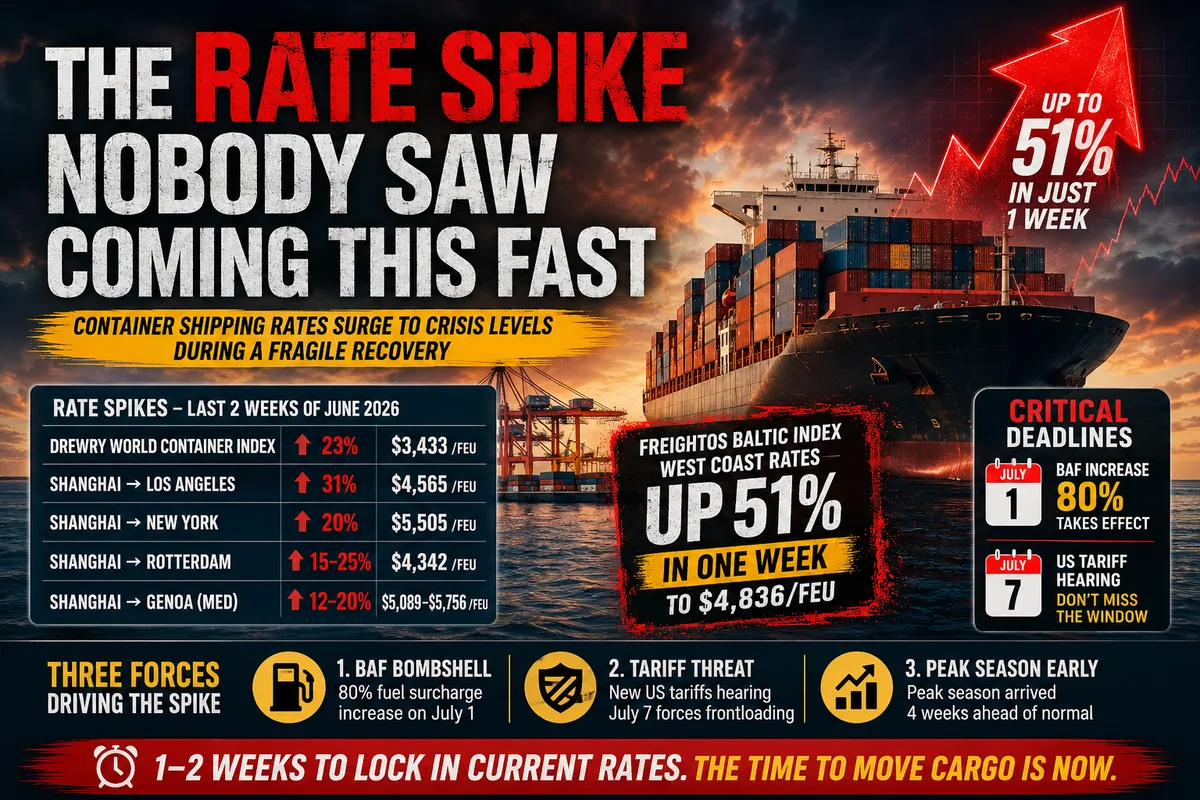
The Rate Spike Nobody Saw Coming This Fast
Container shipping rates are not just climbing — they are surging at levels usually only seen during the most extreme crises. And this spike is happening during what is supposedly a fragile recovery period.
Here are the numbers from the last two weeks of June 2026:
- Drewry World Container Index: UP 23% week-on-week to $3,433/FEU
- Shanghai → Los Angeles: UP 31% to $4,565/FEU (West Coast already spiking)
- Shanghai → New York: UP 20% to $5,505/FEU
- Shanghai → Rotterdam: UP 15-25% to $4,342/FEU
- Shanghai → Genoa (Mediterranean): UP 12-20% to $5,089-$5,756/FEU
But here is the scarier number from the Freightos Baltic Index: West Coast rates spiked 51% in one week to $4,836/FEU — the most dramatic single-week jump since June 2025.
This is not normal peak season. This is panic peak season.
What's Causing the Rate Spike — Three Forces at Once
1. The Bunker Adjustment Factor Bomb — July 1
This is the single biggest driver nobody is talking about enough.
Every major ocean carrier has announced that the Bunker Adjustment Factor (BAF) — the fuel surcharge added to every freight invoice — will increase by 80% starting July 1, 2026.
For context, if your current BAF is $400/FEU, on July 1 it becomes $720/FEU. That is an extra $320 per container hitting your bottom line — just from the fuel surcharge alone.
Shippers who have cargo moving in July will pay this 80% increase. Shippers who move cargo NOW (in late June) before July 1 can lock in the current BAF level and save $300+ per container.
The market understands this perfectly. Every shipper with the financial ability to move cargo early is booking NOW before July 1. This is creating an artificial demand spike — not because actual goods demand is higher, but because shippers are frontloading to avoid the BAF increase.
Carriers know this. They are deliberately booking fewer sailings (blank sailings down to just 3 per week) to keep capacity tight and rates high while they still can before July 1.
2. US Tariff Threats — The Forced Frontloading
On top of BAF increases, the US Trade Representative announced in early June that new tariffs on 60 countries are being considered — specifically on goods deemed to be made with forced labor.
The hearing on these new tariffs is scheduled for July 7, 2026.
Any shipper with goods that might fall under these new tariffs is now rushing to get cargo into US ports before July 7 — before the new tariffs take effect. This creates a compressed 2-week window (June 23-July 7) where all urgent cargo is competing for the same container space.
One analyst noted: "The tariff wall around the US continues to rise. The net effect will be to speed up global supply chain shifts." That speedup is happening right now, in late June 2026.
3. Peak Season Arriving 4 Weeks Early
Normally, peak season starts in mid-July. This year it started in early June.
The National Retail Federation just revised its peak season forecast — moving the expected peak from July to June. The logic is the same: earlier cargo movement due to tariff and BAF uncertainties.
Peak season demand is real demand — retailers stocking inventory for summer and fall sales, manufacturers moving goods ahead of Golden Week and mid-year promotions, and exporters shipping ahead of year-end holiday demand.
But in 2026, this normally-July demand is arriving 4 weeks early. The result is a compressed window where June demand + normal peak season demand + BAF frontloading are all competing for space simultaneously.
The Carrier Strategy — Tight Capacity on Purpose
Carriers are not trying to solve the problem. They are exploiting it.
According to Drewry, only three blank sailings have been announced on major Asia-Europe routes for the next week. Normally, carriers would add extra sailings when demand spikes. Instead, they are reducing supply to keep rates high.
Carriers are also stacking surcharges on top of surcharges:
- General Rate Increases (GRI): Effective June 1, base rates jumped $200-$400/FEU
- Peak Season Surcharges (PSS): Carriers added $400-$800/FEU surcharge on top of the new base rate
- Fuel Adjustment Factors: Already elevated, and scheduled to jump 80% on July 1
- Announced further increases: Carriers have already announced additional GRI and PSS effective mid-June and early July
A shipper moving a container from Shanghai to New York today in June is paying: base rate + June GRI + PSS + current BAF. That same container in July will add an 80% BAF increase on top. The incentive to move NOW is enormous.
The Reality for Shippers — A 1-2 Week Window
If you are an importer with cargo to move, you are now operating under extreme time pressure.
- Book by June 30: Lock in current BAF rates before the 80% increase takes effect.
- Tariff deadline: July 7 hearing on new tariffs means cargo should be in US ports by then to avoid potential increases.
- Capacity crunch: With carriers deliberately keeping blank sailings low, space is being allocated to the highest bidders — those who accept premium surcharges.
- Rates will rise further: Drewry is predicting rates to continue rising in the coming weeks as the July 1 BAF increase approaches.
One logistics analyst summarized it bluntly: "The base ocean freight rate can change faster than the internal approval process."
Meaning: by the time your cost approval comes back from management, the rate has moved up $200. You need to book before approval — or you will miss the window.
What Should Shippers and Freight Forwarders Do This Week?
- Book priority cargo NOW. Any shipment you can move by June 30 should be booked today. The cost of moving early is less than the cost of the July 1 BAF spike.
- Get approvals in advance for July cargo. Do not wait until July 1 to book July cargo. Get management approval NOW for July shipments so you can book immediately when rates for those sailings open up.
- Compare West Coast vs East Coast carefully. West Coast rates are spiking 51% vs East Coast spikes of 25%. If your product can be distributed from the West Coast, you could save $500-$1,000/FEU by choosing LA/Long Beach over NY/NJ.
- Confirm space before confirming rates. Many carriers are only confirming rates IF they have space available. Get space confirmed first, then negotiate rates.
- Have a July 1 BAF impact plan. Work with your finance team now to understand what the 80% BAF increase means for your landed costs. Budget for it. Plan for it.
- Do not book mid-June sailings expecting July 1 BAF rates. If you book for a June 28 sailing, you get current BAF. If you book for a July 5 sailing, you get the new BAF. There is no grey area or negotiation.
Key Takeaways — June 22-23, 2026
- Container rates spiked 23-51% in late June — Drewry at $3,433/FEU, Freightos West Coast at $4,836/FEU.
- Bunker Adjustment Factor increasing 80% on July 1 — creating urgent frontloading demand.
- New US tariffs hearing July 7 — forcing shippers to move cargo before that date.
- Peak season arriving 4 weeks early — normal July demand hitting in June.
- Carriers deliberately keeping capacity tight (3 blank sailings/week) to maximize rates.
- Peak Season Surcharges stacked on top of General Rate Increases stacked on top of fuel surcharges.
- Shipping professionals have 1-2 weeks (until June 30-July 7) to lock in current rate levels.
Peak season has arrived 4 weeks early and carriers are determined to extract every dollar possible before July 1 changes the BAF calculation. The window to book at current rates is closing rapidly. By July 1, shippers who waited will be paying 80% more in fuel surcharges on top of already-spiked spot rates. The time to move cargo is now.

Comments
No comments yet. Be the first to share your thoughts!