What Happened — The Attack That Changed Everything
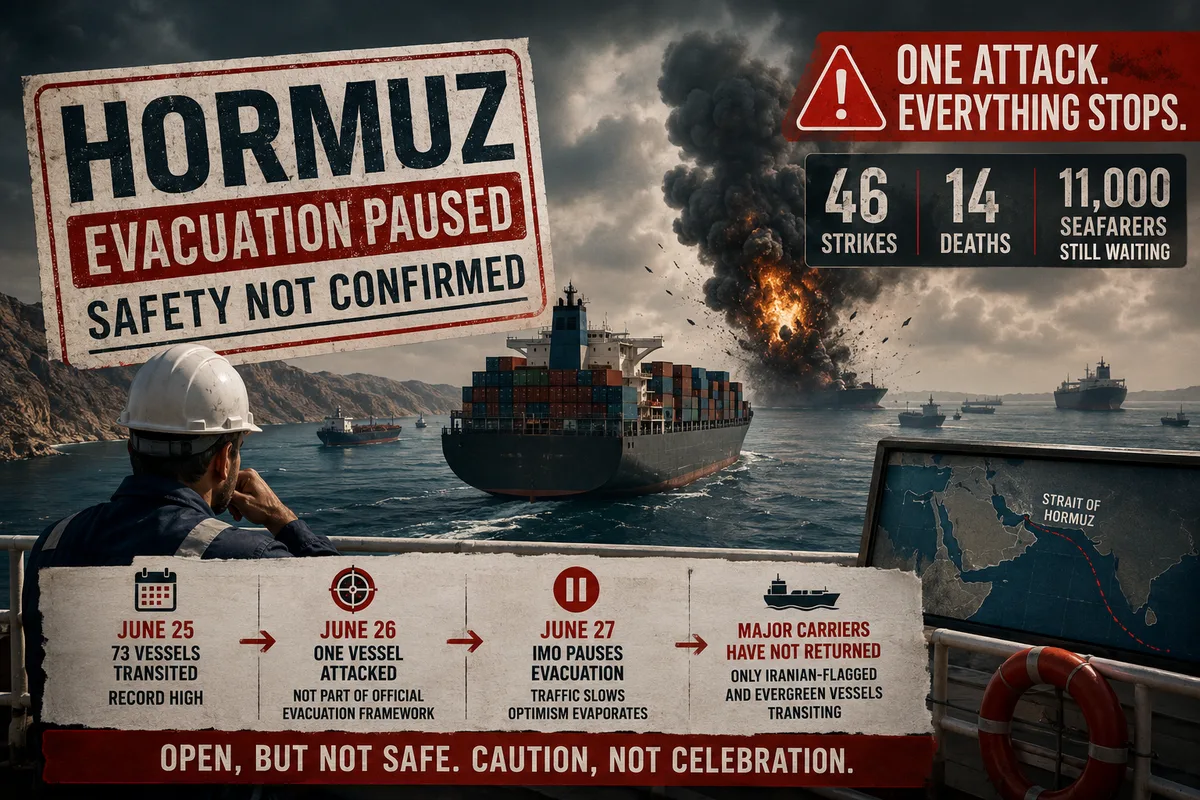
On Thursday June 26, 2026, a vessel was attacked in the Strait of Hormuz. IMO Secretary-General Arsenio Dominguez said in a statement he took the precaution of pausing the program even though the vessel that was attacked "did not transit under IMO's evacuation framework."
In other words: a ship was struck that was NOT part of the official evacuation. This created a critical question: if the deal is holding, why is anyone still being attacked?
The answer forced the IMO to act. IMO plans to "reconfirm that the necessary safety guarantees continue to be in place for the ships on our evacuation list and all those in the region."
Translation: the IMO no longer trusts that safety is guaranteed. The evacuation is paused until confirmations are made.
The Timeline — From Optimism to Caution in 48 Hours
The Strait of Hormuz has seen more traffic in the last week than it has in the past three months. But that has slowed down Friday as a critical evacuation plan is put on hold.
Here is what happened:
Wednesday, June 25: Seventy-three vessels transited the critical waterway on Wednesday, the highest number since shortly after the war with Iran began in late February.
This was a record. Hope was building.Thursday, June 26: One vessel attacked. Not part of official evacuation framework. But attacked nonetheless.
Friday, June 27: IMO pauses evacuation. Traffic slows. Optimism evaporates.
The entire momentum of the Hormuz opening just stalled in 48 hours.
Why This Matters — The 11,000 Seafarers Still Waiting
When the Hormuz deal was signed, the IMO launched a humanitarian evacuation program to get 11,000 stranded seafarers and 500 vessels out of the Persian Gulf. These sailors have been trapped for months — some beyond their contract end dates, many separated from families.
The evacuation was supposed to be the silver lining of the Hormuz closure — finally, these people were going home.
Now, with the IMO paused, they are waiting again. No timeline for when the evacuation resumes. No certainty that it will resume at all.
From a humanitarian perspective, this is devastating. From a logistics perspective, this is a signal: the Strait of Hormuz is not yet safe enough for routine operations.
What Type of Ships Are Actually Transiting?
This is the most telling detail from CNN's report. "The ships actually transiting Hormuz this week are still mostly Iranian-flagged and some (Taiwanese) Evergreen ships. The major global carriers haven't returned yet, so it's closer to status quo than a real shift," said Sanne Manders, president of Flexport.
Let that sink in: the major shipping lines — Maersk, CMA CGM, MSC, Hapag-Lloyd — have NOT returned to transiting Hormuz regularly. Only Iranian ships and a few Evergreen vessels are moving through.
This tells you everything about carrier confidence:
- If the strait were genuinely safe, major carriers would be flooding through to capture the lucrative business
- If the deal were solid, the equipment shortage crisis would be solved by carriers routing normal traffic
- Instead, only the vessels willing to take the risk are transiting
This is not recovery. This is a ghost transit.
The Safety Reality — 46 Strikes, 14 Deaths, Still Counting
To date, there have been at least 46 strikes on vessels and 14 deaths, according to the IMO.
Forty-six strikes. Fourteen people dead. And the closure has only been "open" for about 9 days.
Companies have been hesitant to move cargo and personnel through mine-laden waters under threat of missile strikes. Insurers have dropped coverage on ships because of wartime clauses.
The reality on the ground is very different from the optimistic headlines. Mines are still in the water. Missile threats still exist. Insurance is still refusing to cover war risks in some cases. And now, one vessel got attacked in the last 24 hours.
This is not "open for business." This is "open for the brave."
What Does This Mean for Shipping and Logistics?
The pause in the IMO evacuation program sends a clear message to shippers and carriers:
The Strait of Hormuz is not ready for normal operations.
Implications:
- Equipment shortage will persist longer. If major carriers are not rushing through Hormuz to rebalance equipment, the container shortage we reported on June 26 will last 6-8 weeks instead of 4-6 weeks.
- Rate increases will stick longer. If carriers cannot count on normal Hormuz traffic, they will maintain higher rates through July and possibly into August.
- War-risk insurance costs remain high. One attack on June 26 reminds the market that Hormuz is still a war zone. Premiums will not fall.
- Cape of Good Hope routing will continue. Major shippers will not shift back to Hormuz routing until major carriers confirm regular transits and the evacuation resumes without attacks.
- Fuel surcharge relief is delayed. We said fuel surcharge reductions would begin within 2-3 weeks if Hormuz stabilized. This attack just extended that timeline by 2-3 more weeks.
What Flexport's Sanne Manders Said — The Reality Check
Manders and Seroka expect traffic levels to drop in the coming days during the pause in IMO's evacuation effort.
This is the key insight: traffic will actually DROP as a result of the IMO pause. Shippers will become more cautious, not less. Carriers will revert to safer routes.
The very act of pausing the evacuation — meant to reconfirm safety — will have the opposite effect: it will signal that safety cannot be confirmed.
Key Takeaways — June 27, 2026
- IMO abruptly paused evacuation of 11,000 stranded seafarers on June 27, 2026.
- Reason: one vessel attacked on June 26 that was NOT part of official evacuation framework.
- 73 vessels transited on June 25 (highest since war began), but traffic is already slowing on June 27.
- Major carriers (Maersk, CMA CGM, MSC) have NOT returned to Hormuz — only Iranian-flagged and Evergreen vessels transiting.
- 46 strikes on vessels since conflict began; 14 deaths confirmed.
- Mines still in water; missile threats remain active; insurance still refusing wartime coverage.
- Equipment shortage will persist 6-8 weeks instead of 4-6 weeks.
- Rate increases will stick longer through July-August.
- War-risk insurance premiums will not fall.
- Shippers will likely revert to Cape of Good Hope routing, further delaying normal trade patterns.
The optimistic narrative about the Hormuz reopening just hit a major speed bump. One attack, one pause in an evacuation, one admission from the IMO that safety cannot be confirmed — and the momentum reverses. The strait is technically open. But it is not yet safe. And until the 11,000 stranded seafarers are actually evacuated without incident, the logistics world should remain cautious about treating Hormuz as "normal" again.

Comments
No comments yet. Be the first to share your thoughts!