

What CMA CGM Just Announced — June 24, 2026
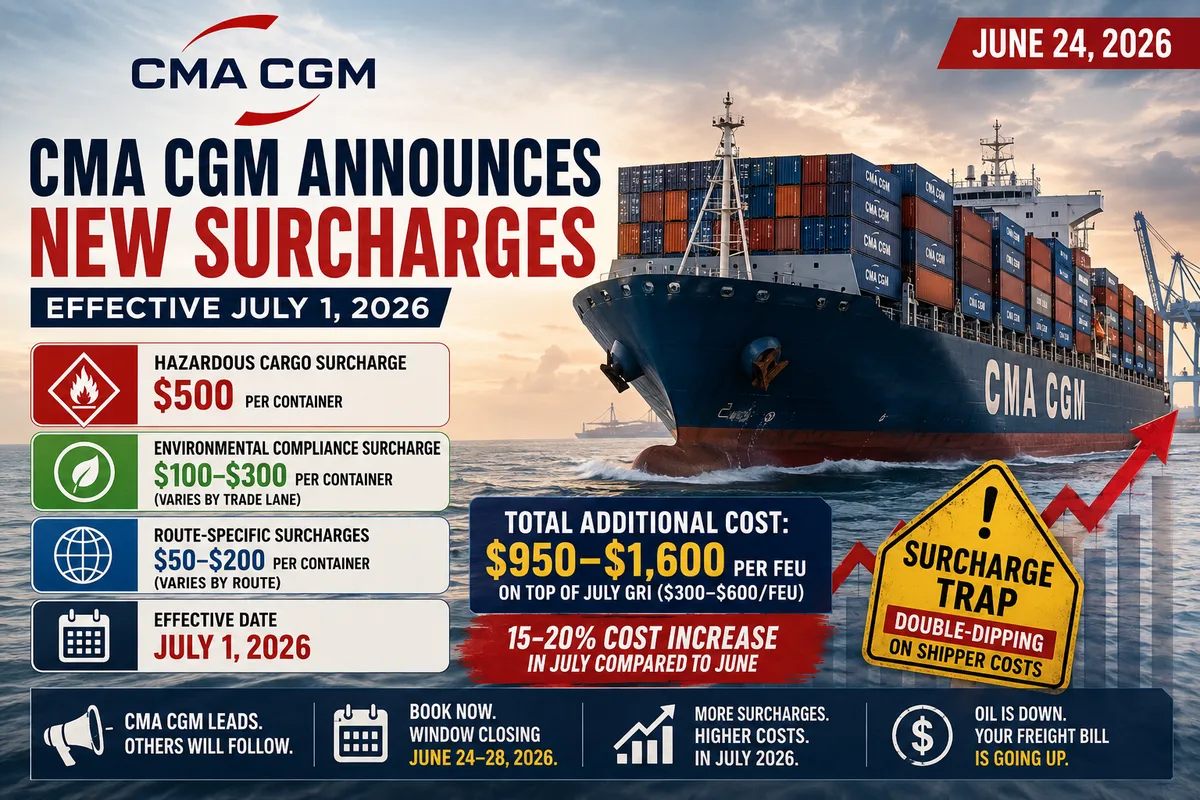
CMA CGM has announced a series of new surcharges across multiple trade lanes, effective in July 2026. The carrier will introduce a Hazardous Surcharge of US$500/container.
This is separate from — and in addition to — the July General Rate Increases that carriers announced earlier this week.
CMA CGM's announcement details:
- Hazardous Cargo Surcharge: $500 per container effective July 1, 2026
- Environmental Compliance Surcharge: Variable by trade lane — addressing EU ETS carbon regulations
- Route-specific surcharges: Additional charges on Asia-Europe, Transpacific, and other key lanes
- Effective date: All new surcharges effective July 1, 2026
The announcement comes just 24 hours after carriers announced July GRIs — rate increases of $300-600/FEU depending on route.
The Surcharge Trap — Double-Dipping on Shipper Costs
Here is what shippers are now facing in July 2026:
Old Model (June 2026): Base rate + Fuel Surcharge + Peak Season Surcharge = Total cost
New Model (July 2026): HIGHER Base rate + Fuel Surcharge + Peak Season Surcharge + Hazardous Surcharge + Environmental Surcharge + Route-specific Surcharge = Much higher total cost
The total cost increase for a typical container shipment could be:
- July GRI increase: $300-600/FEU (announced this week)
- Hazardous Surcharge: $500/container (if goods contain any hazardous materials)
- Environmental Compliance Surcharge: $100-300/container (Asia-Europe)
- Route-specific surcharge: $50-200/container (varies by route)
Total potential increase: $950-1,600/FEU in July compared to June
For shippers already paying elevated June rates, a $1,000+ per container increase is a 15-20% cost jump in a single month.
Why Is CMA CGM Doing This Now?
The timing is strategic — and it reveals carrier thinking.
Despite falling diesel prices, the oil market shows dangerous complacency. CMA CGM is essentially saying: oil prices are falling, yes, but we have other cost justifications for maintaining and even increasing surcharges.
The surcharges CMA CGM is introducing address real costs:
- Hazardous Cargo Surcharge ($500): IMDG (hazardous materials) compliance has become more expensive and complex. CMA CGM is shifting that cost from its own budget to shippers.
- Environmental Compliance Surcharge: The expansion of the EU ETS and the implementation of CII ratings are adding a structural cost layer to international container shipping that did not exist two years ago. CMA CGM is using this as justification for the new surcharge.
- Route-specific surcharges: Singapore, Shanghai, and other key ports have congestion fees. CMA CGM is passing these through to shippers.
But the reality is simpler: CMA CGM sees demand is strong enough to absorb not just rate increases, but additional surcharges. It is harvesting maximum revenue before the market normalizes.
Will Other Carriers Follow?
Almost certainly yes.
When one major carrier announces new surcharges, others typically follow within 1-2 weeks. Expect MSC, Maersk, and Hapag-Lloyd to announce similar or competing surcharges within the next 7-10 days.
The surcharge arms race is beginning:
- Week 1 (June 24): CMA CGM announces new surcharges
- Week 2 (June 28-July 1): Other carriers match or counter with their own surcharges
- Week 3-4 (July 1+): Multiple new surcharges effective simultaneously across all major carriers
Shippers who thought July would just be "base rate increase + known surcharges" are about to discover that major carriers are introducing entirely new surcharge categories.
What Does This Mean for Shipper Costs in Q3 2026?
The bottom line: shippers expecting relief from falling oil prices will be deeply disappointed.
Oil is down 40% from peak ($126 to $76/barrel). But freight rates are not down 40%. In fact, in July they are going UP — because:
- Base rates are increasing 15% (GRI of $300-600/FEU)
- New surcharges are being introduced ($950-1,600/FEU total)
- EU ETS carbon costs are locked in permanently ($150-400/FEU)
The net effect: shippers will pay MORE in July 2026 than they did in June 2026, despite oil being at the lowest level in 6 months.
When Will Rates Actually Fall?
Industry consensus points to August-September 2026, IF:
- The US-Iran nuclear negotiations hold through August 20 deadline
- Red Sea and Hormuz remain open for sustained period
- Port congestion (3.4M TEU stranded) finally clears
- Carriers exhaust their "harvest premium" pricing window by end of July
But there is zero guarantee. Another escalation in the Middle East, another port disruption, or carrier coordination on pricing could extend this elevated rate environment into September or beyond.
What Should Shippers Do Right Now?
- Book ALL possible July cargo THIS WEEK. Every day costs more. If you can move cargo in June or very early July, do it at June rates before the new surcharges hit.
- Check CMA CGM's specific surcharge details today. Get the exact surcharge amounts for your specific trade lanes and cargo types. Some routes may have larger surcharges than others.
- Prepare for MSC, Maersk, and Hapag-Lloyd announcements. Within 7 days, these carriers will announce competing surcharges. Get quotes from multiple carriers before locking in any July bookings.
- Consider non-hazardous cargo reclassification.** If any of your cargo is currently classified as hazardous and can be reclassified safely, doing so avoids the $500 hazardous surcharge. Talk to your freight forwarder about this immediately.
- Lock in August bookings with rate hold options. If you can book August cargo in June at a rate hold (where the rate is locked but cargo ships in August), that might protect you from further July surcharge additions.
Key Takeaways — June 24-25, 2026
- CMA CGM announced new surcharges effective July 1, 2026 — on top of July GRIs.
- Hazardous Cargo Surcharge: $500/container.
- Environmental Compliance Surcharge: $100-300/container depending on route.
- Route-specific surcharges: $50-200/container.
- Total additional cost: $950-1,600/FEU in July compared to June.
- Combined with July GRI ($300-600/FEU), total July cost increase: 15-20% vs June.
- Other carriers (MSC, Maersk, Hapag) expected to announce matching surcharges within 7-10 days.
- Window to book June rates closing: THIS WEEK (June 24-28, 2026).
CMA CGM's new surcharges are the move that seals it: July 2026 will be one of the most expensive months for ocean freight in the first half of the year — despite oil being at six-month lows and the Strait of Hormuz reopening. Carriers are done waiting for market conditions to normalize. They are maximizing revenue now while they can still push through surcharges without losing customers. Shippers have days, not weeks, to lock in June pricing before this new surcharge regime takes effect.

Comments
No comments yet. Be the first to share your thoughts!