The Reversal — What Maersk Just Announced
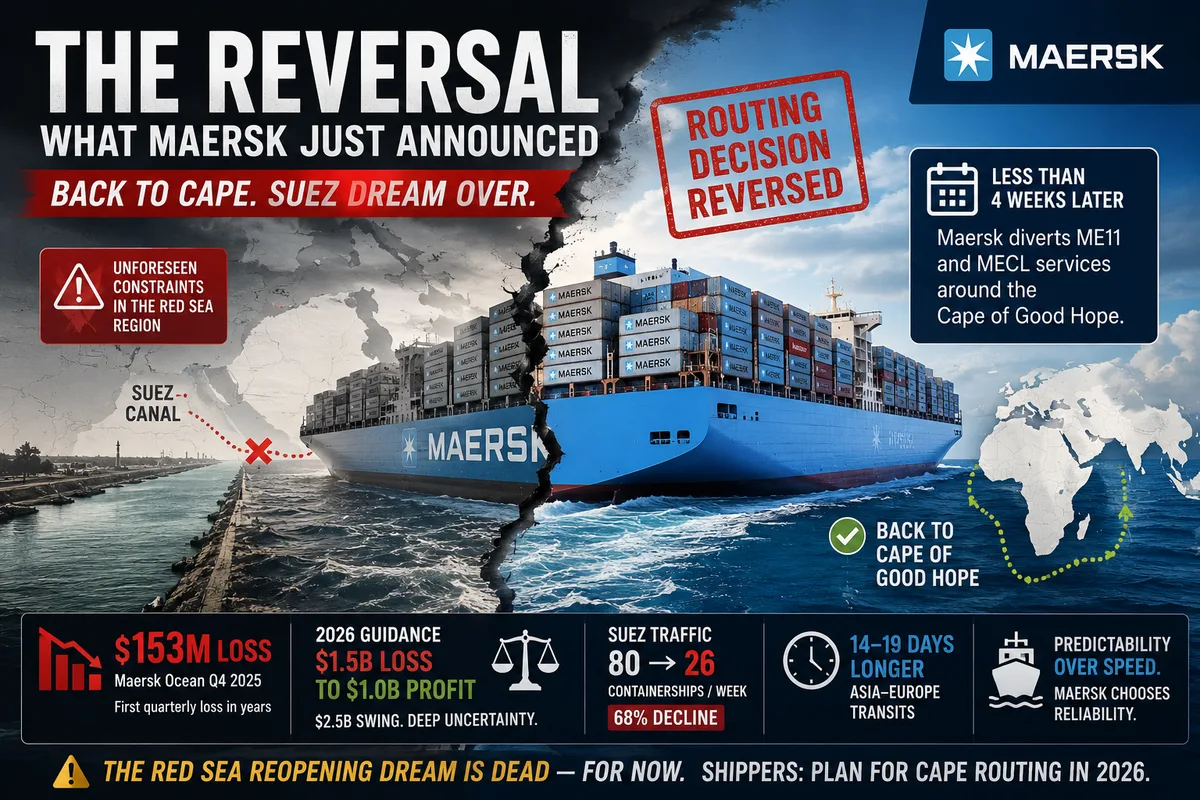
Less than a month after restarting limited Red Sea transits, Maersk is once again rerouting select services around the Cape of Good Hope, underscoring how fragile the industry's return to the Suez corridor remains. The Danish carrier said "unforeseen constraints arising from the wider operating environment in the Red Sea region" are creating delay risks, prompting diversions on upcoming sailings within its ME11 and MECL services.
Let that sink in: Maersk gave the Red Sea/Suez route less than a month before deciding it was not worth the risk.
The affected voyages will bypass the Suez Canal and instead take the longer southern route around Africa.
This is not a "temporary pause." This is not a "wait and see" approach. This is a formal reversal of a routing decision — meaning Maersk is explicitly telling customers: we tried Suez, it did not work, we are going back to Cape of Good Hope.
The Timeline — How Fast Did This Collapse?
December 2025: Maersk makes its first unannounced transit through the Suez Canal, testing the route cautiously.
January 2026: Maersk continues limited, unannounced Red Sea transits. The route seems to be working.
February 2026: CMA CGM announces official return to Suez Canal on three services, creating industry momentum toward Red Sea reopening.
March-April 2026: Maersk appears to be building toward announced Red Sea services. Hope grows that major carriers will sustain Suez transits.
April 20, 2026: Maersk reverses course. Announces it is diverting back to Cape of Good Hope on ME11 and MECL services.
The entire "comeback" lasted less than 5 months. From first unannounced test to full reversal: barely 20 weeks.
What Caused This? "Unforeseen Constraints"
Maersk's statement is deliberately vague: "unforeseen constraints arising from the wider operating environment in the Red Sea region."
What does that actually mean? The statement is vague because Maersk cannot be too specific without either:
- Admitting operational security failures
- Creating panic among customers about Suez safety
- Alienating the Egyptian government and Suez Canal Authority
- Exposing insurance coverage gaps
But industry analysts understand what "unforeseen constraints" likely means:
- Continued Houthi threat. While attacks have paused, the threat has not disappeared. Insurers still classify Red Sea as high-risk. New attacks could restart at any time.
- Schedule reliability failures. Unannounced transits can be tricky for both shippers and ports if ships and containers suddenly arrive a week earlier than planned. Maersk may have discovered that Suez route compression creates operational chaos.
- Port congestion on arrival. If carriers return to Red Sea at significant scale in a short period of time, large numbers of ships could arrive at port at the same time, creating severe congestion. This defeats the entire purpose of saving 14-19 days of transit time.
- Insurance cost volatility. War-risk insurance for Red Sea transits remains unpredictable and expensive. If insurance costs spike, the fuel savings from shorter routes disappear.
Maersk's reversal signals that one or more of these factors made the Red Sea route untenable on a sustained basis.
The Financial Pressure — Why Maersk Needs This Route
Here is the context that makes this reversal so significant: Maersk is facing unprecedented financial pressure.
Maersk reported a $153 million loss in its Ocean division for Q4 2025, marking its first quarterly loss in years as it navigates the difficult transition between Cape diversions and Suez transits.
$153 million. A loss. In a single quarter. For the world's largest container carrier.
Even more telling: The company issued wide 2026 guidance ranging from a $1.5 billion loss to a $1.0 billion profit, reflecting deep uncertainty around the pace of any sustained Red Sea reopening.
The guidance range is so wide — $2.5 billion swing — that it essentially admits Maersk has no idea which direction 2026 is going. Everything depends on whether Suez works or does not.
For a company of Maersk's size to issue guidance with a $2.5 billion range is an admission of helplessness in the face of operational uncertainty.
And now, by reversing the Red Sea strategy, Maersk is betting the company will make its money through Cape of Good Hope routing — which is slower, less efficient, more expensive, and requires more vessels.
What This Means for Suez Canal Traffic Recovery
The numbers tell the story:
Before the attacks, the Suez Canal processed roughly 80 containerships per week; by mid-January 2026, that figure had recovered to just 26.
80 containerships per week → 26 per week = 68% decline in Suez traffic.
Maersk's reversal means that 26 number is likely to fall further, not rise.
Suez Canal tolls remain a critical source of foreign currency for Egypt, and canal authority chairman Admiral Ossama Rabiee has forecast a return to normal traffic levels by the second half of 2026.
Admiral Rabiee's forecast is now looking unrealistic. If the world's largest carrier gives up on Suez after less than a month, how long will it take for confidence to fully recover?
The Operational Reality — Why Maersk Is Right
Despite how this looks for Suez Canal hopes, Maersk's decision is operationally sound.
The operational benefits of the Red Sea route remain compelling — westbound ME11 sailings save 19 days via Suez, while eastbound voyages are seven days shorter. Maersk has consistently argued that the route "is the fastest, most sustainable and most efficient way for us to serve our customers."
Those benefits are real. But they only matter if they can be delivered reliably. But the repeated reversals threaten something perhaps more valuable than time: predictability.
For manufacturing and retail supply chains, predictability is worth more than speed. A container that arrives 19 days earlier than expected but disrupts your warehouse operations and incurs demurrage charges is not actually faster — it is more expensive.
Maersk realized that the Red Sea route cannot be run predictably. So they are abandoning it.
What Does This Mean for Shippers?
- Do NOT expect Suez-driven rate relief in 2026. One of the theories supporting lower rate forecasts for mid-2026 was that Suez would reopen and release 2.5 million TEU of capacity into the market. If Maersk — and likely others following its lead — are back on Cape routing, that capacity release does not happen. Rates stay elevated longer.
- Plan on 14-19 day longer transits for Asia-Europe. The Cape of Good Hope route takes roughly that much longer. If you are contracting for services starting in June-July, assume longer transit times than pre-crisis baseline.
- Lock in long-term contracts soon. With uncertainty about Suez, shippers who contract now with clear surcharge terms (Red Sea surcharge removal triggers, Cape route pricing certainty) will protect themselves better than those waiting for "clarity" that may never come.
- Consider index-linked contracts. Shippers tendering for new contracts should consider index-linked contracts or fixed renegotiation triggers based on market movements (either by date or percentage shift in rates).
Key Takeaways — June 26, 2026
- Maersk reversed Red Sea routing decision, diverting back to Cape of Good Hope after less than 4 weeks of Suez transits.
- "Unforeseen constraints" cited — code for operational/schedule/insurance issues made Suez unviable.
- Maersk reported $153M loss in Ocean division Q4 2025 — first quarterly loss in years.
- 2026 guidance range: $1.5B loss to $1.0B profit — $2.5B swing showing deep uncertainty.
- Suez Canal traffic remains at just 26 containerships/week vs 80 pre-crisis — likely to fall further.
- Operational benefits of Red Sea (19-day savings) mean nothing if route cannot be run predictably.
- Shippers should expect 14-19 day longer Asia-Europe transits as status quo for 2026.
The Red Sea reopening dream is dead — at least for now. While the Strait of Hormuz opens and oil prices fall, the other critical shortcut for global shipping remains too unstable to trust. Maersk's reversal is the first domino. Others will follow. And shippers who were betting on Red Sea reopening to save them on costs and transit time are about to face a harsh reality: they are back to Cape of Good Hope routing for the foreseeable future.

Comments
No comments yet. Be the first to share your thoughts!