
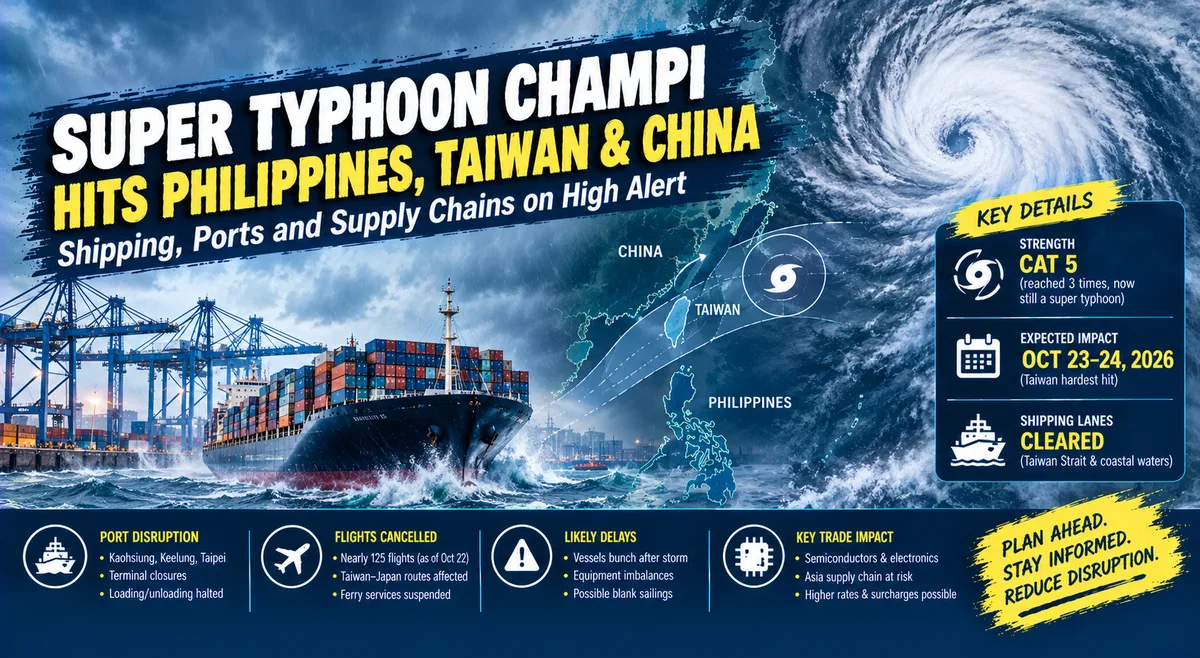
Super Typhoon Champi, the strongest storm of the 2026 season, is moving toward the Philippines, Taiwan, and China. Taiwan's Central Weather Administration has issued sea and land warnings and expects the heaviest impact on the island on Friday, October 23, and Saturday, October 24. The storm has put shipping lines, ports, and cargo owners across the region on alert.
How strong is the storm
Champi first reached Category 5 hurricane intensity on October 17, about six hours after passing Guam, with sustained winds of around 165 mph. It weakened afterward, then regained Category 5 strength the next day, and has now reached that level for the third time. It eased slightly on Thursday, October 22, but remains a super typhoon as it approaches Taiwan.
Shipping lanes ordered clear
According to Lloyd's List, authorities on both sides of the Taiwan Strait have taken unusual steps to clear shipping traffic. Fujian has barred vessels arriving from Guangdong from entering the Taiwan Strait. Taiwan will clear ships from its 12-nautical-mile coastal zone, and foreign vessels that refuse to leave face port bans. Vessel-tracking data from Lloyd's List Intelligence shows ships already steering clear of waters east of Taiwan and Luzon.
The storm arrives in a container market that is already congested, and in a waterway that is politically sensitive. Earlier this year, port delays removed about 3 million TEU of containership capacity, so even a short closure can have an outsized effect on schedules.
Disruption on land and in the air
Preparations are well under way in Taiwan. Airlines cancelled nearly 125 flights for Thursday, including flights between Taiwan and Japan's Okinawa, while the rail network was running normally at last report. The Maritime and Port Bureau suspended several domestic ferry routes, including Keelung to Lienchiang and Kaohsiung to Magong, and the Kinmen to Xiamen ferry stopped operating in both directions from 8:30 am on October 22. Authorities have closed many tourist sites, deployed extra water pumps in flood-prone areas, and ordered checks of drainage and flood-control equipment.
What typhoon disruption usually means for cargo
Typhoons rarely cause trouble only on the day they hit. Port closures typically halt loading and unloading for 24 to 72 hours, and vessels leave berths to ride out the storm. The real damage often begins afterward, when delayed ships arrive together, yards fill up, and containers sit waiting for berths and trucks. Carriers often respond with omitted port calls, blank sailings, or discharge at alternative hubs, and shippers can find space in those alternatives disappearing quickly once a storm lands. Taiwan's main gateway is Kaohsiung, while Keelung and Taipei handle significant northern cargo, and the storm's track affects both sides of the strait.
Why it matters for the logistics industry
Taiwan is a key hub for semiconductors, electronics, and machinery, and its ports link into the wider East Asia network that feeds transpacific and Asia-Europe trades. Even if the storm passes quickly, forwarders should expect delayed vessel arrivals, equipment imbalances, and short-term pressure on rates and surcharges. This comes on top of the capacity strain from Gulf shipping attacks and high fuel prices.
What shippers and forwarders should do now
- Check with carriers for vessel omissions, rolled bookings, and revised ETAs on cargo moving through Taiwan, Fujian, and Guangdong.
- Confirm terminal closure and reopening notices for Kaohsiung, Keelung, Taipei, and nearby Chinese ports.
- Warn customers early about likely delays of several days, and about possible demurrage and detention charges.
- Ask about alternative gateways and routings now, before space on those services fills up.
- Consider cargo insurance coverage for weather-related delay and damage on time-sensitive shipments.
Key takeaways
- Super Typhoon Champi, the strongest storm of 2026, is expected to hit Taiwan hardest on October 23-24.
- Fujian and Taiwan have ordered vessels to clear key parts of the Taiwan Strait and coastal waters.
- Nearly 125 flights were cancelled and several ferry routes suspended as of October 22.
- Delays are likely to continue after the storm passes, as vessels bunch and terminals work through backlogs.
- Shippers should confirm schedules, plan alternatives, and prepare customers for delays.
For forwarders and shippers moving cargo through Taiwan and southern China, the next few days will be critical, and clear communication with carriers and customers can limit the cost of delays.




Comments
No comments yet. Be the first to share your thoughts!