
What Happened
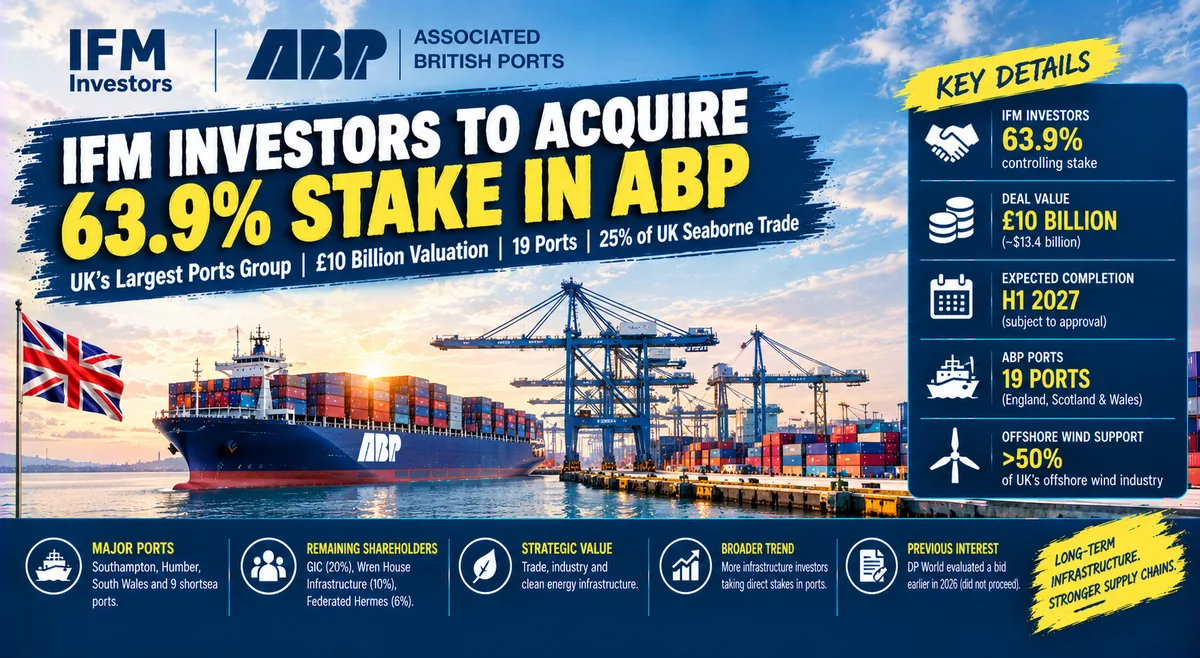
A fund managed by Australia's IFM Investors has agreed to acquire a 63.9% controlling stake in Associated British Ports (ABP), the UK's largest ports group, the companies announced Wednesday, October 21, 2026. The fund will buy out two Canadian pension investors entirely: Canada Pension Plan Investment Board (CPP Investments) is selling its 33.9% stake, and OMERS is divesting its 30% holding.
The deal values ABP at approximately £10 billion ($13.4 billion), though specific financial terms of the transaction itself have not been disclosed. It is expected to complete in the first half of 2027, subject to shareholder and regulatory approvals — meaning this is an agreement, not yet a finished sale.
Why This Matters: ABP's Scale and Reach
ABP is the UK's largest ports group by tonnage, operating 19 ports across England, Scotland and Wales and handling roughly 25% of the country's entire seaborne trade. Its deep-sea assets include Southampton and facilities across the Humber and South Wales, alongside nine shortsea ports.
Perhaps more strategically significant for the energy transition: ABP's ports support more than half of the UK's offshore wind industry, including the future floating offshore wind development at Port Talbot. That dual role — as both a conventional trade gateway and critical infrastructure for renewable energy build-out — likely made ABP an especially attractive target for a long-term infrastructure investor like IFM.
The End of a 20-Year Ownership Chapter
This transaction closes out roughly two decades of Canadian pension fund involvement in British ports infrastructure. OMERS first invested in ABP in 2006, and CPP Investments followed in 2015. Both investors framed the exit as a chance to realise value and redirect capital toward other opportunities, rather than signalling any concern about the UK ports sector itself.
The remainder of ABP's shareholder base — Singapore's GIC sovereign wealth fund (around 20%), Kuwait Investment Authority's Wren House Infrastructure (around 10%), and Federated Hermes via Anchorage Ports (around 6%) — are staying in place as minority holders.
Who Is IFM Investors?
IFM Investors is owned by a consortium of Australian pension funds along with the UK's Nest pension scheme, and manages approximately £157 billion in assets globally. The firm already holds significant transport infrastructure stakes elsewhere, including the leaseholds of the ports of Melbourne and Brisbane in Australia, as well as Perth Airport and Northern Territory Airports.
Kyle Mangini, IFM Investors' global head of infrastructure, said: "We are pleased to have reached an agreement where a fund managed by IFM would acquire a majority stake in ABP, the UK's largest ports group with strategically located assets serving some of the country's most important trade and industrial regions. We look forward to supporting continued development of ABP's infrastructure and operations, drawing on IFM's long-term investment approach and experience across ports and other essential infrastructure assets."
ABP CEO Henrik L. Pedersen welcomed the news: "Attracting investment from a fund managed by IFM Investors is a powerful endorsement of our business, our people and our strategy."
This Isn't the First Suitor
IFM is not the only major infrastructure player to have shown interest in ABP recently. Earlier this year, Dubai's DP World was separately reported to be evaluating a bid for a controlling stake in the same company, when CPP Investments and OMERS first signalled they wanted to sell their combined holding. That earlier interest did not result in a deal — IFM has instead emerged as the buyer.
Part of a Broader Pattern: Infrastructure Investors Moving Into Ports
This acquisition fits a pattern we've tracked repeatedly across our recent coverage: long-term capital increasingly flowing directly into port ownership rather than just shipping operations. We've reported on Hapag-Lloyd taking a stake in Rotterdam's Maasvlakte II terminal, CMA Terminals completing its Nador Container Terminal acquisition in Morocco, and now a pension-fund-backed infrastructure manager taking majority control of Britain's largest ports group entirely.
The common thread across these deals is the same: ports are increasingly viewed as stable, long-duration infrastructure assets — offering predictable, inflation-linked returns tied to trade volumes and, increasingly, energy infrastructure like offshore wind — rather than purely operational businesses bought and sold on short-term logistics cycles.
What This Means for Shippers, Carriers, and the Wider Industry
- No immediate operational change expected. With completion not anticipated until the first half of 2027 and pending regulatory approval, shippers and carriers using ABP's facilities should not expect any near-term disruption to port operations, pricing, or service levels.
- Watch for long-term investment signals, not short-term cost pressure. IFM has explicitly framed this as a long-term infrastructure play, which historically tends to support continued capital investment in port facilities rather than the kind of aggressive short-term cost-cutting sometimes associated with private equity ownership.
- Offshore wind supply chains should pay particular attention. Given ABP's role supporting more than half of UK offshore wind activity, companies involved in renewable energy logistics and offshore wind component shipping should monitor how IFM's ownership approach may affect future investment in that specific infrastructure.
- This reinforces a broader trend of consolidated port ownership by infrastructure capital. Shippers negotiating long-term port access or handling agreements across multiple global gateways should be aware that port ownership is increasingly concentrated among a smaller group of large infrastructure investors — IFM, DP World, CMA Terminals, and others — which may affect how terminal strategy and pricing are set over the coming years.
- Regulatory approval remains a real hurdle to watch. Given ABP's scale and strategic importance — a quarter of UK seaborne trade and majority support for offshore wind — UK regulators may scrutinise this deal closely. Stakeholders with long-term planning tied to ABP facilities should monitor the approval process through to the expected first-half 2027 completion.
Key Takeaways
- IFM Investors has agreed to acquire a 63.9% controlling stake in Associated British Ports (ABP), announced October 21, 2026.
- CPP Investments (33.9%) and OMERS (30%) are both fully exiting their ABP holdings.
- The deal values ABP at roughly £10 billion ($13.4 billion); specific transaction terms remain undisclosed.
- Completion is expected in the first half of 2027, subject to shareholder and regulatory approval.
- ABP operates 19 ports handling about 25% of UK seaborne trade and supports more than half of the UK's offshore wind industry.
- Remaining minority shareholders — GIC, Wren House Infrastructure, and Federated Hermes — are staying in place.
- DP World had separately evaluated a bid for ABP earlier in 2026 but did not proceed with an acquisition.
- This fits a broader 2026 pattern of infrastructure investors and carriers taking direct ownership stakes in strategic ports, alongside recent deals involving Hapag-Lloyd and CMA Terminals.


Comments
No comments yet. Be the first to share your thoughts!