What Happened
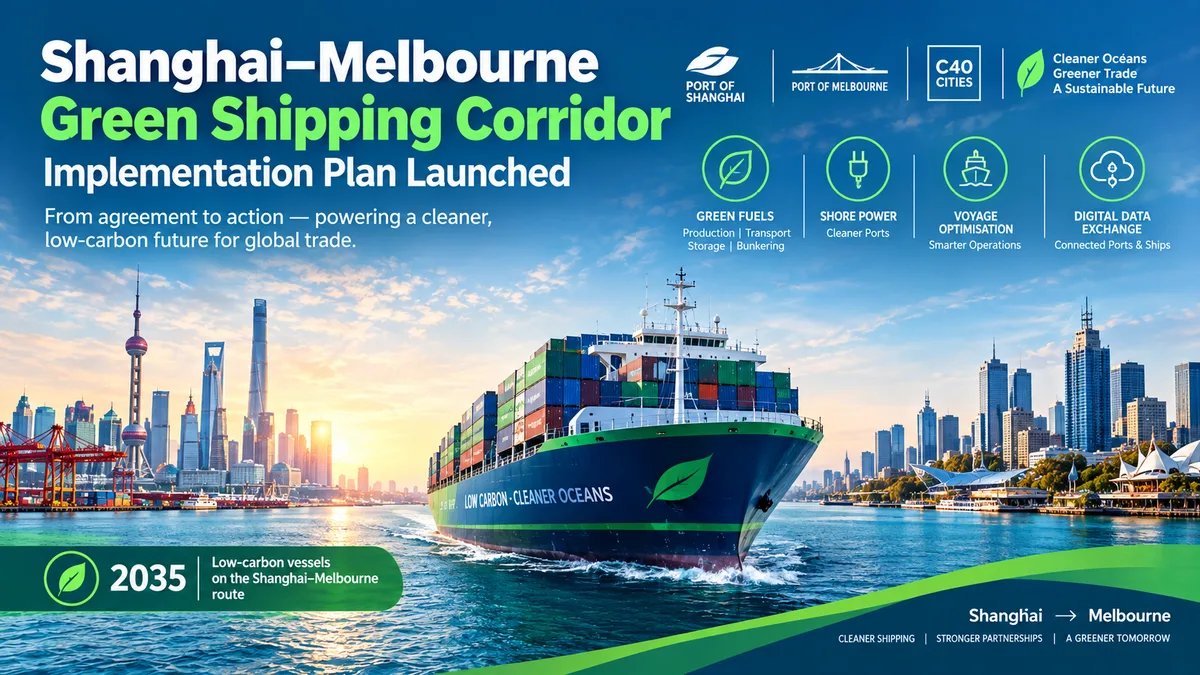
The ports of Shanghai and Melbourne, together with C40 Cities, launched an implementation plan for their Green Shipping Corridor (GSC) on October 21, 2026, moving the partnership from agreement into its delivery phase. The Shanghai-Melbourne Green Shipping Corridor Implementation Plan Outline was released at the Green and Low-Carbon Forum of the North Bund International Shipping Forum in Shanghai.
The two ports first established the corridor through a memorandum of understanding formalised on October 19, 2025, also at the North Bund Forum. This week's announcement sets out the concrete steps that will put that earlier agreement into action — covering low-carbon marine fuel production, transport, storage and bunkering, as well as shore power, voyage optimisation and digital data exchange between ports and ships.
The 2035 Target: Low-Carbon Ships on the Route
The plan's headline goal is to deploy one or more low-carbon-fuelled container vessels on the Shanghai-Melbourne route by 2035. Getting there requires completing baseline and feasibility studies first, with the two ports building out the surrounding fuel infrastructure in parallel.
Shanghai, the world's busiest container port, is aiming to build an annual bunkering capacity of one million tonnes for green methanol and biofuels — building directly on methanol bunkering capabilities the port has already established. Melbourne, Australia's largest container port, will study the feasibility of alternative fuel bunkering and shore power infrastructure at its own facilities, a less advanced starting point than Shanghai's.
Melbourne has separately committed to net-zero emissions from its own port operations by 2030, giving the corridor plan two complementary timelines: a 2030 target for the port's own operational footprint, and a 2035 target for low-carbon vessels actually sailing the trade route.
Who Is Involved
The partnership brings together the Shanghai Municipal Transportation Commission, the Port of Melbourne, and C40 Cities as the core governance structure. A wider group of industry partners is supporting the initiative on the commercial and technical side: Shanghai International Port Group (SIPG), COSCO Shipping Lines, HAMR Energy, ABEL Energy, and Shenergy. The China Classification Society is also supporting the project, specifically on fuel standards and certification — a detail that matters because new marine fuels need recognised technical standards before they can be used at commercial scale.
HAMR Energy and ABEL Energy are both Australian renewable-fuel developers, suggesting Melbourne's side of the corridor is leaning on local fuel-production capacity rather than relying solely on imported green fuels.
What Port of Melbourne's CEO Said
Saul Cannon, Chief Executive Officer of the Port of Melbourne, said the plan would help advance shore power, alternative fuel bunkering, and the use of lower-emission vessels on the route. The emphasis on shore power is notable: it allows a docked ship to plug into electricity from the grid rather than running its own engines for power while berthed, cutting local emissions at the port itself even before any change to the fuel used at sea.
Why This Trade Route Specifically
China is the Port of Melbourne's largest trading partner, accounting for roughly 50% of the port's total container imports and 20% of its container exports. That concentration makes the Shanghai-Melbourne corridor a meaningful test case — a decarbonisation effort here affects a disproportionately large share of one major port's overall trade, rather than a marginal or low-volume route.
The announcement also coincides with the 20th anniversary of the sister-port partnership between Shanghai and Melbourne, a relationship that began in 2006 and has now evolved from a general cooperation agreement into a specific, funded decarbonisation programme with named industry partners and dated targets.
How This Fits the Broader Green Corridor Trend
This is not Shanghai's only green shipping corridor initiative. The port has separately pursued similar partnerships with Hamburg and Barcelona, positioning itself as a hub for multiple green corridor projects simultaneously rather than committing its decarbonisation efforts to a single trade lane. For COSCO Shipping Lines and Shanghai International Port Group, participating across several of these corridors likely builds shared technical experience — in fuel bunkering, vessel retrofitting, and port infrastructure — that can be applied across routes rather than developed from scratch each time.
What This Means for Shippers and the Wider Industry
- No immediate operational change, but a dated roadmap now exists. With the plan explicitly targeting 2035 for low-carbon vessel deployment, shippers using the Shanghai-Melbourne route should treat this as a long-term infrastructure signal rather than something affecting bookings or costs in the near term.
- Watch Shanghai's methanol and biofuel bunkering buildout as a leading indicator. Shanghai's push toward one million tonnes of annual green methanol and biofuel capacity will likely benefit vessels beyond just the Melbourne route, since bunkering infrastructure built at a major hub port typically serves multiple trade lanes calling there.
- Melbourne's slower starting position is worth noting for Australian shippers. Since Melbourne is still at the feasibility-study stage for its own alternative fuel bunkering, the corridor's practical progress will likely be led by developments on the Shanghai side first, with Melbourne's infrastructure following.
- This adds to a growing list of green corridor commitments shaping long-term vessel newbuild decisions. Carriers planning container ship orders for delivery in the 2030s may increasingly need to account for which trade lanes have committed green corridor infrastructure in place, as this can influence fuel choice and vessel specification decisions made years in advance.
Key Takeaways
- Shanghai and Melbourne launched the implementation plan for their Green Shipping Corridor on October 21, 2026, at Shanghai's North Bund International Shipping Forum.
- The plan targets deployment of low-carbon-fuelled container vessels on the route by 2035.
- Shanghai aims for 1 million tonnes of annual green methanol and biofuel bunkering capacity; Melbourne will assess its own alternative fuel and shore power feasibility.
- Melbourne has separately committed to net-zero port operations by 2030.
- Industry partners include COSCO Shipping Lines, Shanghai International Port Group, HAMR Energy, ABEL Energy, and Shenergy, with the China Classification Society supporting fuel standards.
- China accounts for about 50% of Melbourne's container imports and 20% of its container exports, making this a high-volume route for the decarbonisation effort.
- The announcement marks the 20th anniversary of the Shanghai-Melbourne sister-port partnership, which began in 2006.
- This builds on the original corridor agreement signed October 19, 2025, and is part of Shanghai's broader portfolio of green corridor partnerships, including with Hamburg and Barcelona.


Comments
No comments yet. Be the first to share your thoughts!