APM Terminals, the ports and infrastructure arm of Danish shipping giant A.P. Moller-Maersk, has signed a non-binding memorandum of understanding (MOU) with Vietnamese conglomerate Hateco Group to develop and operate a $3.5 billion railway container terminal network in northern Vietnam. The agreement was inked in Copenhagen on Tuesday, October 20, during an official state visit to Denmark by Vietnamese President To Lam.
What Was Agreed
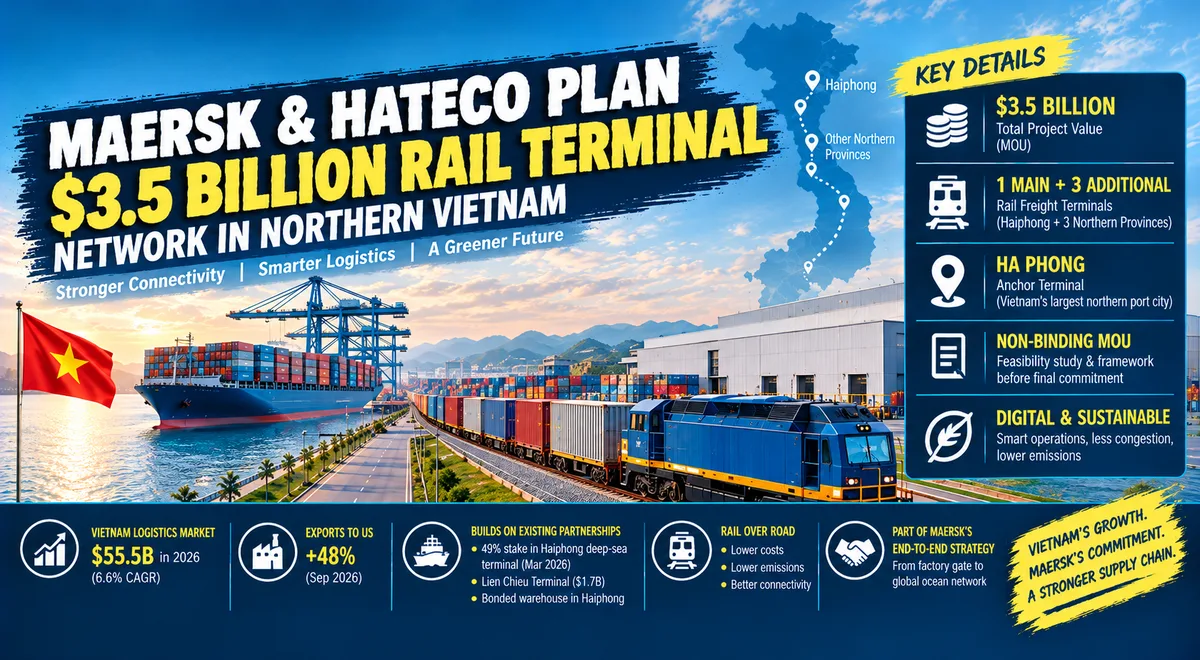
The MOU covers the development of a rail freight terminal in Haiphong — Vietnam's largest northern port city — along with three additional railway freight facilities in neighboring northern provinces. According to a statement from Hateco, the proposed network aims to connect industrial parks, logistics hubs, and production zones with major transport infrastructure across the region.
The project is designed to leverage digital technologies to optimize cargo handling and reduce road congestion — a growing challenge in Vietnam's rapidly industrializing northern corridor. It is important to note that the MOU is non-binding: APM Terminals and Hateco have agreed to study the development and operational framework before committing to construction. The Vietnamese government confirmed the signing in an official statement.
Why Vietnam and Why Now
This deal is not Maersk's first major move in Vietnam — it is the latest in a series of deepening commitments. In March 2026, Maersk took a 49% stake in a deep-sea terminal development in Haiphong. Earlier this year, the company also partnered with Hateco and Da Nang City on the Lien Chieu Container Terminal — a $1.7 billion project. And in late 2024, Maersk inaugurated its first own-licensed bonded warehouse in Hai Phong, cutting customs clearance time by 40% for northern exporters.
Vietnam's freight and logistics market is valued at $55.5 billion in 2026 and is growing at a compound annual rate of 6.6%, according to Mordor Intelligence. The country has emerged as a primary beneficiary of global supply chain diversification away from China, with exports to the US surging 48% in September 2026 alone, driven by manufacturers relocating or expanding production capacity in the country.
The Strategic Logic for Maersk
For Maersk, Vietnam represents a critical node in its integrated logistics strategy. The company is not merely moving containers through Vietnam — it is building the infrastructure to own the entire supply chain: from factory gate in northern industrial provinces, through rail and inland terminals, to deep-sea port facilities, and onto its global ocean network.
The Haiphong rail terminal is particularly significant. Northern Vietnam is home to major manufacturing clusters producing electronics, textiles, and machinery — industries that require fast, reliable connections to export gateways. Currently, most cargo moves by truck, creating road congestion and higher logistics costs. A rail network connecting industrial parks directly to port terminals would materially reduce transit times and carbon emissions.
The deal also reflects a broader trend: as the Strait of Hormuz crisis continues to disrupt Gulf and Middle East trade lanes, global carriers are doubling down on Southeast Asian infrastructure — a region that has seen consistent trade growth throughout 2026 and is seen as increasingly central to resilient global supply chains.
What Comes Next
As a non-binding MOU, the $3.5 billion figure represents the projected investment scope rather than a confirmed commitment. Both parties will now undertake detailed feasibility studies covering terminal design, rail connectivity, regulatory approvals, and financing structures before a binding agreement can be reached. Given the scale of prior Maersk-Hateco collaboration and the political backdrop of a presidential state visit, analysts view the deal as a strong signal of intent from both sides.
Full third-party details — including a project timeline and construction start date — are expected to be disclosed once the feasibility phase is complete.
Key Takeaways — October 20, 2026
- $3.5 billion MOU signed today — Maersk's APM Terminals and Vietnam's Hateco Group agree to develop a railway container terminal network in northern Vietnam.
- Haiphong is the anchor — the primary rail freight terminal will be in Haiphong, Vietnam's key northern port, with three additional facilities planned across surrounding provinces.
- Non-binding at this stage — this is a study agreement, not a construction contract. Full commitment follows feasibility review.
- Maersk is building an end-to-end Vietnam network — this rail MOU adds to a deep-sea terminal stake (March 2026), the Lien Chieu Terminal ($1.7B), and a bonded warehouse in Haiphong already operational.
- Vietnam's logistics market growing at 6.6% CAGR — valued at $55.5B in 2026 and forecast to reach $76.4B by 2031, driven by manufacturing migration from China.
- Rail over road = lower cost, lower emissions — the project directly addresses Vietnam's truck-heavy logistics bottleneck in its industrial north.
- Signed during a presidential state visit — political-level backing from both Denmark and Vietnam signals strong government support for the project moving forward.
Source date: October 20, 2026 | Published: October 20, 2026
Comments
No comments yet. Be the first to share your thoughts!