
What Happened
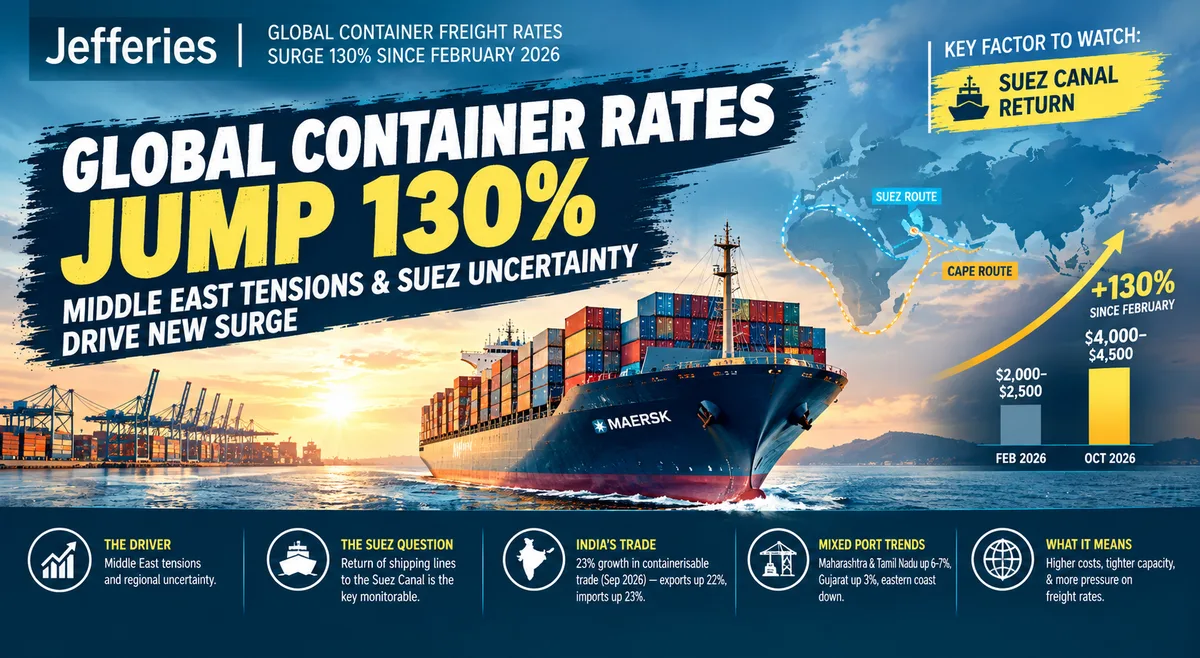
Global container freight rates have surged 130% since February 2026 amid renewed tensions in the Middle East, according to a report by Jefferies cited by multiple outlets on October 19, 2026. The research firm's data shows global container freight rates rising from around $2,000-$2,500 in February 2026 to approximately $4,000-$4,500 in October 2026.
Jefferies' report states plainly: "Freight rates have risen 130 per cent since Feb-26, due to the impact of Middle-East tensions." The firm added a note of caution for the months ahead: "The potential impact of shipping lines' return to the Suez Canal, despite Middle East tensions, is a key monitorable."
How Rates Got Here: The Longer Chart
The pattern behind this spike is worth understanding, because it is not simply a straight climb. According to the chart accompanying Jefferies' report, global container freight rates had fallen substantially from their 2021-22 pandemic-era highs before recovering during 2024. Rates then eased again through much of 2025 and early 2026 — meaning carriers and shippers had just settled into a calmer, lower-rate environment before this year's renewed Middle East tensions reversed that trend sharply from February onward.
That context matters: this is not a market moving from already-elevated levels, but one that was genuinely declining and relatively settled before this year's disruption hit.
The Suez Canal Question: Why It's the Number to Watch
Jefferies specifically flagged the potential return of shipping lines to the Suez Canal as the single most important variable to monitor going forward, even as Middle East tensions continue. This aligns closely with what we've tracked in our own recent coverage — carriers including MSC, Maersk, CMA CGM and the Premier Alliance have been gradually and selectively resuming Red Sea transits in recent weeks, with Suez Canal container capacity rising from roughly 8% of relevant Asia-Europe capacity to 36% by early October.
The logic here is straightforward: more vessels taking the shorter Suez route rather than the longer Cape of Good Hope detour effectively adds capacity back into the market without adding new ships. If that return accelerates, it works directly against the kind of rate strength Jefferies is currently describing — which is exactly why the firm is treating it as the key swing factor rather than a settled trend.
India's Trade Keeps Growing Despite Higher Rates
One of the more notable findings in the report is that higher shipping costs have not yet visibly slowed India's trade growth. India's containerisable export-import trade rose 23% year-on-year in September 2026, supported by a 22% increase in exports and a 23% rise in imports. Exports to the United States specifically grew 48% year-on-year in the same month.
Jefferies was careful to note the limits of what the data shows: the report's figures do not establish that higher freight rates have already slowed India's export-import growth. In other words, trade is still expanding strongly even with rates more than double where they stood in February — though that does not mean costs aren't being felt elsewhere, such as in margins or pricing passed on to end buyers.
A More Mixed Picture Within India
Port-level data tells a less uniform story than the national trade figures suggest. Among non-major ports, volumes at Gujarat ports rose 3% year-on-year, while ports in Maharashtra and Tamil Nadu recorded stronger growth of 6-7%. Major and non-major ports on India's eastern coast, however, saw a sharp decline during the month — a regional divergence worth watching for anyone routing cargo through specific Indian port clusters rather than looking at national totals alone.
Separately, trade with the UAE and Saudi Arabia dipped slightly during the month, even as overall exports to the US surged — suggesting the rate pressure and regional tensions may be affecting different trade corridors unevenly rather than uniformly dampening activity.
How This Connects to the Broader Picture We've Been Tracking
This Jefferies data lines up closely with other freight-rate signals we've covered through October. Drewry's World Container Index rose 3% to $4,485 per 40ft container in mid-October, driven mainly by Asia-Europe increases, while carriers pushed new FAK rates of $4,500-$4,800 per 40ft effective October 19 — the same date as this Jefferies report. Separately, Asia-US East Coast rates have remained near post-Hormuz-crisis peaks, with Xeneta describing the market as likely having reached its 2026 high after a surge that left rates at more than four times pre-crisis, February 28 levels.
Taken together, these sources paint a consistent picture: elevated global container rates driven primarily by the ongoing Strait of Hormuz and wider Middle East disruption, with the pace and durability of any relief now tied closely to how quickly, and how fully, carriers resume normal Suez Canal operations.
What This Means for Shippers and Importers
- Budget around a market that has effectively doubled since February, not pre-crisis rates. With global rates up 130% and showing no clear sign of a near-term reversal, cost planning for Q4 2026 and early 2027 bookings should assume current elevated levels persist rather than expecting a quick return to February pricing.
- Watch Suez Canal return data as your leading indicator. Since Jefferies itself names this as the key variable, tracking weekly Suez transit volumes (which we've covered reaching roughly 753,000 TEUs in early October) gives shippers an early signal of whether rate pressure is likely to ease or persist.
- If you route through Indian ports, check your specific corridor rather than relying on national averages. With eastern coast ports showing declines while Maharashtra and Tamil Nadu grew 6-7%, broad national trade figures can mask meaningful regional differences relevant to your own routing.
- US-bound Indian exporters are currently seeing the strongest growth despite rate pressure. With US exports up 48% year-on-year, demand on this specific corridor appears to be absorbing higher freight costs more readily than some other lanes — worth factoring into capacity and booking-priority decisions if you compete for space on US-bound services.
- Don't assume growth means costs aren't being felt. Jefferies' own caution — that the data doesn't prove rates haven't affected trade — is a reminder that strong headline volume growth can still coexist with real margin pressure further down the supply chain.
Key Takeaways
- Global container freight rates have surged 130% since February 2026, rising from roughly $2,000-$2,500 to $4,000-$4,500 per container, per a Jefferies report cited October 19, 2026.
- Jefferies attributes the surge primarily to continuing Middle East tensions and flags a possible shipping-line return to the Suez Canal as the key factor to watch going forward.
- Rates had been declining through 2025 and early 2026 before this year's sharp reversal from February onward.
- India's containerisable export-import trade grew 23% year-on-year in September, with exports up 22% and imports up 23%; exports to the US grew 48%.
- Jefferies notes the data does not establish that higher rates have already slowed India's trade growth.
- Indian port-level data is mixed: Maharashtra and Tamil Nadu ports grew 6-7%, Gujarat ports rose 3%, while eastern coast ports saw a sharp decline.
- UAE and Saudi Arabia trade dipped slightly even as US-bound exports surged.
- This aligns with other October data we've tracked, including Drewry's WCI rising to $4,485/40ft and new carrier FAK rates effective the same date, October 19.




Comments
No comments yet. Be the first to share your thoughts!