What Happened
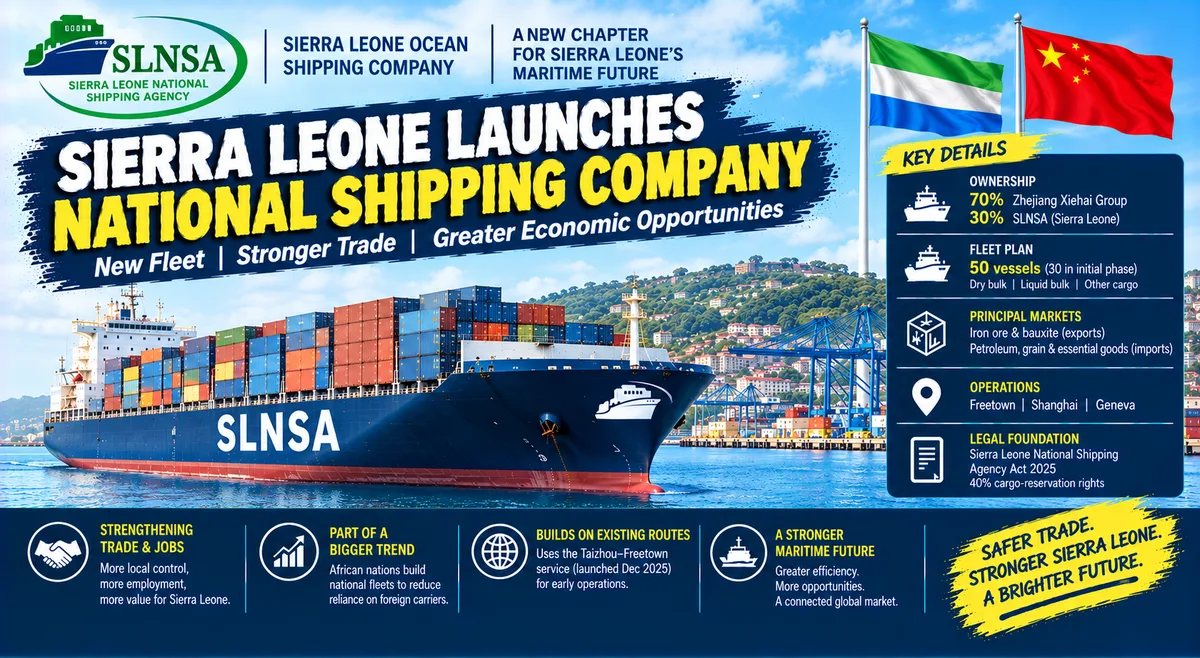
Sierra Leone has launched a new national shipping company backed by China's Zhejiang Xiehai Group, with ambitions to develop a fleet of 50 vessels and capture a greater share of the country's international cargo trade. President Julius Maada Bio inaugurated the Sierra Leone Ocean Shipping Company (SLOSCo) on Monday, October 19, 2026, at Queen Elizabeth II Quay in Freetown.
"For far too long, we have relied on international carriers to export and import our products. Today, we're taking a bold step forward, giving Sierra Leone a greater stake in transporting the goods we trade with the world," Bio said at the launch.
Who Owns It, and How Big Will It Get
The venture is 70% owned by Zhejiang Xiehai Group, with the remaining 30% held by the state-owned Sierra Leone National Shipping Agency (SLNSA). The company plans to establish a fleet of 50 ships, with an initial phase involving 30 vessels, targeting dry bulk, liquid bulk and other cargo types.
SLOSCo's principal markets include Sierra Leone's substantial iron ore and bauxite exports, alongside imports of petroleum products, grain and other essential commodities — the core categories that have historically defined the country's seaborne trade. The company has already established operations in Freetown, Shanghai and Geneva, giving it a footprint spanning its home market, its majority owner's base, and a major global shipping and trade finance hub.
The Legal and Institutional Groundwork
This launch follows a broader restructuring of Sierra Leone's shipping sector. The country's longstanding national shipping company was restructured into SLNSA last year under the Sierra Leone National Shipping Agency Act 2025, which transformed the old Sierra Leone National Shipping Company into its current regulatory and agency form.
Legislation underpinning the new structure provides the national carrier with rights covering 40% of the value of the country's import and export cargoes — a significant built-in commercial advantage that distinguishes SLOSCo from a purely market-driven new entrant. Sierra Leone's parliament approved the joint venture agreement with Zhejiang Xiehai Group in August 2026, ahead of this week's formal launch.
SLOSCo will also be able to draw on an existing direct shipping route between Taizhou Port in China and Queen Elizabeth II Quay in Freetown, which was launched in December 2025 — meaning the new company inherits an operational trade lane rather than starting entirely from scratch.
What Officials on Both Sides Said
Mustapha Mark Lissa, Director-General of SLNSA, welcomed President Bio to the launch and thanked Zhejiang Xiehai Group for its investment commitment, describing the partnership as an opportunity to expand maritime operations, generate employment and strengthen Sierra Leone's shipping industry.
Wang An, President of Zhejiang Xiehai Group, reaffirmed his company's commitment to the partnership, calling it another demonstration of the longstanding economic and diplomatic relationship between Sierra Leone and China. Following the launch, Zhejiang Xiehai representatives met separately with leadership of the Sierra Leone Ports and Harbors Authority (SLPHA) to discuss easing cargo movement through the port.
An Honest Look at the Challenges Ahead
It's worth noting that launching a national carrier does not, on its own, guarantee lower trade costs or higher revenues. Sierra Leone's total container traffic is small relative to the volumes typically required to justify deploying a large, dedicated fleet — a 50-vessel fleet serving Sierra Leonean trade primarily would operate at a fraction of the utilisation rates achieved by global carriers, which spread vessel costs across multiple markets and routes.
Zhejiang Xiehai Group's broader vessel access and Chinese trade connections could help SLOSCo carry cargo beyond Sierra Leone's own import and export channels, which would improve the fleet's commercial viability. But as with any new shipping venture at this scale, SLOSCo's long-term success will depend on securing adequate financing and vessels, identifying genuinely profitable routes, attracting steady cargo volumes, and competing effectively with the established international carriers Sierra Leone has relied on until now.
Part of a Wider African Trend
Sierra Leone's move fits into a broader pattern across the continent, with multiple African governments currently planning or building out domestic shipping fleets as part of efforts to reduce reliance on foreign carriers and capture more value from their own international trade. Minister of Transport Alhaji Fanday Turay previously noted that the sector needed a renewed vision built around "greater efficiency, flexibility, and authority" — language that reflects this wider regional push for greater maritime self-sufficiency, not just a Sierra Leone-specific initiative.
What This Means for Shippers and Trading Partners
- No immediate rate or booking changes — this is still an early-stage build-out. With the first operational phase targeting just 30 of the planned 50 vessels, and no published rates or cargo rules yet, shippers trading with Sierra Leone should not expect near-term changes to how cargo is booked or priced.
- Watch how the 40% cargo-reservation rule is implemented in practice. Since legislation gives the national carrier rights covering 40% of the value of Sierra Leone's import and export cargo, international shippers and freight forwarders active in this market should monitor how and when this rule begins affecting carrier selection and cargo allocation.
- The existing Taizhou-Freetown route offers an early indicator of SLOSCo's operational style. Companies already using the direct China-Sierra Leone shipping route launched in December 2025 may be among the first to see how SLOSCo integrates into existing trade flows, since the company can build on this established lane rather than developing new routes from zero.
- Commodity exporters and importers in iron ore, bauxite, petroleum and grain should track this closely. These are SLOSCo's stated principal markets, meaning companies trading in these specific categories with Sierra Leone are the most likely to see direct commercial engagement from the new carrier first.
- This reflects a broader African trend worth monitoring regionally. With multiple African governments pursuing similar national fleet strategies, shippers and forwarders with pan-African trade exposure should watch whether other countries follow Sierra Leone's specific model — a majority foreign-backed joint venture paired with a domestic cargo-reservation law.
Key Takeaways
- Sierra Leone launched the Sierra Leone Ocean Shipping Company (SLOSCo) on October 19, 2026, backed by China's Zhejiang Xiehai Group.
- Ownership: Zhejiang Xiehai Group holds 70%, Sierra Leone National Shipping Agency (SLNSA) holds 30%.
- Planned fleet: 50 vessels total, with 30 in the initial phase, targeting dry bulk, liquid bulk and other cargo.
- Principal markets: iron ore and bauxite exports, plus petroleum, grain and other essential imports.
- The venture builds on the Sierra Leone National Shipping Agency Act 2025 and an existing direct Taizhou-Freetown shipping route launched in December 2025.
- Legislation gives the national carrier rights covering 40% of the value of Sierra Leone's import and export cargo.
- SLOSCo has established operations in Freetown, Shanghai and Geneva.
- Analysts note the venture's long-term viability will depend on financing, route profitability, and cargo volumes, given Sierra Leone's relatively small container trade base.
- The launch is part of a broader trend of African governments building domestic shipping fleets to reduce reliance on foreign carriers.


Comments
No comments yet. Be the first to share your thoughts!