
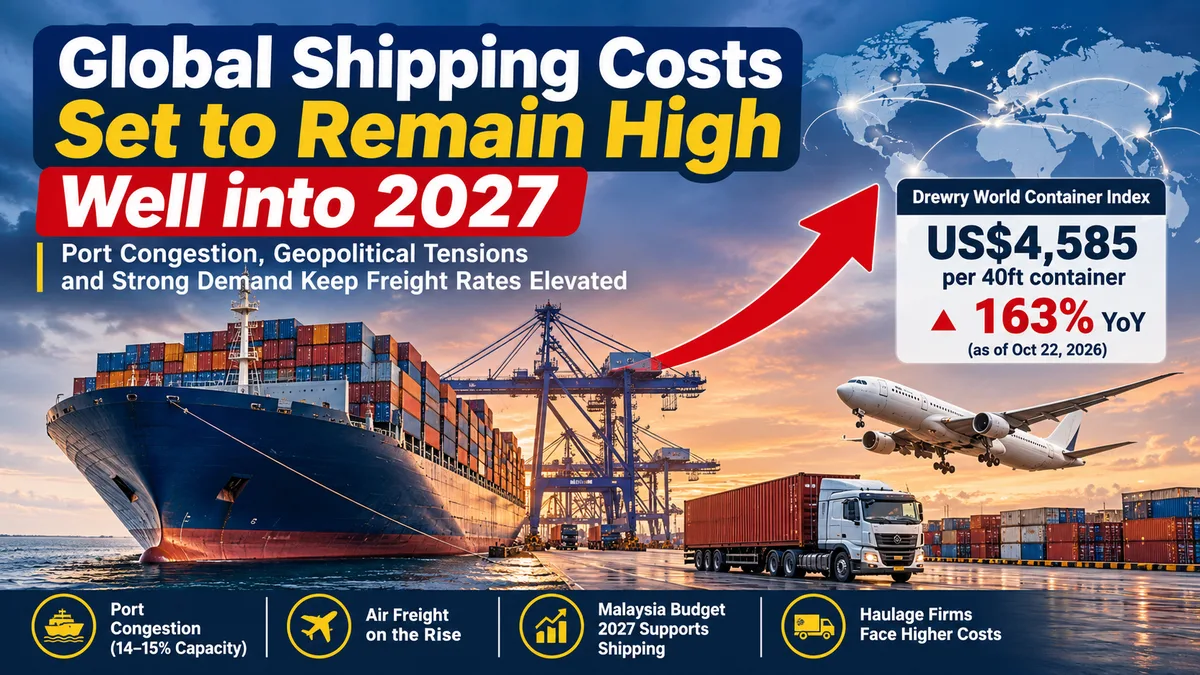

Exporters and importers are unlikely to see any relief from elevated shipping costs in the near term, with global freight rates expected to remain high well into 2027. The Drewry World Container Index recorded spot freight rates at US$4,585 per 40ft container as at October 22, 2026 — a surge of 163% year-on-year — as ongoing disruptions continue to drain capacity from the global container shipping system.
Three major fault lines are keeping the pressure on: the continuing US-Iran conflict disrupting the Strait of Hormuz, Houthi strikes on commercial shipping in the Red Sea, and persistent port congestion amplified by a string of typhoons across Asia. Industry executives across shipping, haulage, and logistics say the structural conditions driving elevated rates are unlikely to resolve before 2027 at the earliest.
Port Congestion Absorbing 14–15% of Global Shipping Capacity
Port congestion has become one of the most significant capacity drains in the global shipping system in 2026. Ooi Lean Hin, co-founder and managing director of MTT Shipping — Malaysia's largest container liner operator by market share — estimates that congestion is absorbing an estimated 14% to 15% of global shipping capacity, as vessels bunch up after port closures caused by increasingly disruptive typhoons.
"Typhoons have become more disruptive, forcing port closures and causing vessels to bunch up as operations resume," Ooi said. Major Chinese ports remain constrained following Typhoon Saudel in late August, compounding delays from multiple storms earlier in the year. Meanwhile, drought restrictions at the Panama Canal limited capacity to 32–34 daily transits in September, with Neo-Panamax slots capped at just nine per day.
Carriers have responded with increasingly disciplined capacity management — a significant departure from pre-pandemic behaviour. Rather than allowing excess capacity to collapse rates, shipping lines are actively blanking sailings during softer demand periods to support freight rate stability.
"Carriers are not as destructive as they were before Covid-19. They manage capacity against actual demand by blanking sailings during slower periods, which helps support a more stable freight environment," Ooi noted.
Air Freight Gaining as Ocean Capacity Tightens
The tightening of ocean freight capacity — driven by the Middle East conflict and widespread port congestion — is accelerating a structural modal shift for high-value, time-sensitive cargo. Integrated logistics provider Tasco Bhd has seen its air freight forwarding (AFF) business grow at the direct expense of ocean freight forwarding in its latest financial quarter, as shippers move data centre equipment, pharmaceuticals, and technology components by air rather than risk ocean delays.
This trend mirrors findings from DHL's Logistics of Things report published last month, which identified AI infrastructure supply chains — covering semiconductors, server hardware, and data centre components — as uniquely time-sensitive cargo that cannot afford ocean freight delays. As Fabio Weiss of DHL Global Forwarding Asia Pacific noted: delays in this category have direct downstream consequences for entire AI infrastructure deployment timelines.
For logistics providers with air freight capabilities, the ongoing ocean disruption is creating a significant revenue opportunity heading into Q4 2026 and 2027.
Shipping Firms Benefit from Malaysia Budget 2027 Support
Against the challenging freight backdrop, Malaysia's Budget 2027 has provided a meaningful boost to domestic shipping operators. The extension of the full income tax exemption for shipping companies to 2036 — previously renewed on an uncertain three-year cycle — gives operators the long-term planning certainty needed to commit to fleet expansion and vessel newbuildings.
Alongside the tax exemption extension, the government revised stamp duty rates on qualifying ship financing loans to fixed amounts of RM2,000 for loans up to RM100 million and RM5,000 for loans above RM100 million, replacing the previous 0.5% rate. For capital-intensive vessel purchases, the savings are material.
Orkim Bhd, a Malaysian operator of clean petroleum product and LPG tankers, has already capitalised on the supportive environment. The group acquired two chemical tankers in 2026 and took delivery of a third on November 3, with plans for two further newbuildings for delivery in 2028. Average daily charter rates have risen to around RM59,000 from RM58,400 in H1 2026, underpinned by strong vessel utilisation and limited newbuilding supply in the region.
"We do not see many newbuildings in this region and most shipments are already fully booked," said Captain Cheah Sin Bi, executive director and CEO of Orkim.
Haulage Operators Navigate Fuel and Labour Pressures
On the landside, Malaysian haulage operators are managing a different set of cost pressures. Swift Haulage Bhd — the country's largest container haulier by fleet size — raised haulage rates by 5% to 10% across its customer base from mid-2026, with further increases to be reviewed contract by contract through the remainder of the year.
Swift's group CEO Loo Yong Hui said the impact of higher diesel prices has so far been limited by two factors: fuel adjustment clauses built into most of its haulage contracts, and the government's Subsidised Diesel Control System 2.0 (SKDS 2.0), which allows eligible commercial fleets to purchase diesel at RM2.15 per litre. However, rising labour costs — including minimum wage reviews and mandatory EPF contributions for foreign workers — combined with a persistent driver shortage, continue to pressure margins.
Swift is also accelerating its electric vehicle transition, operating seven electric prime movers today against a total fleet of 1,600 prime movers, with plans to add at least 50 more electric units next year under a heads of agreement with SINOTRUK International (M) Sdn Bhd.
Swift's warehousing segment slipped into losses in the second quarter of 2026 following customer departures, but management expects a return to profitability as occupancy improves across its 1.8 million sq ft of facilities. Current utilisation stands at approximately 70%, with a target of 80–85% by year end.
Outlook: Elevated Rates, Resilient Demand
The consensus across Malaysian shipping, haulage and logistics operators is clear: freight rates will remain elevated through the rest of 2026 and into 2027, with no structural catalyst for a near-term reversal. Port congestion, geopolitical risk, carrier capacity discipline and the AI-driven surge in air freight demand all point in the same direction.
For shippers and freight buyers globally, the message is consistent with what DHL and Xeneta have both flagged in recent weeks: plan for elevated costs, secure capacity early, and build resilience into logistics contracts before the market tightens further heading into the Chinese New Year cycle in early 2027.
🔑 Key Takeaways — November 9, 2026
- Drewry WCI at US$4,585 per 40ft container — up 163% year-on-year as of October 22, 2026. No near-term relief expected.
- Port congestion absorbing 14–15% of global capacity — typhoon-related bunching at Asian ports, Panama Canal at 32–34 daily transits, and Middle East disruptions all compounding each other.
- Carriers blanking sailings to defend rates — a structural shift from pre-pandemic behaviour that is keeping the freight market tighter than raw supply data would suggest.
- Air freight gaining at ocean's expense — data centre equipment, pharma, and tech components moving by air as ocean delays become unacceptable for time-sensitive supply chains.
- Malaysia Budget 2027 extends shipping tax exemption to 2036 — giving domestic operators long-term certainty and reduced financing costs for fleet expansion.
- Orkim daily charter rates at RM59,000 — firm and rising, with limited regional newbuilds and near-fully booked shipments.
- Swift Haulage raised rates 5–10% — managing fuel and labour cost pressures through FAF contracts and government diesel subsidies, with EV fleet expansion accelerating.
- Action for shippers now: lock in Q1 2027 ocean and air freight capacity before Chinese New Year cycle tightens the market further.
Source date: November 9, 2026 | Published: November 9, 2026



Comments
No comments yet. Be the first to share your thoughts!