What Happened
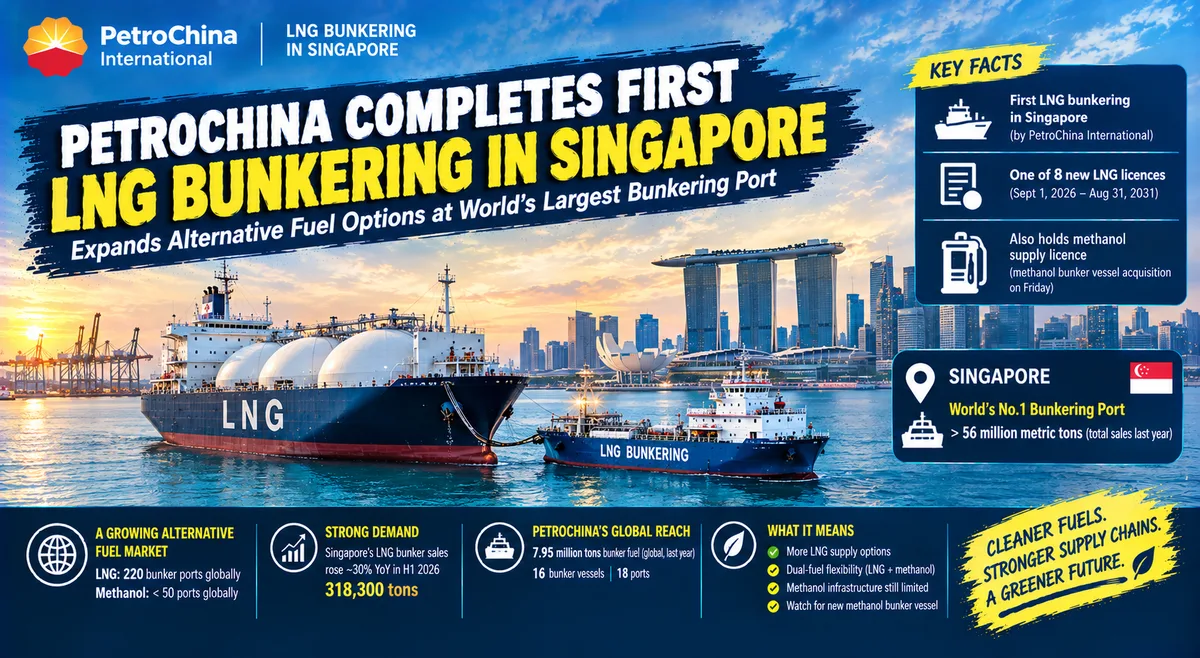
PetroChina International used liquefied natural gas to bunker a vessel in Singapore for the first time on Thursday, chairman Wu Junli announced at the Singapore International Bunkering conference. This marks the company's entry into LNG fuel supply at the world's largest bunkering port, widening the alternative-fuel options it can offer shipowners calling there.
PetroChina had already carried out LNG bunkering operations elsewhere — including its first commercial LNG bunkering in Europe last year, a ship-to-ship LNG bunkering operation in Hong Kong, and earlier LNG bunkering work in Shenzhen — but Thursday's operation was its first specifically in Singapore.
How PetroChina Got the Licence
The trading arm of Chinese state major PetroChina was one of eight firms that received LNG bunkering licences from the Singapore government. Singapore's Maritime and Port Authority (MPA) issued these eight new licences, valid from September 1, 2026 to August 31, 2031, following a call for applications launched in January 2026. The other licence holders include Aramco Trading Singapore, Equatorial Marine Fuel Management Services, ExxonMobil Asia Pacific, Shell Eastern Trading, Sinopec Fuel Oil Singapore, the TotalEnergies-Sembcorp joint venture, and Vitol Bunkers. Before this round, Singapore had only three LNG bunker suppliers: FuelLNG, Pavilion Gas, and TotalEnergies Marine Fuels.
PetroChina also holds a licence to supply methanol to ships in Singapore, and Wu said the company will complete the acquisition of a methanol bunker vessel on Friday — a day after the LNG operation.
Why Singapore Matters So Much Here
Singapore is the world's top bunkering port, with total bunker sales exceeding 56 million metric tons last year. PetroChina alone accounted for about 10 percent of that volume. Globally, the company sold 7.95 million tons of bunker fuel last year and says it can supply 18 ports using 16 bunker vessels on time charter.
Entering the LNG market in Singapore specifically gives PetroChina a presence in alternative marine fuels at the port that effectively sets pricing and availability benchmarks for the rest of the industry.
Infrastructure Still Lags Fleet Growth
Wu was candid about a gap in the wider alternative-fuels market: infrastructure for emerging marine fuels significantly lags behind fleet development. He noted that the number of existing and planned methanol bunkering ports worldwide remains below 50, compared with 220 LNG bunker ports globally.
In other words, shipowners who have already ordered or converted vessels to run on methanol or LNG may find far more places to refuel on LNG than on methanol, at least for now — a gap that is shaping which alternative fuel strategies make practical sense on which trade routes.
Singapore's own LNG bunker sales reflect this growing demand: they totalled 318,300 tons in the first half of 2026, up roughly 30 percent from the same period a year earlier.
What Does This Mean for Shipowners and Charterers?
- More LNG supply options at the world's busiest bunkering port. PetroChina joining the roster of eight newly licensed suppliers means shipowners calling at Singapore now have a wider pool of LNG providers to negotiate with, which can support more competitive pricing and better availability.
- Dual-fuel flexibility from one supplier. With both LNG and methanol licences in Singapore, PetroChina can offer shipping lines a single point of contact for more than one alternative fuel — useful for operators running mixed fleets or still deciding which fuel pathway to commit to long-term.
- Methanol infrastructure remains the bigger constraint. If your fleet strategy depends on methanol rather than LNG, be aware that port coverage is far more limited worldwide — fewer than 50 ports versus 220 for LNG — so route planning around methanol refuelling needs extra care for now.
- Watch for PetroChina's methanol bunker vessel addition. The company's planned acquisition of a dedicated methanol bunker vessel, completing the day after this LNG operation, signals it intends to build out both fuel offerings in Singapore in parallel rather than favouring one over the other.
Key Takeaways
- PetroChina International completed its first LNG bunkering operation in Singapore on Thursday, confirmed by chairman Wu Junli at the Singapore International Bunkering conference.
- PetroChina was one of eight firms awarded new LNG bunkering licences by Singapore's MPA, valid from September 1, 2026 to August 31, 2031.
- The company also holds a methanol supply licence in Singapore and will complete acquisition of a methanol bunker vessel on Friday.
- PetroChina accounted for about 10% of Singapore's bunker sales last year, out of total sales exceeding 56 million metric tons.
- Globally there are around 220 LNG bunkering ports versus fewer than 50 for methanol, a gap Wu said is holding back alternative-fuel infrastructure relative to fleet growth.
- Singapore's LNG bunker sales rose about 30% year-on-year in the first half of 2026, reaching 318,300 tons.


Comments
No comments yet. Be the first to share your thoughts!