
The Same Planes, a Completely Different Cargo Mix
Airfreight demand is increasingly being driven by high-value technology cargo, particularly data centre, cloud, semiconductor and AI-related shipments. The aircraft flying between Asia and North America today are largely the same ones that flew these routes a few years ago — but what fills their cargo holds has changed dramatically.
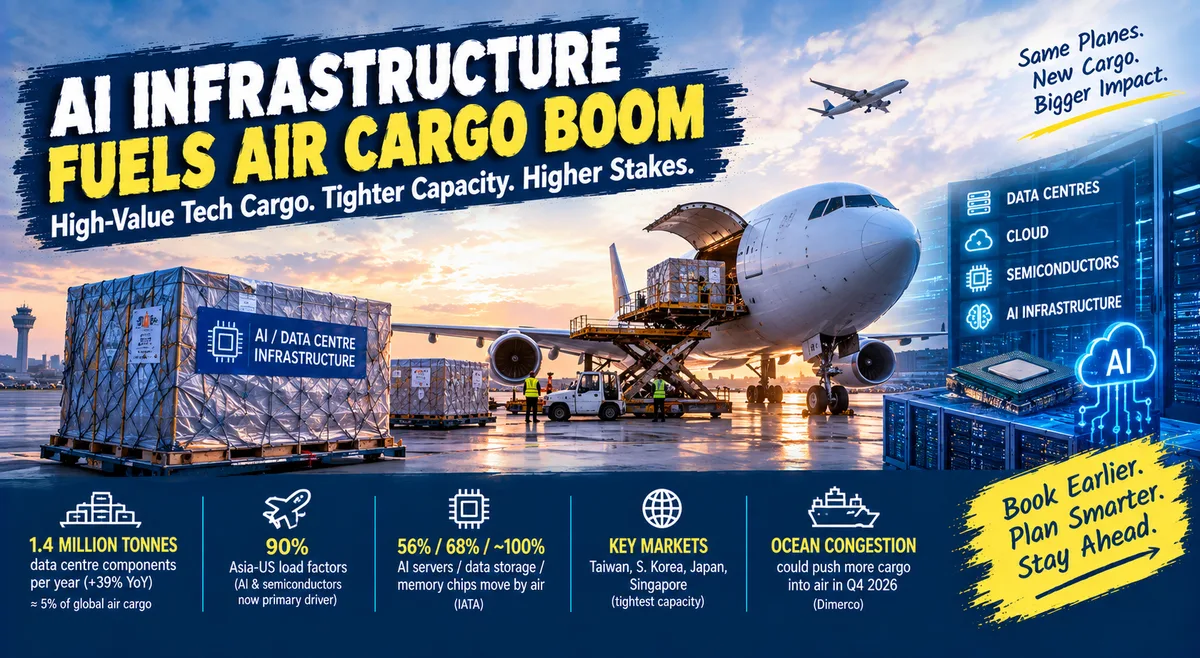
Data centre components alone represent around 1.4 million tonnes of annual air cargo and grew 39 percent year on year, accounting for roughly 5 percent of global air cargo volumes for a single vertical. That is a striking concentration of growth in one category of freight.
How Dominant Has This Shift Become?
The scale of the shift is visible in carrier-level data. Dimerco — which works with Cathay Cargo, Air China Cargo, China Airlines, EVA Air, Korean Air, Starlux Airlines and Singapore Airlines for AI infrastructure movement — reports that load factors on Asia-US lanes have reached approximately 90%, with AI and semiconductor shipments replacing e-commerce as the primary capacity driver.
Individual carrier results back this up. Korean Air reported Q2 2026 cargo revenue of KRW 1.5419 trillion ($1.07 billion), up 46% year-on-year, with AI-related cargo — including chips, server racks and data-centre infrastructure — replacing e-commerce shipments from China as a primary growth driver. Japan Airlines separately disclosed that, excluding mainland China, roughly 80% of Asia's air cargo export growth over the past year has come from technology products.
Industry Air Trade Association (IATA) data illustrates just how dependent this category is on air transport specifically: 56% of AI servers move by air, 68% of data storage units fly, and memory chips are transported by air nearly 100% of the time. This is not a category that can easily shift to ocean freight even under cost pressure — the time-sensitivity is built into how these products are deployed.
Why Does This Cargo Command Priority Over Everything Else?
AI infrastructure combines high cargo value with unusually high time sensitivity. A delayed shipment of chips, servers, or other critical components can hold up the deployment of a much larger data-center project, making the cost of delay far greater than the premium paid for air freight.
This economic logic explains why this cargo is increasingly pushing other freight out of the way. The more significant constraint today is limited capacity, with high-value, high-priority cargo — particularly cloud, semiconductor and AI-related goods — taking precedence over lower-value shipments and consequently causing delays in e-commerce and other cargo movements.
Estes Forwarding Worldwide, reporting earlier this year, described exactly how this plays out operationally: priority cargo "is booked earlier, protected more aggressively, and often displaces freight with flexible delivery windows." As the cargo mix shifts, cutoff times move earlier and last-minute availability shrinks. For shippers outside these priority categories, availability can disappear quickly without any obvious change in headline data.
Why Is AI Infrastructure Logistics So Complicated?
Moving a data centre's worth of equipment is far more complex than typical freight. As Kathy Liu of Dimerco explained: "A data centre needs around nine categories of hardware — compute, networking, storage, racks, power, cooling, facility systems, security and AI-specific components — and they have little in common."
This complexity is compounded by geography. AI infrastructure supply chains connect semiconductor manufacturing and assembly hubs across Taiwan, South Korea, Japan and Southeast Asia with rapidly expanding data-center markets in North America, Europe and the Middle East. A single AI project can involve memory chips moving from South Korea to Taiwan, components passing through Southeast Asia, finished servers moving by air, oversized equipment moving by ocean — all synchronised with a data centre's construction schedule.
Regional hubs in locations like Singapore and San Francisco have emerged specifically to allow equipment to arrive according to a data centre's build sequence, rather than simply as fast as possible — sequencing matters as much as speed.
Which Markets Are Seeing the Strongest Impact?
The geographic concentration of this trend is pronounced. Singapore Changi Airport handled approximately 1.08 million tonnes of air freight in the first half of 2026, up 8.7% year over year, with growth attributed partly to strong demand for semiconductors and AI-related electronics shipments.
Taiwan continues to see particularly strong demand for AI servers, semiconductors, high-performance computing equipment and electronic components, keeping rates under upward pressure to the US and across intra-Asia lanes. More broadly, airfreight remains tight across several Northeast Asian markets, while air capacity to the US also remains constrained from most origins across Southeast Asia, India and Australia.
Could Ocean Congestion Push Even More Cargo Into the Air?
Looking ahead, industry forecasters see additional pressure building on air cargo capacity from an unexpected direction: ocean shipping problems. The air cargo sector could benefit from shippers switching from congested ocean transport to air in the fourth quarter, plus further shifts once there is more clarity on tariffs, according to Dimerco's October Asia Pacific Freight Report.
"Dimerco expects clearer tariff direction and persistent ocean congestion to potentially push more cargo into air as Q4 progresses," the company said. Kathy Liu added: "Bookings look quiet right now, but that's the calm before the door opens. Once held-back China-US cargo releases and ocean congestion pushes shippers into air, the space will face some constraints."
This connects directly to our October 3 report on Asian port congestion potentially persisting into 2027 — if ocean delays continue at current levels, the pressure to shift time-sensitive cargo onto already AI-saturated air cargo capacity will likely intensify, not ease.
What Does This Mean Heading Into October?
Technology-related freight remains one of the strongest demand drivers for October. Servers, semiconductor equipment, data center components, and other high-value electronics continue to generate significant trans-Pacific volume. Meanwhile, general freight is expected to increase more gradually as manufacturers and retailers bring in inventory ahead of early Black Friday sales, Cyber Monday, and year-end demand — meaning general cargo may compete directly for the same aircraft, gateway capacity, and airline allocations as time-sensitive technology freight.
Industry observers increasingly view air cargo volumes themselves as a real-time indicator of the broader AI industry's momentum. As Niall van de Wouw, chief airfreight officer at Xeneta, put it: "AI demand is driving global air cargo data growth, and nobody knows how long it will last."
What Does This Mean for Shippers and Freight Forwarders?
- Book earlier than you think you need to. With priority AI/tech cargo increasingly booked and protected well in advance, cutoff times for general cargo are moving earlier. Waiting until your usual booking window may mean finding reduced space or higher rates than expected.
- Watch Taiwan and Northeast Asian origins closely. These markets are experiencing the tightest capacity pressure from AI and semiconductor freight. If your supply chain touches these origins, build extra lead time and flexibility into Q4 planning.
- Prepare for an unpredictable Q4 if ocean congestion persists. If Dimerco's forecast proves accurate and ocean delays push additional cargo into air freight, already-tight capacity could tighten further. Consider locking in space commitments now rather than waiting for spot market availability later in the quarter.
- Understand that this is a structural shift, not a temporary spike. With data-centre components now representing roughly 5% of global air cargo volume and still growing nearly 40% year-on-year, this is reshaping the fundamental economics of air freight capacity — not a one-off seasonal surge.
- Non-priority shippers should diversify routing options. If your cargo does not fall into the high-value technology category being prioritized, consider alternative gateways, flexible delivery windows, or multimodal options to avoid being squeezed out during peak competition for aircraft space.
Key Takeaways — October 5, 2026
- Data-centre components now account for approximately 1.4 million tonnes of annual air cargo globally — up 39% year-on-year, roughly 5% of total volume.
- Asia-US load factors have reached around 90%, with AI and semiconductor cargo replacing e-commerce as the primary growth driver.
- Korean Air's Q2 2026 cargo revenue rose 46% year-on-year, driven by AI-related freight; 80% of Japan Airlines' Asia export growth (ex-China) came from tech products.
- IATA data: 56% of AI servers, 68% of data storage units, and nearly 100% of memory chips move by air.
- High-priority AI/tech cargo is displacing e-commerce and general freight, pushing booking cutoffs earlier and shrinking last-minute availability.
- Dimerco forecasts ocean congestion and clearer tariff direction could push even more cargo into air freight during Q4 2026.
- Taiwan, South Korea, Japan, and Singapore remain the tightest capacity markets as semiconductor and AI hardware flows intensify.
- Shippers outside the AI/tech priority category should book earlier and build flexibility into routing plans for the rest of the year.
The air cargo industry is being reshaped from the inside out by the AI infrastructure boom — not as a temporary surge, but as a structural shift in what moves by air and who gets priority access to it. With ocean congestion potentially adding further pressure this quarter, shippers across every category of cargo should watch capacity conditions closely heading into the final months of 2026.



Comments
No comments yet. Be the first to share your thoughts!