What Was Just Announced?
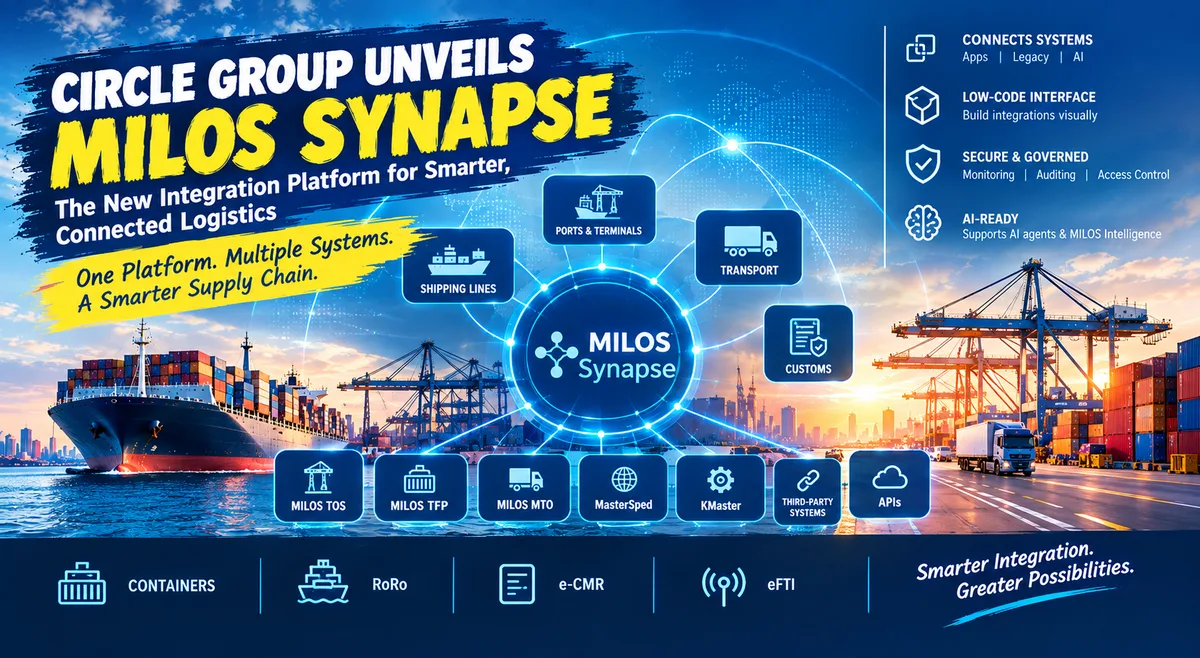
Italian logistics technology company CIRCLE Group has unveiled MILOS Synapse, a new digital platform designed to connect applications, legacy systems and AI tools across port, transport and logistics operations.
The platform aims to simplify how different systems exchange information across the supply chain. This addresses one of the most persistent headaches in global logistics: ports, terminals, shipping lines, trucking companies, and customs authorities all run their own separate software systems — often built years or decades apart, by different vendors, using different data formats.
Instead of relying on separate point-to-point connections, MILOS Synapse provides a common environment where software, services and data can interact through a modular architecture.
Why Does This "Point-to-Point" Problem Matter So Much?
To understand why this announcement matters, it helps to understand the problem it is trying to solve.
Right now, when a port's terminal operating system needs to talk to a trucking company's dispatch software, or a customs platform, or a shipping line's booking system, someone typically has to build a custom, one-off connection between those two specific systems. If you have ten different systems that all need to talk to each other, you could end up needing dozens of separate point-to-point connections — each one expensive to build and painful to maintain when either system gets updated.
A platform like Synapse instead creates one shared environment that every connected system plugs into once — dramatically reducing the number of individual connections needed and making it far easier to add new systems later.
What Can MILOS Synapse Actually Connect To?
MILOS Synapse is designed to work with both CIRCLE Group's existing solutions and third-party platforms. It includes connections to MILOS TOS (Terminal Operating System), MILOS TFP, MILOS MTO, MasterSped and KMaster — all part of CIRCLE Group's existing product family — while standard APIs will allow integration with external transport management and ERP systems.
The platform also supports logistics standards and processes covering containers, RoRo, e-CMR and eFTI — the electronic consignment note and electronic freight transport information standards that are becoming increasingly important across European logistics regulation. This is intended to make it easier for ports, terminals, transport operators and other supply chain participants to connect systems that may otherwise operate separately.
A Low-Code Approach to Integration
One of the more practical features described is a low-code visual interface that will allow integrations to be created through configurable pipelines and reusable components.
In plain English: instead of requiring specialist software developers to write custom code every time two systems need to connect, users with less technical expertise should be able to build these connections through a visual, drag-and-drop style interface. CIRCLE Group said this approach should reduce the time needed to connect different systems while improving visibility and standardisation across logistics processes.
Security, monitoring and auditing functions are also built into the architecture, allowing interactions between connected systems to be tracked and controlled — an important consideration when sensitive shipment, customs, and commercial data is flowing between multiple organizations' systems.
Built With AI Agents in Mind
Beyond simply connecting existing software systems, artificial intelligence forms another part of the development. MILOS Synapse is being designed to connect with CIRCLE Group's MILOS Intelligence tools as well as external AI agents.
The longer-term objective is to allow AI agents from different systems to work together while maintaining control over what they can access and the tasks they can perform. This positions Synapse as infrastructure for exactly the kind of "agentic AI" trend that DHL's own Logistics Trend Radar flagged this week (which we covered separately) — AI systems that can autonomously take action across supply chains, rather than simply respond to individual requests.
CIRCLE Group has previously positioned Synapse as part of the evolution of its wider MILOS Intelligence ecosystem and agentic AI strategy.
What Did CIRCLE Group's Leadership Say?
Luca Abatello, Chairman and CEO of CIRCLE Group, explained the strategic thinking behind the platform: "With MILOS Synapse, we are building a new enabling layer for the evolution of our solutions: not simply an integration tool, but an environment capable of orchestrating systems, data, services and, progressively, Artificial Intelligence agents."
That framing is important — Abatello is explicitly describing Synapse as more than a technical connector. It is being positioned as the foundational layer that future AI capabilities across CIRCLE Group's logistics software will be built on top of.
What Stage Is Development Actually At?
It is worth being clear-eyed about where this project currently stands. The architectural design phase has already been completed, covering the platform's microservices structure, data models and the main frameworks for authentication, deployment and monitoring.
Initial development is taking place during 2026. This first stage will establish the core architecture and orchestrator, alongside Proofs of Concept connecting different systems.
Further development will then focus on expanding integrations and introducing applications built around the MILOS Synapse architecture. Importantly, CIRCLE Group has not yet announced a commercial deployment of the new platform with a specific port, terminal or logistics operator.
In other words: this is a genuine, serious platform development announcement — but it remains in the design and proof-of-concept stage rather than something already running in live port operations. Shippers and terminal operators should treat this as a technology to watch over the coming months, not a system currently available for use.
Why Is This Part of a Bigger Industry Trend?
This announcement lands at a moment when integration and AI-readiness are becoming central themes across port and logistics technology. Just this week, Huawei unveiled its own Port Intelligent Planning Solution at Huawei Connect in Shanghai, and DHL's Logistics Trend Radar flagged agentic AI as the defining technology shift moving supply chains from AI assistance to autonomous action.
The common thread across all of these announcements is the same underlying problem: modern logistics technology increasingly assumes that multiple systems — across multiple companies — need to share data and, eventually, allow AI agents to act across those systems. Building the "plumbing" that makes that possible, safely and with proper controls, is becoming a competitive battleground of its own.
What Does This Mean for Ports, Terminals, and Logistics Operators?
- Watch for pilot announcements over the coming months. With the architecture phase complete and proof-of-concept work underway, expect CIRCLE Group to announce its first pilot port or terminal partner sometime in the coming months — that will be the real signal of how close this platform is to operational use.
- Integration platforms like this could reduce IT costs long-term. If your port or logistics operation currently maintains multiple custom point-to-point connections between systems, a platform like Synapse — once mature — could significantly reduce the ongoing maintenance burden and cost of adding new software systems.
- Standards support (e-CMR, eFTI) is a signal worth noting. CIRCLE Group's explicit support for e-CMR and eFTI — European electronic transport documentation standards — suggests this platform is being built with an eye toward European regulatory compliance requirements that are becoming increasingly important for cross-border freight documentation.
- AI governance built in from the start is a positive sign. The inclusion of security, monitoring, and auditing functions specifically for AI agent interactions — rather than adding these as an afterthought — reflects growing industry awareness that autonomous AI systems need proper oversight from day one, a concern DHL's report also highlighted this week.
- This remains early-stage — plan accordingly. Logistics IT teams evaluating integration platforms should note that MILOS Synapse has no confirmed commercial deployment yet. It is worth tracking, but not yet a solution ready for immediate adoption.
Key Takeaways — September 26, 2026
- CIRCLE Group unveiled MILOS Synapse, a new integration platform connecting port, transport, and logistics software systems.
- The platform replaces costly point-to-point system connections with a shared, modular integration environment.
- It connects CIRCLE Group's own MILOS TOS, MILOS TFP, MILOS MTO, MasterSped, and KMaster products, plus external systems via standard APIs.
- Supports container, RoRo, e-CMR, and eFTI logistics standards and processes.
- Features a low-code visual interface for building integrations without heavy custom development.
- Designed specifically to support AI agents working across connected systems, with built-in security and access controls.
- CEO Luca Abatello describes it as an "orchestrating" layer for systems, data, services, and AI agents — not just a connector.
- Architecture phase is complete; initial development and proof-of-concept work is underway through 2026.
- No commercial deployment with a specific port, terminal, or logistics operator has been announced yet.
- The announcement fits a broader industry trend toward AI-ready, interoperable logistics infrastructure, alongside similar moves from Huawei and DHL this same week.
MILOS Synapse represents an early but serious step toward solving one of logistics technology's oldest problems — getting different systems to talk to each other — while explicitly building for a future where AI agents, not just people, are the ones doing the talking. For now, it is a platform to watch rather than one to adopt, but the direction it points toward is unmistakable.

Comments
No comments yet. Be the first to share your thoughts!