
What Was Just Launched?
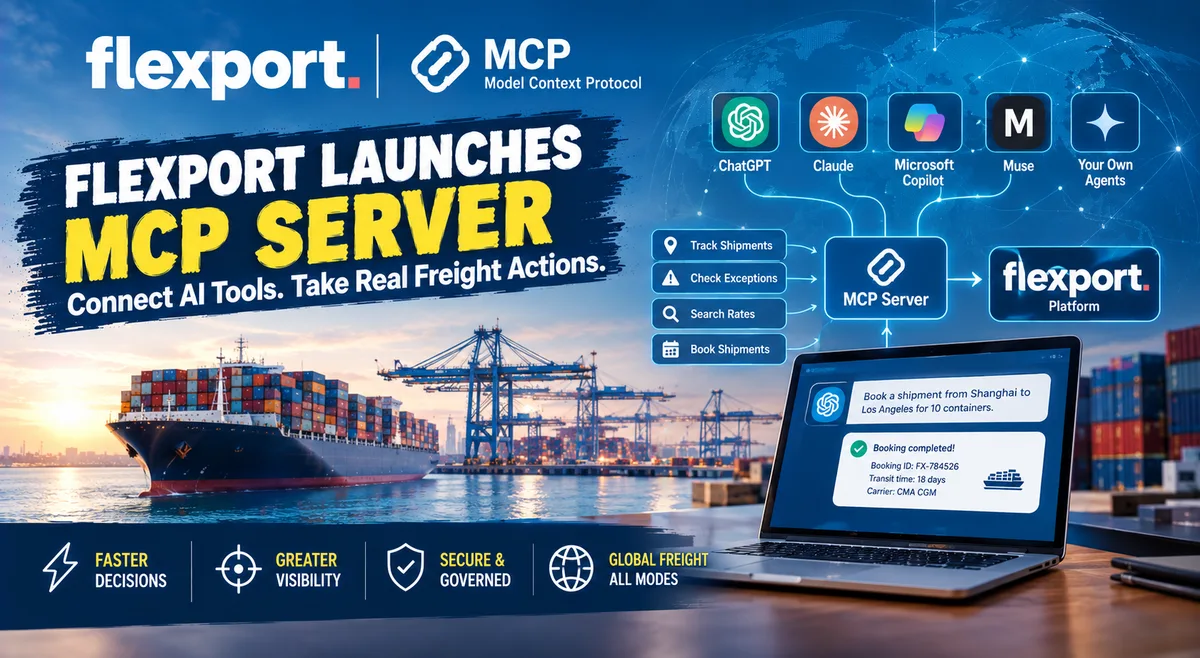
On September 29, 2026, digital freight forwarder Flexport announced its latest technology release, headlined by the Flexport Model Context Protocol (MCP) Server — a system that lets outside AI tools connect directly to Flexport's platform and carry out real freight actions on a company's behalf.
Businesses can now connect Flexport to Claude, ChatGPT, Microsoft Copilot, Muse, or their own internal agents and ask in plain language to track a shipment, surface every exception or customs hold, search rates on any lane, or book a shipment outright. An agent can submit cargo details, book against a company's negotiated rate, and return a booking ID and transit time — all without a person having to log into the Flexport platform at all.
Flexport founder and CEO Ryan Petersen framed the launch in sweeping terms: "The future of global logistics is autonomous: intelligent supply chains that see problems before they happen, calculate the fix, and execute it in a recurring self-improvement loop. This is a real first for both the AI industry and the logistics industry; we're giving AI tools the power to actually ship freight in the real world."
What Exactly Is an "MCP Server" — In Plain English?
Model Context Protocol, or MCP, is an open technical standard — originally introduced by Anthropic in late 2024 — that lets AI assistants connect to external software and take real actions inside it, rather than just answering questions about it.
Think of it like this: previously, if you wanted an AI chatbot to help you book freight, it could only talk about freight — it had no way to actually log into Flexport, enter your cargo details, and complete a real booking. An MCP server changes that. It gives the AI tool a direct, secure connection into Flexport's systems, so when you ask it in plain language to "book this shipment" or "where is my container," it can genuinely go and do that — not just describe how you might do it yourself.
This approach is becoming common across industries. Similar MCP servers have already been launched by smaller shipping platforms like Easyship, and by e-commerce platforms like Shopify, which opened its checkout process to AI agents in late September. Flexport's move brings this same capability to full-scale global freight forwarding — ocean, air, truck, and rail — at a significantly larger scale.
Who Actually Processes These AI Requests?
Requests coming through the MCP server do not go into a void — they land on Flexport's own internal fleet of AI agents, which the company says already autonomously processes 21 million tasks a year across its network. A quoting agent, for example, converts a rate request into a custom quote whether it arrives by email, through MCP, or directly inside the Flexport platform.
Importantly, Flexport built in specific guardrails. Every agent runs with guardrails thanks to a custom evaluation platform Flexport built to provide governance and trace all AI actions, keeping its experts in the loop wherever required to ensure compliance. Every exception routes to a human expert, and every action is traceable through Flexport's evaluation process.
This is a design pattern we have seen repeated across other recent AI logistics announcements — DHL's Trend Radar report and Descartes' Innovation Forum showcase both emphasized the same principle: automate the routine work, but keep humans in the loop for exceptions and judgment calls.
Flexport Atlas Goes Multimodal
Alongside the MCP server, Flexport significantly expanded Flexport Atlas, its live, free, dynamic world model for global trade, with three major upgrades:
- Multimodal routing — Atlas now adds air, rail, and barge options alongside ocean freight, allowing companies to view all shipping options between any two points on Earth, across every transport mode, in one place.
- An AI-curated disruption layer — the system automatically monitors a broad range of news sources to flag events at risk of impacting shipments, effectively giving shippers an early-warning system for emerging disruptions.
- Per-container emissions estimates — available on every ocean route, making it easier for companies to compare and choose lower-carbon shipping options.
New AI Tools for Customs Compliance
Given how frequently US tariff policy has shifted throughout 2026 — a theme we have tracked extensively, from the July Section 301 tariffs to the September Trump-Xi trade truce extension — Flexport also extended its customs technology suite.
Companies can now build bespoke audit rules around their own standard operating procedures, checked against every entry in real time and flagged to operations before filing. Flexport said these AI-powered compliance products have allowed it to achieve compliance accuracy rates almost 100 times better than the error rates of other customs brokerages — though this figure comes from the company itself and has not been independently verified.
Flexport also launched an AI classification tool that turns the process of assigning a 10-digit Harmonized Tariff Schedule (HTS) code into a guided conversation, surfacing a recommended code in seconds rather than hours, with linked US Customs and Border Protection rulings and real-time reasoning behind each suggestion. Users can then send that recommended code to one of Flexport's licensed customs brokers for human validation before actually filing it — again keeping a person in the loop for the final compliance decision.
The feature is currently live for US entries, with the Netherlands and the UK to follow.
AI Is Moving Into Physical Warehouses Too
Flexport's automation push is not confined to software. The company opened its first fully automated e-commerce fulfillment center outside Chicago, featuring more than 350 robots that bring inventory to workers, with exceptional inventory accuracy and double the efficiency of a traditional warehouse. Flexport also announced its first fulfillment centers in Canada and the UK earlier in September.
Separately, the company has been expanding its physical footprint rapidly — opening offices in eight new countries over the past year, including Tokyo, Paris, Antwerp, Phnom Penh, São Paulo, Manila, Melbourne, and Jakarta, bringing its total to 47 offices worldwide.
How Does This Fit Into the Broader AI-in-Logistics Trend?
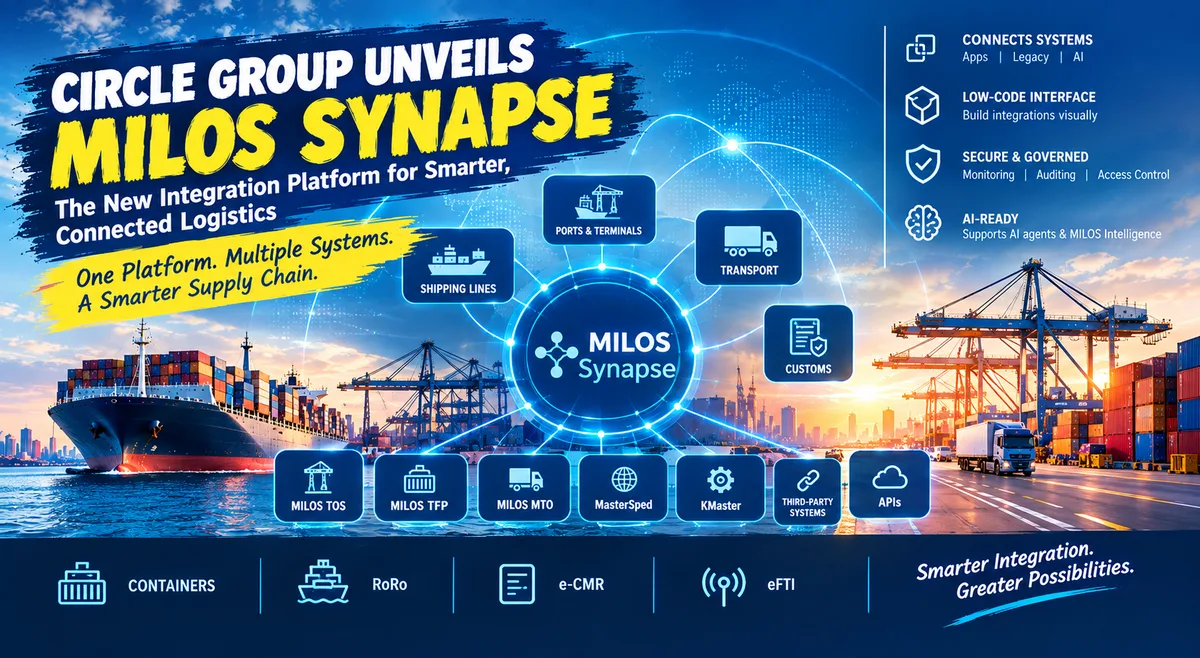
Flexport's launch lands in the middle of a wave of similar announcements we have covered in recent weeks. DHL's Logistics Trend Radar flagged "agentic AI" — systems that act autonomously rather than simply assist — as the industry's defining shift. CIRCLE Group unveiled its MILOS Synapse platform to connect port and logistics systems with AI agents in mind. Descartes previewed a suite of AI tools spanning tracking, fleet safety, and trade compliance ahead of its Innovation Forum.
Flexport's MCP server represents one of the most concrete, hands-on examples of this trend yet — rather than an AI tool that analyzes data or suggests actions, this is infrastructure that lets outside AI agents actually execute real freight bookings and payments, directly inside a live logistics platform used by more than 13,000 companies.
What Does This Mean for Shippers and Freight Forwarders?
- Freight booking may increasingly happen inside the AI tools you already use. Instead of logging into a separate freight platform, shippers using Flexport could soon manage bookings and tracking directly through Claude, ChatGPT, or Copilot — if their organization chooses to enable this connection.
- This could meaningfully speed up quoting and booking for routine shipments. For straightforward, repeat bookings against already-negotiated rates, the ability to complete a booking through a plain-language request — rather than navigating a platform manually — could save real time for logistics teams handling high shipment volumes.
- Human oversight remains built into the exception process. Flexport's design — routing every exception to a human expert and requiring broker validation before customs filings — suggests the company is positioning this as augmentation for routine tasks rather than full autonomy for complex or high-risk decisions.
- Multimodal visibility could simplify mode selection. With Atlas now covering ocean, air, rail, and barge options side by side, shippers comparing routing options across modes gain a single reference point rather than needing to check multiple separate systems.
- Competitive pressure on other forwarders will likely increase. As major digital forwarders like Flexport roll out AI-agent booking capabilities, shippers may begin expecting similar functionality from other providers — a dynamic worth watching if your organization works with multiple freight forwarders.
Key Takeaways — October 3, 2026
- Flexport launched its Model Context Protocol (MCP) Server on September 29, 2026, letting AI tools like Claude, ChatGPT, and Microsoft Copilot book, track, and quote freight directly.
- Requests route to Flexport's internal AI agent fleet, which already processes 21 million tasks a year.
- Every AI action includes built-in governance guardrails, with exceptions routed to human experts.
- Flexport Atlas expanded to cover air, rail, and barge routing alongside ocean freight, plus a new AI disruption-monitoring layer and per-container emissions data.
- New AI customs tools include bespoke real-time audit rules and an AI-assisted HTS code classification tool (US live now; Netherlands and UK to follow).
- Flexport opened its first fully automated fulfillment center outside Chicago, featuring 350+ robots.
- The company now operates 47 offices worldwide, having opened eight new country offices in the past year.
- This launch fits a broader industry pattern of AI moving from assistance into direct execution, following similar recent moves from DHL, CIRCLE Group, and Descartes.
Flexport's MCP launch marks one of the clearest, most concrete steps yet toward AI agents that don't just inform logistics decisions but actually execute them — booking real freight, at real negotiated rates, inside a platform already used by thousands of companies. For shippers and freight forwarders watching the broader shift toward agentic AI across the industry, this is a milestone worth tracking closely as adoption spreads.



Comments
No comments yet. Be the first to share your thoughts!