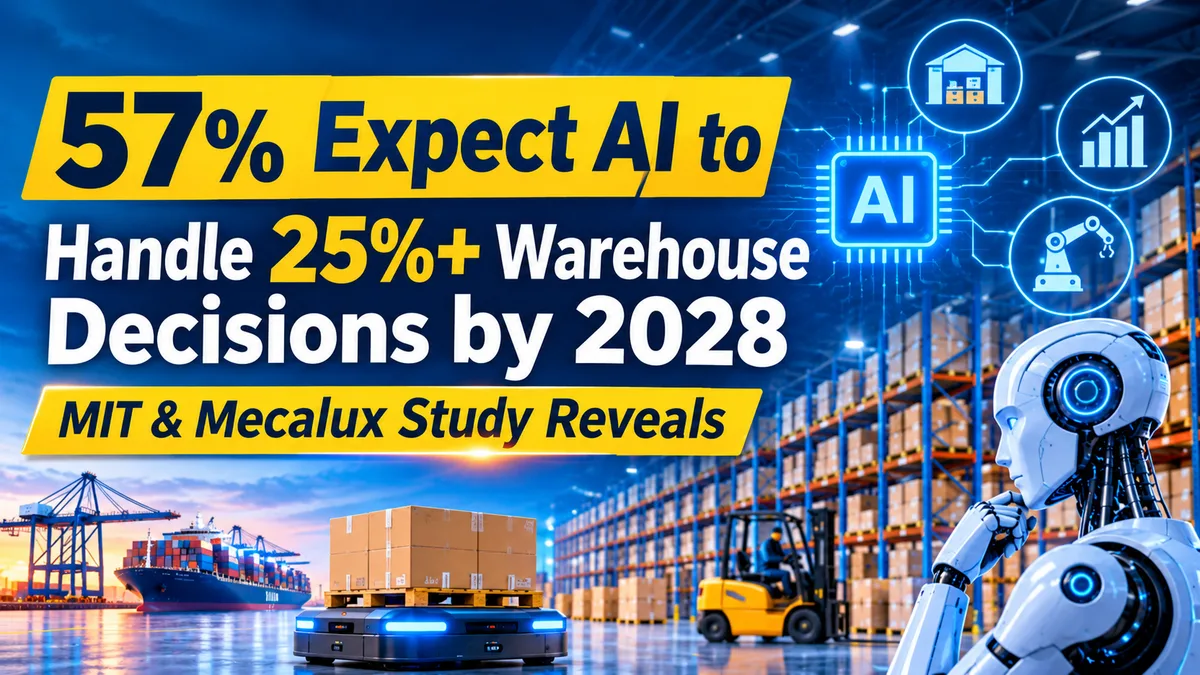
A major new study from the MIT Center for Transportation & Logistics (MIT CTL) and warehouse technology company Mecalux has found that artificial intelligence is rapidly moving from pilot programmes to real operational authority inside warehouses — with more than half of organisations expecting AI to autonomously execute over a quarter of their warehouse decisions by 2028.
The report, titled The State of Generative and Agentic AI in Warehouse Operations, draws on responses from 1,967 supply chain and warehousing professionals across 21 countries, making it one of the most comprehensive studies of AI adoption in logistics to date. Data was collected between August 14 and October 1, 2026.
Key Findings
Adoption of generative AI (GenAI) in warehouse operations is already widespread, with 61% of organisations reporting large-scale deployment or full integration. Agentic AI — systems that act and make decisions independently — is not far behind, with 56% at the same level. Despite this, most deployments are still young: approximately three in four have been at their current stage for less than a year.
The results, however, are already showing measurable impact. 87% of GenAI use cases and 81% of agentic AI use cases show at least moderate improvement in target metrics. Where companies could estimate the gain, the typical improvement was around 20% on their primary target metric.
AI Agents: Real Authority, Clear Limits
Companies are granting AI agents genuine decision-making power — but with guardrails. AI agents most commonly act without human approval on inventory movements (51% of agentic use cases) and data corrections (42%). Far fewer allow AI to make customer-facing commitments (22%) or financial decisions (12%).
The most common oversight model is "human-on-the-loop" — AI operates within defined parameters, while employees monitor and can intervene when needed. This model balances operational speed with human accountability.
Governance Is the Differentiator
The study identifies strong AI governance as the key factor separating companies achieving documented results from those that are not. Businesses with comprehensive, actively enforced AI governance are approximately twice as likely to report significant, documented improvements: 51% versus 26% for GenAI, and 46% versus 23% for agentic AI.
The single largest obstacle to scaling GenAI remains system integration. 40% of respondents cite legacy-system integration as the top constraint, and 54% say better connectivity with warehouse management and ERP systems would have the biggest impact on accelerating adoption.
Jobs Are Changing, Not Disappearing
On workforce impact, the findings challenge fears of mass automation-driven job losses. 56% of organisations say AI has primarily shifted employees toward higher-value tasks, while only 11% report reduced headcount. Meanwhile, 73% are upskilling warehouse-floor staff and 61% are creating entirely new technical roles.
What Comes Next
Looking ahead, 90% of companies expect to increase AI investment over the next two to three years, with 29% planning to raise investment by more than 25%. Among organisations that have fully integrated AI, 70% expect autonomous AI decision-making to exceed 25% of warehouse operations by 2028 — significantly higher than the 57% overall average.
For logistics and supply chain leaders, the report's practical guidance is clear: establish governance frameworks before scaling adoption, treat data quality and system integration as foundational rather than optional, and measure results rigorously over the first 12 to 24 months before expanding or discontinuing any application.
🔑 Key Takeaways — November 18, 2026
- 57% of companies expect AI to autonomously handle 25%+ of warehouse decisions by 2028 — rising to 70% among organisations already at full integration.
- AI is already deployed at scale — 61% of organisations report large-scale or full integration of GenAI; 56% for agentic AI.
- Results are real but often undocumented — 87% of GenAI use cases show improvement, but only 39% have formally quantified and documented the gains.
- AI agents make real decisions — within limits — most autonomous action happens in inventory and data, not customer-facing or financial decisions.
- Governance doubles your chances of success — companies with strong AI governance are twice as likely to report significant documented improvements.
- Legacy integration is the #1 blocker — 40% cite it as the top constraint; better ERP and WMS connectivity is the most requested improvement.
- Jobs are shifting, not vanishing — 56% say AI has moved staff to higher-value tasks; 73% are actively upskilling warehouse workers.
- 90% will increase AI investment in the next 2–3 years — the direction of travel across the industry is unambiguous.
Source date: November 18, 2026 | Published: November 18, 2026

Comments
No comments yet. Be the first to share your thoughts!