What Happened
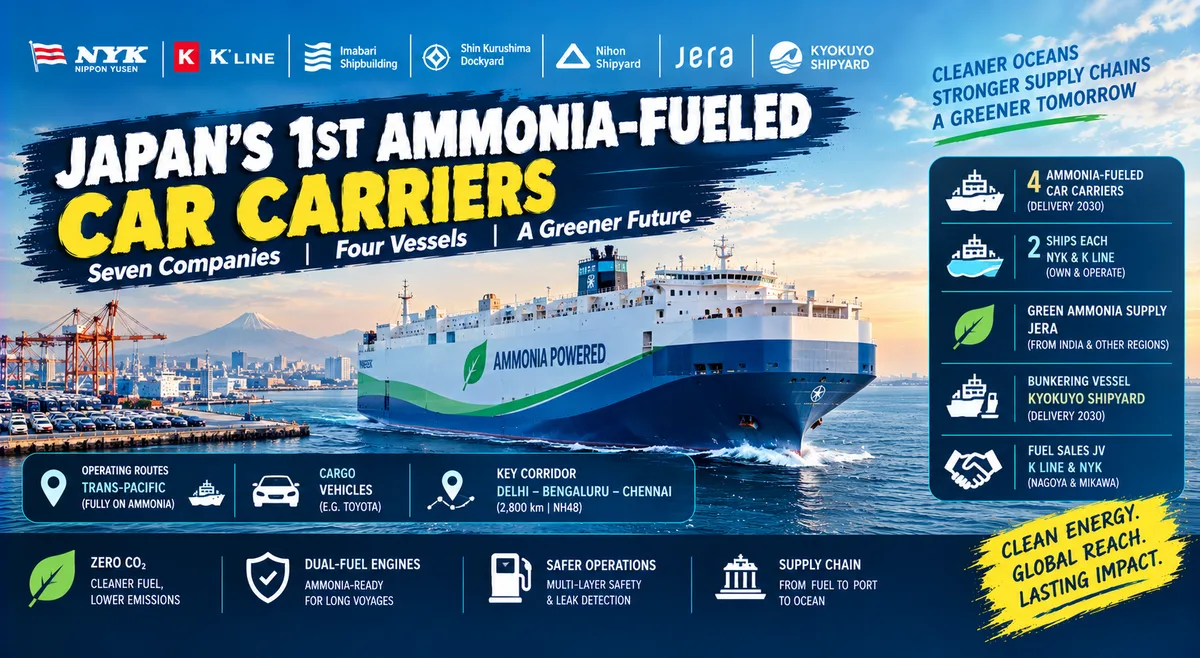
Seven Japanese companies agreed on Tuesday, October 27, 2026, to build four ammonia-fueled car carriers and develop an integrated ammonia fuel supply chain centered on Japan's Chubu region — one of the most ambitious commercial shipping projects yet involving the alternative fuel.
The consortium brings together shipowners Nippon Yusen Kabushiki Kaisha (NYK) and Kawasaki Kisen Kaisha (K Line); shipbuilders Imabari Shipbuilding, Shin Kurushima Dockyard and Nihon Shipyard; energy company JERA; and Kyokuyo Shipyard. All four vessels are scheduled for completion in 2030, and the partners describe them as Japan's first ammonia-fueled car carriers.
Who Builds What, and Who Carries the Cargo
NYK and K Line will each own and operate two of the four carriers. The ships are expected to carry completed vehicles for customers including Toyota Motor Corporation — giving the project a direct, named commercial anchor rather than relying purely on speculative future demand.
Shin Kurushima Dockyard will lead the basic design work, then collaborate with Imabari Shipbuilding and Nihon Shipyard on detailed design and construction. The capacity and precise dimensions of the carriers have not yet been disclosed.
Built for Full Trans-Pacific Voyages on Ammonia Alone
Each vessel will feature dual-fuel engines capable of burning ammonia, with fuel tanks sized specifically so the ships can complete trans-Pacific voyages on ammonia alone, without needing to switch fuels mid-route. That is a meaningful design commitment: it means the vessels are not simply equipped to use ammonia opportunistically, but built around it as a primary fuel for their longest typical routes.
Given ammonia's toxicity and corrosiveness, the carriers will incorporate multiple layers of safety protection, including leak prevention and detection systems, along with equipment to neutralize ammonia following any release.
Building the Fuel Supply Chain From Scratch
A new vessel fleet running on ammonia is only useful if the fuel is actually available where the ships need it — and this project treats that infrastructure build-out as equally important as the vessels themselves.
JERA will procure "green ammonia" — produced using renewable energy, with supplies expected from regions including India — and develop ship-loading facilities at its existing ammonia receiving terminal next to the Hekinan Thermal Power Station. Kyokuyo Shipyard will construct a dedicated ammonia bunkering vessel, also scheduled for completion in 2030, which will be owned and operated by NYK or one of its subsidiaries.
K Line and NYK will additionally establish a fuel sales joint venture, equally owned by the two companies, to handle ship-to-ship fuel supply to the car carriers, mainly at the ports of Nagoya and Mikawa.
This Builds on Earlier, Smaller-Scale Ammonia Trials
This announcement does not emerge in isolation — it follows a deliberate, staged progression of ammonia-fuel demonstrations in Japan. In 2025, NYK's ammonia-fueled tug Sakigake completed a three-month demonstration in Tokyo Bay, providing real operational data on handling the fuel at smaller scale. More recently, Japan completed its first ship-to-ship ammonia bunkering operation to an ammonia-fueled vessel in September 2026, led by NYK.
K Line and NYK are also separately working with Sumitomo on a newbuild ammonia bunkering vessel intended for Singapore — suggesting Japan's shipping majors are pursuing ammonia infrastructure on multiple fronts simultaneously, both domestically in the Chubu region and internationally at major bunkering hubs.
How This Fits the Broader Marine Fuel Transition
This project adds ammonia to a growing list of alternative marine fuels that major shipping lines are actively testing and deploying at commercial scale, alongside the LNG and ethanol bunkering milestones we've covered in Singapore this year. Unlike those fuels, ammonia produces no carbon dioxide at all when burned, making it an attractive long-term decarbonization pathway for shipping — though its toxicity and the current scarcity of green ammonia production capacity remain real practical constraints, which is precisely why this project treats fuel supply infrastructure as a first-order priority rather than an afterthought.
The car carrier segment specifically is a logical early adopter for alternative fuels: these vessels run fixed, predictable routes (often trans-Pacific or trans-oceanic) tied to major automakers' production and distribution schedules, making it easier to plan dedicated bunkering infrastructure around known traffic patterns than it would be for more variable container or bulk trades.
What This Means for Automakers, Shippers, and the Wider Industry
- Automakers planning long-term export logistics should watch this project's progress closely. With Toyota already named as a customer and delivery set for 2030, vehicle manufacturers using trans-Pacific car carrier services may want to evaluate how this new low-carbon capacity fits into their own sustainability and logistics planning over the next several years.
- This is a multi-year infrastructure build, not a near-term operational change. With vessels and the bunkering vessel both scheduled for 2030, shippers and logistics planners should treat this as a long-term signal about where marine fuel technology is heading, not something affecting current car-carrier capacity or rates.
- Green ammonia supply, including from India, could create new demand signals in that supply chain. Companies involved in renewable energy or ammonia production — particularly in India, named as an expected supply source — may see this as an early indicator of growing Japanese demand for green ammonia exports.
- Watch for similar consortium models elsewhere. The structure here — shipowners, shipbuilders, an energy company and a bunkering specialist all committing jointly to both vessels and fuel infrastructure simultaneously — could become a template other alternative-fuel shipping projects follow, given how directly it addresses the classic chicken-and-egg problem of new marine fuels (ships need fuel availability; fuel suppliers need committed vessel demand).
- This reinforces Japan's positioning as a serious player in ammonia shipping, alongside its LNG and hydrogen efforts. Companies with long-term supply chain strategies touching Japanese ports or Japanese shipping lines should factor this growing ammonia capability into their multi-year outlook on available low-carbon shipping options.
Key Takeaways
- Seven Japanese companies announced on October 27, 2026, a joint project to build four ammonia-fueled car carriers and an integrated ammonia fuel supply chain centered on Japan's Chubu region.
- NYK and K Line will each own and operate two vessels, with delivery scheduled for 2030; Toyota is named among the expected customers.
- Shipbuilders Imabari Shipbuilding, Shin Kurushima Dockyard and Nihon Shipyard will design and build the carriers.
- Each vessel will feature dual-fuel engines and sufficient ammonia tank capacity for full trans-Pacific voyages on ammonia alone.
- JERA will supply green ammonia and build ship-loading infrastructure at its Hekinan terminal; Kyokuyo Shipyard will build a dedicated bunkering vessel, also due in 2030.
- K Line and NYK will form a joint venture to handle ship-to-ship fuel sales, mainly at the ports of Nagoya and Mikawa.
- The project follows NYK's 2025 ammonia tug demonstration in Tokyo Bay and Japan's first ship-to-ship ammonia bunkering operation in September 2026.
- K Line and NYK are separately developing an ammonia bunkering vessel for Singapore with Sumitomo, extending their ammonia infrastructure ambitions internationally.
- Vessel capacity and dimensions have not yet been disclosed.

Comments
No comments yet. Be the first to share your thoughts!