What Happened
Saudi Arabia's air cargo sector is increasingly turning to artificial intelligence and automation to improve efficiency, reduce waiting times and strengthen connectivity across the logistics network, a senior SAL Logistics Services executive told Arab News in comments published October 24, 2026.
Simon Hassannia, chief digital officer at the firm, said the company is working to become a hub connecting airlines, customs authorities, transport companies and customers across the Kingdom. "Our digital strategy is simple: make SAL the digital hub connecting the Kingdom's air cargo ecosystem," Hassannia said.
The Numbers Behind the Digital Push
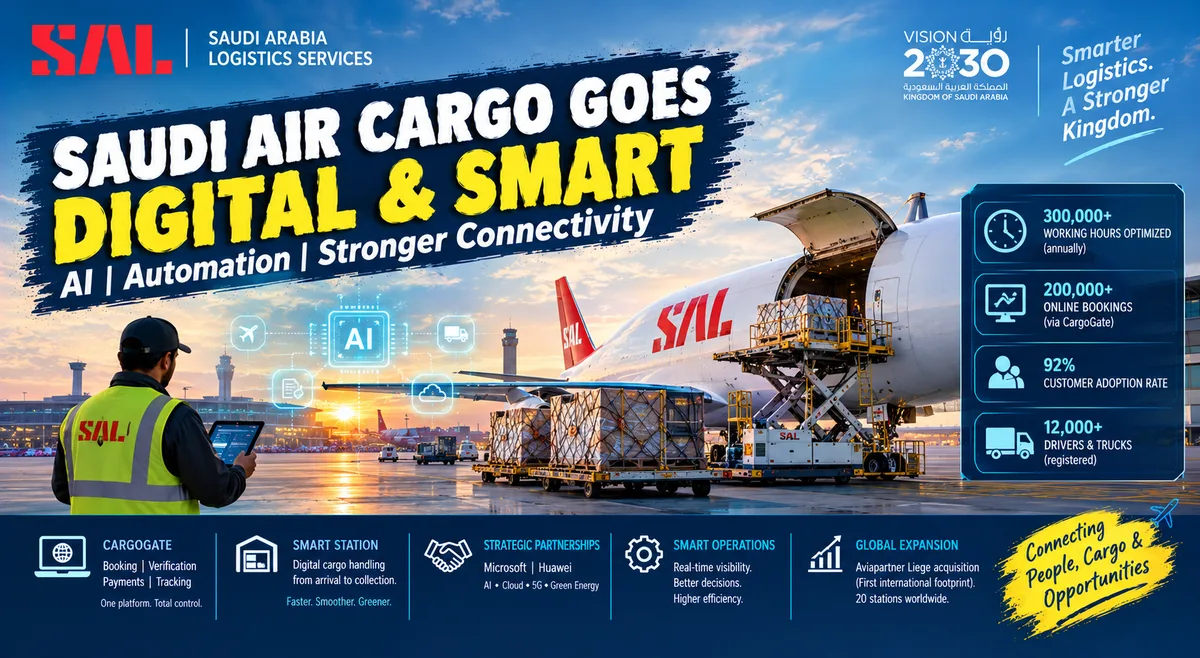
The company's wider digital transformation program has already optimized more than 300,000 working hours annually by eliminating repetitive tasks and manual processes — a substantial efficiency gain for an air cargo operation of SAL's scale.
Central to this strategy is CargoGate, SAL's digital gateway launched at LEAP 2026 in collaboration with Elm, which combines booking, online verification, payments and shipment information into a single platform. Since its introduction, CargoGate has processed more than 200,000 online bookings, achieved a 92% customer adoption rate, and registered more than 12,000 drivers and trucks combined.
Hassannia was explicit that adoption numbers alone don't tell the real story: "Going digital is not the success. Making the customer's life easier is the success," he said, emphasizing that the adoption rate reflects customers incorporating the platform into regular operations rather than simply completing transactions digitally.
How the Platform Actually Reduces Delays
CargoGate's practical value comes from giving SAL advance visibility into who is arriving and when. "When we know earlier who is coming, when they are coming and which shipment is needed, our operation can prepare the cargo in advance," Hassannia explained. This allows operational teams to prepare shipments before customers physically arrive, reducing unnecessary station visits, congestion and collection delays.
"The goal is clear: make cargo move faster by making information move faster," he added. He noted that advanced forecasting has improved visibility over expected delivery times, though he did not provide specific figures for waiting-time reductions.
Smart Station: Digitizing the Physical Cargo Flow
Beyond booking and verification, SAL's Smart Station program is digitizing cargo handling from aircraft arrival through to customer collection, using real-time shipment visibility, automated processes, paperless warehouse operations and advanced planning tools. Hassannia said the initiative is designed to reduce manual work for employees while giving customers greater visibility over shipments and collection schedules.
Major Technology Partnerships: Microsoft and Huawei
SAL is expanding its AI capabilities through two significant technology partnerships. The company signed a memorandum of understanding with Microsoft Arabia at LEAP 2026 to explore cooperation in AI, cloud technologies, data analytics and digital logistics solutions, covering potential applications in customer experience, operational efficiency and sustainability.
Separately, SAL has signed an MoU with Huawei Tech Investment Saudi Arabia to explore the use of 5G, AI, cloud computing and green energy technologies in logistics operations. That partnership includes potential digital solutions for logistics zones and the possibility of establishing an inventory and distribution hub supporting Huawei's own Saudi operations.
What's Next: The Smart Operations Platform
One of the company's next developments is its Smart Operations Platform, designed to bring operational information together and help teams identify priority tasks and determine where personnel and equipment are needed. The platform is built to answer three operational questions in real time: which tasks should take priority, where workers are needed, and where equipment should be deployed.
Hassannia was careful to frame this as augmentation rather than replacement of human decision-making — a distinction we've seen repeated across other recent AI-in-logistics announcements from companies like DHL and Descartes. "People remain responsible for the decisions. Technology helps them see the situation earlier and act faster," he said. He added that AI should improve the customer experience invisibly: "For the customer, the AI should be invisible. They should simply experience better service."
Connecting the Wider Ecosystem
Hassannia highlighted that Saudi Arabia's substantial investments in airports, logistics infrastructure and capacity have created opportunities to improve connectivity between existing assets — but that shipments often pass through multiple organizations, making timely information exchange essential even when individual operators perform efficiently.
SAL is strengthening real-time data connections with airlines, the General Authority of Civil Aviation, the Zakat, Tax and Customs Authority, and customers, aiming to replace manual coordination with automated data accuracy. "The next competitive advantage in logistics will be how well the whole ecosystem works together," Hassannia said, noting that customers ultimately care about when their cargo will be available, not which organization handles each stage of the shipment.
The Financial Backdrop
This digital expansion is happening alongside solid financial growth. SAL reported net profit of SR347.99 million ($92.8 million) in the first half of 2026, up 10.35% year-on-year, supported by a 23.12% increase in revenue to SR957.92 million.
The company has also been expanding its physical footprint. In August 2026, SAL completed its approximately SR120 million acquisition of Belgium-based Aviapartner Liege — its first operational expansion outside Saudi Arabia — bringing its network to 20 stations.
The Longer-Term Vision
Looking three to five years ahead, Hassannia expects air cargo technology to evolve from providing shipment visibility toward predicting operational requirements before aircraft even arrive, allowing operators to anticipate warehouse workloads, identify potential bottlenecks, and allocate personnel and equipment more proactively.
SAL's longer-term strategy focuses on integrating Smart Station, CargoGate and Smart Operations as Saudi Arabia advances its ambitions to become a global logistics hub under Vision 2030.
What This Means for Shippers and Freight Forwarders
- Faster, more predictable collection times at SAL-handled stations. If your operation moves cargo through SAL facilities in Saudi Arabia, CargoGate's advance-visibility model means booking and verifying shipments digitally ahead of arrival could meaningfully reduce the waiting time and congestion you experience on-site.
- Growing data integration with Saudi customs and aviation authorities could streamline compliance. As SAL builds real-time data connections with the General Authority of Civil Aviation and the Zakat, Tax and Customs Authority, freight forwarders handling Saudi-bound or outbound cargo may see fewer manual coordination delays over time.
- Watch for expanded AI capabilities from the Microsoft and Huawei partnerships. Both MoUs are still in the exploration phase rather than fully deployed — shippers with long-term Saudi logistics strategies should monitor how these partnerships translate into concrete operational tools over the coming months.
- SAL's European expansion signals broader ambitions beyond the Kingdom. With the Aviapartner Liege acquisition giving SAL its first operational presence outside Saudi Arabia, companies with Europe-Saudi cargo flows may want to evaluate whether SAL's expanding network offers new routing or service options.
- This fits the broader pattern of AI augmenting, not replacing, logistics decision-making. Consistent with recent moves from DHL, Descartes, and Flexport that we've covered, SAL's approach keeps humans responsible for final decisions while using AI to surface information faster — a reassurance for shippers concerned about over-automated, less accountable operations.
Key Takeaways
- SAL Logistics Services is positioning itself as the central digital hub for Saudi Arabia's air cargo ecosystem, per comments from CDO Simon Hassannia published October 24, 2026.
- SAL's digital transformation has optimized more than 300,000 working hours annually by eliminating repetitive manual tasks.
- CargoGate, launched at LEAP 2026 with Elm, has processed 200,000+ online bookings with a 92% customer adoption rate and 12,000+ registered drivers and trucks.
- The Smart Station program digitizes cargo handling from aircraft arrival through customer collection.
- SAL signed MoUs with both Microsoft Arabia and Huawei Tech Investment Saudi Arabia to explore AI, cloud, 5G and green energy applications.
- A new Smart Operations Platform is in development to help allocate tasks, personnel and equipment in real time — with humans retaining final decision authority.
- SAL reported SR347.99 million ($92.8 million) net profit in H1 2026, up 10.35% year-on-year, with revenue up 23.12% to SR957.92 million.
- The company's August 2026 acquisition of Aviapartner Liege marked its first operational expansion outside Saudi Arabia, bringing its network to 20 stations.
- SAL's strategy aligns with Saudi Arabia's Vision 2030 ambitions to become a global logistics hub.


Comments
No comments yet. Be the first to share your thoughts!