
What Happened
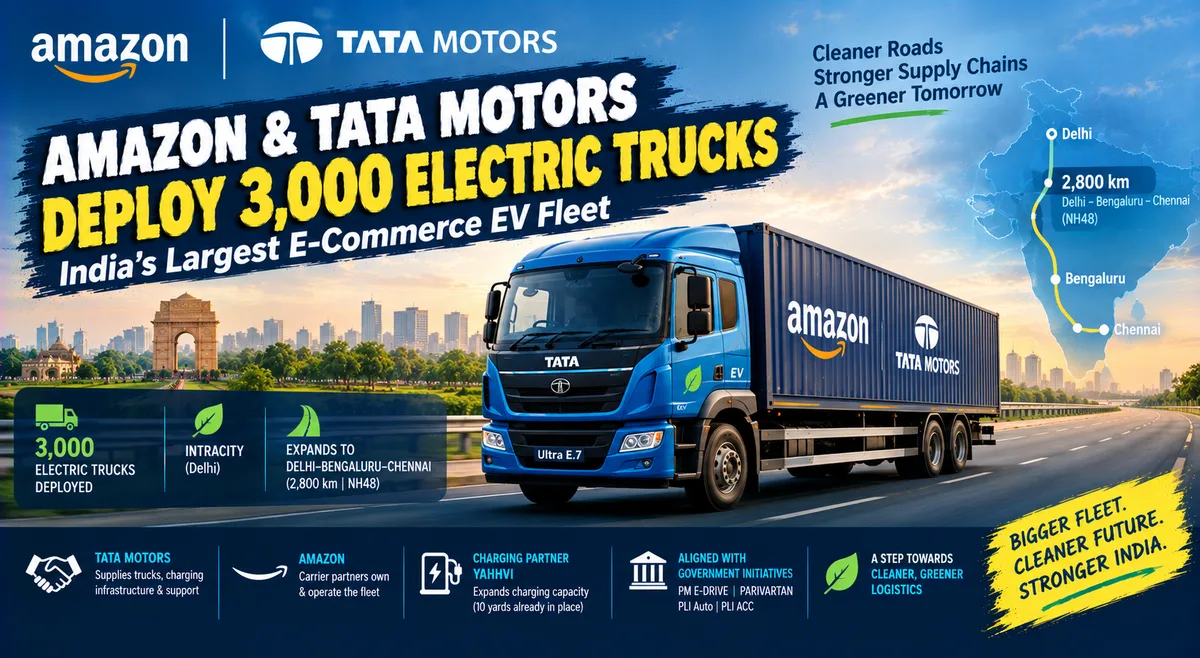
Amazon and Tata Motors announced a collaboration on October 27, 2026 to deploy 3,000 electric trucks across Amazon's transportation network in India — which the companies describe as the largest electric-truck deployment by an e-commerce company in the country. The first batch of Tata electric trucks was flagged off at a launch event in Delhi.
Under the arrangement, Tata Motors will supply the electric trucks, while Amazon's carrier partners will own and operate them — a structure that keeps the actual fleet ownership with Amazon's existing logistics partner network rather than Amazon itself, consistent with how much of its middle-mile trucking already operates in India.
Where the Trucks Will Operate
The deployment begins with intracity operations in Delhi before expanding to major freight corridors, with the companies specifically targeting the 2,800-kilometre Delhi-Bengaluru-Chennai highway corridor along National Highway 48. This takes Amazon's fleet electrification beyond last-mile delivery — where electric two- and three-wheelers are already common in Indian e-commerce — into the middle-mile segment: the longer-haul trucking that moves goods between fulfillment centres and across cities.
Abhinav Singh, Vice President of Operations at Amazon for APAC, Middle East, Africa and Turkey, said: "By combining our strengths, we aim to accelerate the deployment of electric trucks across more routes, starting with intracity operations and expanding to India's major freight corridors."
Which Trucks, and What Support Comes With Them
The deployment uses the Tata Ultra E.7, an electric truck model aimed at light and medium-duty freight work. Rajesh Kaul, Vice President and Business Head for Trucks at Tata Motors, framed the deal as a sign of the market's maturity: "Electric trucking in India is moving beyond the pilot stage and entering a phase of wider adoption." He added that Tata Motors is "going beyond vehicle deployment to provide charging infrastructure, servicing and operational support," aimed at demonstrating how electric trucks can be integrated into large-scale logistics operations.
Supporting infrastructure is already partly in place: charging partner Yahhvi will help expand charging capacity, building on 10 charging yards it has already developed for Amazon in India — meaning this is not a cold start requiring charging infrastructure to be built from zero before operations can begin.
Government Policy Context
The deployment was framed explicitly within India's broader electric mobility push. Minister H.D. Kumaraswamy, who attended the flag-off, said the collaboration shows "sustained demand from a nationwide logistics network, met by electric trucks manufactured in India," linking it to India's longer-term Viksit Bharat 2047 development goals. He noted the government will continue supporting the transition through schemes including PM E-DRIVE (the PM Electric Drive Revolution in Innovative Vehicle Enhancement programme), PARIVARTAN, PLI Auto and PLI ACC.
The deployment also builds on earlier groundwork: Amazon has previously run Laneshift, a pilot programme with C40 Cities that tested electric trucks on the Bengaluru-Chennai corridor and contributed to what the company describes as India's first evidence-based roadmap for zero-exhaust-emission trucks.
What This Means for Tata Motors Commercially
For Tata Motors, this deal provides a significant, large-scale reference deployment for its electric-truck platform at a moment when the company is actively pushing to expand its battery-electric commercial vehicle lineup. Tata Motors recorded 26% year-on-year growth in commercial-vehicle wholesales in the June 2026 quarter and has logged more than 3,400 electric-vehicle orders across segments. A fleet-scale commitment from a logistics operator the size of Amazon gives the company a visible proof point in a vehicle category where achieving meaningful scale has historically been difficult.
How This Compares to Other Indian E-Commerce Electrification Efforts
This announcement adds Amazon to a broader pattern of large Indian e-commerce logistics networks committing to electric fleets. Walmart-owned Flipkart has separately committed to deploying more than 25,000 electric vehicles across its supply chain by 2030, aiming for a complete transition to electric mobility within a decade, working with EV makers including Hero Electric, Mahindra Electric and Piaggio for its first- and last-mile delivery fleets.
Amazon's own electrification push in India has also previously extended to three-wheelers through a partnership with Mahindra Electric. Taken together, these moves suggest Indian e-commerce logistics is moving well past pilot-stage electric vehicle trials into fleet-level commitments spanning the full range of vehicle types — from delivery two- and three-wheelers through to mid-size freight trucks.
This Indian electric truck push also connects to a wider global trend we've tracked this year — including the ZET SCALE alliance's record 2,500-truck US electric truck order involving Microsoft, PepsiCo, Ikea and Red Bull — pointing to electric freight trucking moving from isolated pilots to coordinated, fleet-scale commitments across multiple major logistics markets simultaneously.
What This Means for Logistics Operators and Freight Partners in India
- Expect Amazon's carrier-partner network to face new operational expectations around EV integration. Since Amazon's existing carrier partners will own and operate the new electric trucks rather than Amazon itself, logistics companies working with Amazon in India should prepare for conversations about electric vehicle operations, charging logistics, and driver training if they haven't already.
- Watch the Delhi-Bengaluru-Chennai corridor for early signals on highway-scale EV trucking viability. As one of the first major freight corridors targeted for expansion beyond intracity operations, this 2,800-km route will be an important test case for whether electric trucks can reliably handle India's longer-haul freight routes, not just city deliveries.
- Charging infrastructure partners may see expanded opportunity. With Yahhvi already building out charging yards for Amazon and more capacity planned, logistics operators and fleet managers in India may want to track how this charging network develops, since shared or adjacent infrastructure could become available to other fleet operators over time.
- This reinforces India's EV policy momentum as a genuine commercial driver, not just government mandate. With both the minister's comments and the scale of Amazon's commercial commitment aligning closely with government schemes like PM E-DRIVE, companies evaluating their own fleet electrification timelines in India now have a clearer signal that policy support and major-corporate buy-in are moving in the same direction simultaneously.
- Tata Motors' expanded EV truck servicing network could benefit other fleet operators too. As Tata Motors builds out charging, servicing and operational support infrastructure specifically to support this deployment, other companies operating or considering Tata electric trucks may indirectly benefit from the expanded support network this partnership is driving.
Key Takeaways
- Amazon and Tata Motors announced a collaboration on October 27, 2026 to deploy 3,000 electric trucks across Amazon's India logistics network — the largest such deployment by an e-commerce company in the country.
- The first batch of Tata Ultra E.7 electric trucks was flagged off in Delhi, with operations starting intracity before expanding to the 2,800-km Delhi-Bengaluru-Chennai corridor along NH48.
- Tata Motors will supply the trucks and provide charging infrastructure, servicing and operational support; Amazon's carrier partners will own and operate the vehicles.
- Charging partner Yahhvi will expand capacity, building on 10 charging yards already developed for Amazon in India.
- The deployment is explicitly linked to government EV schemes including PM E-DRIVE, PARIVARTAN, PLI Auto and PLI ACC.
- It builds on Amazon's earlier Laneshift pilot programme with C40 Cities on the Bengaluru-Chennai corridor.
- Tata Motors recorded 26% year-on-year growth in commercial-vehicle wholesales in the June 2026 quarter, with 3,400+ EV orders across segments.
- This fits a broader pattern of Indian e-commerce fleet electrification, alongside Flipkart's separate commitment to deploy 25,000+ EVs by 2030, and connects to the global shift toward fleet-scale electric trucking we've tracked with the ZET SCALE alliance in the US.



Comments
No comments yet. Be the first to share your thoughts!