What Happened
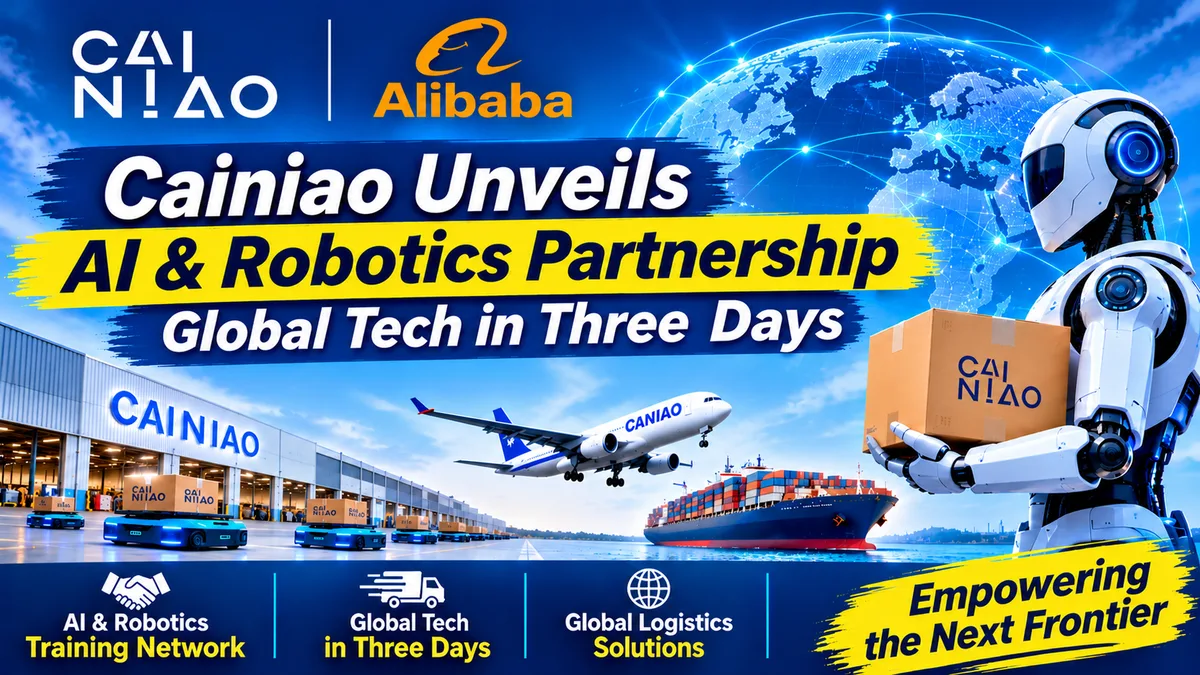
Cainiao, the e-commerce logistics and technology arm of Alibaba, launched a new industry partnership initiative for AI and embodied intelligence on November 5, 2026, in Hong Kong, opening its global warehouse network to partners to build what the company describes as the world's largest logistics real-scene training cluster for AI and embodied intelligence.
"AI has become a new engine of productivity," said William Xiong, CEO of Cainiao Global. "Over the past decade, Cainiao has built an open, efficient and sustainable smart logistics network. We want to extend the global logistics capabilities we have built for e-commerce into AI and embodied intelligence."
Two Separate but Connected Announcements
It's worth separating out exactly what was announced, because this covers two distinct initiatives addressing two different problems facing the AI and robotics industry.
First, a training partnership: Cainiao is opening its existing global logistics network — which handles high volumes of multi-SKU shipments across varied goods and workflows — to robotics and AI partners as a physical training environment. Rather than developing and testing embodied AI systems only in controlled laboratory settings, companies can now access Cainiao's dozens of real-world logistics operating scenarios for technology training, validation and deployment.
Second, a logistics service: Alongside the training partnership, Cainiao introduced "Global Tech in Three Days," a supply chain service specifically built for AI computing and robotics companies. This addresses a different challenge entirely — not where to test robots, but how to physically move AI hardware, prototypes and components across international borders efficiently.
How the Global Tech in Three Days Service Works
The new service is structured around three tiers:
- Global Express — for smaller, faster shipments
- Global Air Freight — built specifically for large, high-value and overweight shipments such as AI computing equipment, control systems and core modules
- Global Warehouse Network — supporting regional stocking, multi-country warehousing and local delivery
"It supports flexible multimodal transportation options to meet the needs of both trial shipments and scaled delivery," Cainiao said. The service is designed to cover the full technology development cycle — from prototype testing and product validation through to scaled delivery and overseas operations — and includes customs support, forward and reverse logistics, high-value cargo insurance, forward warehousing and spare-parts management.
This directly addresses a practical pain point that AI hardware makers and robotics companies face when expanding internationally: the challenge isn't just selling products, but managing testing shipments, spare parts, returns, customs processes and local storage for equipment that is often large, expensive, and sensitive to handling.
What's Genuinely New Versus What's Still Vague
It is worth being precise about the limits of this announcement, since several details remain unconfirmed. Cainiao said it has signed initial cooperation agreements with companies in AI computing and embodied intelligence, but did not name them or disclose terms. The company also did not describe the service name as a literal three-day delivery guarantee, nor did it provide pricing, specific coverage details, or service-level terms. No date was set for when partners can actually begin using the logistics sites for training purposes.
Why This Fits a Broader Pattern
This launch connects directly to the AI infrastructure logistics boom we've tracked extensively throughout 2026 — from air cargo's broader shift toward AI and semiconductor freight, to Kuehne+Nagel's air logistics division crediting cloud infrastructure and semiconductor demand for an 84% profit jump this quarter, to GXO's new Malaysia hub already serving a semiconductor equipment supplier. Cainiao's move represents a major Chinese logistics player building dedicated infrastructure specifically for this category, rather than treating AI hardware shipments as a subset of general high-value cargo.
Cainiao also pointed to its own internal AI and robotics investment, saying the technology has already improved speed, efficiency and cost across merchant interactions, exception handling, security inspection, warehouse allocation, customs classification and global operations. Looking ahead, the company said it is investing in AI technology covering core operations including warehouse picking, intelligent navigation and delivery, high-altitude inspection, security operations, aviation logistics and auto parts management. Cainiao separately forecast that physical AI could produce efficiency gains of 10 to 50 times over the coming decade.
What This Means for AI Hardware Companies and Robotics Firms
- A new dedicated logistics pathway exists for AI hardware expansion, though details are still forming. Companies developing AI computing equipment or embodied robotics that need to move prototypes and scaled production internationally now have a named service option to evaluate — but should request specific pricing, timelines and coverage terms directly from Cainiao before committing, given the limited public detail so far.
- Access to real-world training environments could reduce development timelines. For robotics companies currently limited to laboratory testing, Cainiao's offer of real logistics operating scenarios — handling actual, varied multi-SKU shipments — could provide meaningfully more realistic validation conditions than simulated environments.
- This adds another major logistics provider to the competitive AI hardware shipping space. With Kuehne+Nagel, GXO, and now Cainiao all building explicit AI/semiconductor-focused logistics capabilities this year, companies in this sector gain more provider options — and shippers more broadly should expect continued competition and specialization in this niche.
- Watch for named partner companies and concrete service terms in coming months. Since Cainiao has not disclosed which companies signed initial cooperation agreements or published pricing and service-level details, this remains an early-stage initiative — worth monitoring for further announcements before treating it as a fully operational offering.
- This reinforces the broader AI air cargo capacity trend. With Global Air Freight specifically positioned for large, high-value AI equipment, this adds to the competitive pressure on air cargo capacity for this category that we've tracked in recent Dimerco and other freight reports — particularly on routes already tight with chip and server exports.
Key Takeaways
- Cainiao launched a new AI and embodied-intelligence industry partnership on November 5, 2026, opening its global warehouse network as a real-world robotics training environment.
- Alongside it, the company introduced "Global Tech in Three Days," a supply chain service for AI computing and robotics shipments.
- The service has three tiers: Global Express, Global Air Freight (for large, high-value AI equipment), and Global Warehouse Network.
- Services include customs support, forward and reverse logistics, high-value cargo insurance, and spare-parts management.
- Cainiao has signed initial cooperation agreements with AI computing and embodied intelligence companies but has not named them or disclosed pricing or terms.
- CEO William Xiong said the company wants to extend its e-commerce logistics capabilities into AI and embodied intelligence.
- This fits a broader 2026 trend of major logistics providers — including Kuehne+Nagel and GXO — building dedicated AI and semiconductor-focused shipping capabilities.
- Cainiao forecasts physical AI could deliver efficiency gains of 10 to 50 times over the coming decade.

Comments
No comments yet. Be the first to share your thoughts!