What Was Just Announced?
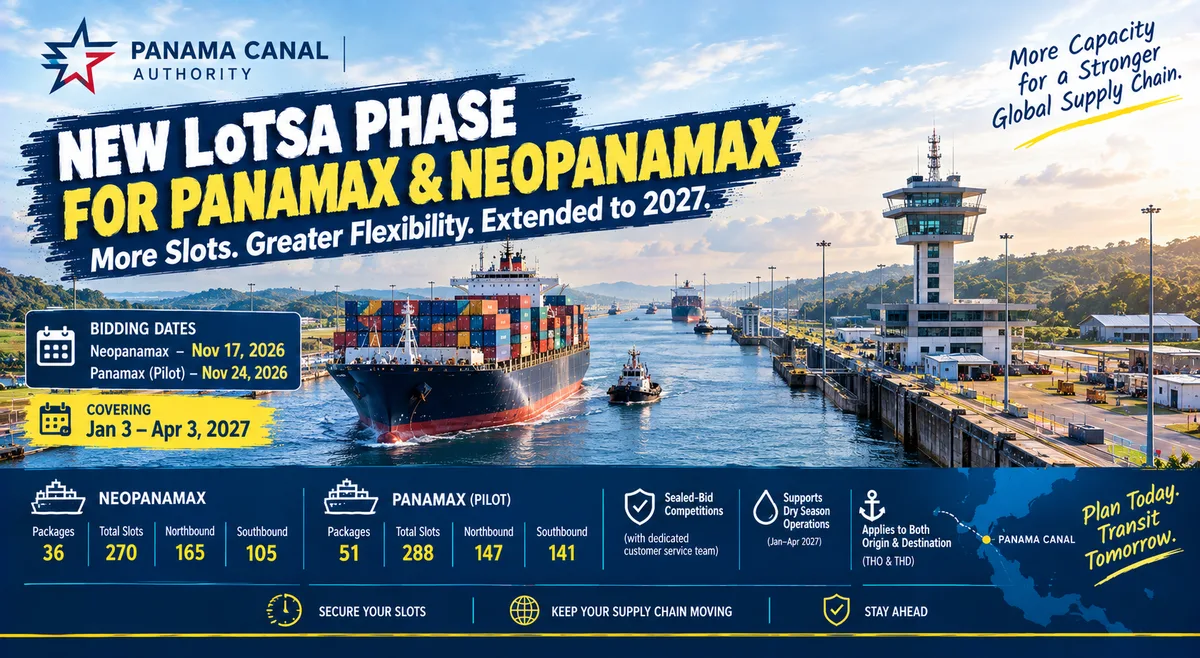
The Panama Canal announced a new phase of its Long-term Slot Allocation (LoTSA) programme on October 5, 2026, covering the period from January 3rd to April 3rd, 2027. For the first time, the programme reaches both sets of locks: LoTSA Neopanamax continues the programme customers already know, while a new LoTSA Panamax Pilot Programme extends the same opportunity to customers transiting the smaller Panamax locks.
This is a significant expansion. Until now, long-term advance booking certainty through the Panama Canal Authority's (ACP) sealed-bid system has only been available to operators of the larger Neopanamax vessels. Smaller Panamax-class ships — still a major part of global bulk, container, and tanker traffic — have had to rely entirely on shorter-term booking windows and daily auctions.
How Will the Bidding Work?
Both programmes will be offered through sealed-bid competitions, meaning customers submit confidential bids without knowing what competitors are offering, and the canal allocates slots to the winning bids. This will be backed by a specialised customer service team dedicated to providing timely support and a smooth experience for participants.
The bidding dates are set as follows:
- LoTSA Neopanamax auction: November 17, 2026
- LoTSA Panamax Pilot Programme auction: November 24, 2026
How Many Slots Are Actually Available?
Here is the breakdown of capacity on offer across both lock systems:
| Lock System | Packages | Total Slots | Northbound | Southbound |
|---|---|---|---|---|
| Neopanamax | 36 | 270 | 165 | 105 |
| Panamax (new pilot) | 51 | 288 | 147 | 141 |
The Panamax pilot programme is equivalent to roughly three daily transit slots throughout the programme period, under a single level of flexibility. The ACP confirmed that remaining transit capacity beyond the LoTSA allocations is expected to continue being offered through the regular booking system and standard auctions.
Why Is This Timing Significant? The Dry Season Context
The ACP was explicit about why this expansion matters right now: the extended programme is particularly relevant in the current operational context, as the Panama Canal adopts measures to ensure the sustainability of operations in the face of weather conditions affecting water availability.
This is a direct reference to the recurring dry-season water challenges that have disrupted canal operations in recent years. The canal runs entirely on freshwater drawn from Gatun Lake, and when rainfall is low, the authority has historically been forced to cut daily transit slots and tighten vessel draft limits — exactly the kind of disruption we have tracked in our previous coverage of El Niño-driven Panama Canal restrictions.
By offering long-term, pre-booked certainty even during the historically challenging January-to-April dry season window, the ACP is giving shipping lines a way to lock in capacity now, rather than competing for scarce slots if water levels force new restrictions later.
How Did We Get Here? The LoTSA Programme's History
This expansion builds on a system the ACP has been refining since it was first introduced in 2024, when the authority began offering blocks of future reservations to customers seeking greater scheduling certainty after the severe 2023-24 drought.
The programme has evolved considerably since then. Earlier iterations required 12-month commitments, which the ACP later shortened to six months to help shipping companies better align their transit planning with market conditions, seasonal fluctuations and fleet deployment strategies. The system also removed a restriction that had limited customers to one booking slot per day through the Neopanamax locks.
Demand for certainty on this system has been intense. Splash reported in May 2026 that Neopanamax auction prices had surged to as much as $4 million as Middle East disruption redirected more US energy cargoes through Panama — illustrating just how valuable guaranteed transit slots have become during periods of regional shipping disruption elsewhere in the world.
What Happened With Restrictions Earlier This Year?
The canal's water-related challenges were not merely theoretical this year. The ACP subsequently cut daily booking capacity to 32 ships and tightened draft limits as rainfall disappointed, before recent rains allowed some restrictions to be eased again. This pattern of restriction-then-relief underscores exactly why long-term booking certainty has become such a valuable commodity for shipping lines planning months ahead.
What Does This Mean for Shippers and Carriers?
- Panamax operators gain a new planning tool they have never had before. If your fleet or chartered vessels use the Panamax locks, this is the first opportunity to secure guaranteed transit slots months in advance rather than relying entirely on short-term bookings and daily auctions.
- Mark your calendar for the November auction dates. Neopanamax bidding is November 17; Panamax pilot bidding is November 24. Companies wanting to participate need to prepare their bid strategy and documentation well ahead of these dates.
- This covers the dry season window specifically. The January 3 to April 3, 2027 period falls within the canal's historically higher-risk dry season for water availability. Securing a slot through this programme provides a hedge against potential future restrictions during that window.
- Expect continued competitive bidding, especially if disruption elsewhere persists. Given that Neopanamax auction prices reportedly reached $4 million earlier this year amid Middle East-driven rerouting, demand for guaranteed Panama Canal capacity may remain elevated if disruptions in other global shipping chokepoints continue.
- Standard booking and auction capacity remains available for non-LoTSA transits. If your operation does not participate in or win a LoTSA slot, remember that the regular booking system and standard auctions continue to operate alongside this programme for remaining capacity.
Key Takeaways — October 6, 2026
- The Panama Canal Authority announced a new LoTSA phase on October 5, 2026, covering January 3 to April 3, 2027.
- For the first time, long-term slot booking extends to the Panamax locks via a new pilot programme, alongside the existing Neopanamax system.
- Neopanamax auction: 36 packages, 270 slots (165 northbound, 105 southbound) — bidding November 17, 2026.
- Panamax pilot auction: 51 packages, 288 slots (147 northbound, 141 southbound) — bidding November 24, 2026.
- Both allocated via sealed-bid competitions, supported by a dedicated customer service team.
- The expansion is explicitly tied to ensuring operational sustainability amid dry-season water availability concerns.
- This builds on the LoTSA system introduced in 2024 after the severe 2023-24 drought, which has since been adjusted multiple times for flexibility.
- Neopanamax auction prices reportedly reached $4 million earlier in 2026 amid rerouted Middle East energy cargo demand.
- Remaining capacity outside LoTSA allocations continues through standard booking and regular auctions.
This marks a meaningful evolution in how the Panama Canal manages scarce transit capacity — extending the scheduling certainty previously reserved for the largest vessels down to the Panamax fleet for the first time. For shippers and carriers planning operations through the canal's traditionally challenging dry season, the November auction dates are now a key date to watch.


Comments
No comments yet. Be the first to share your thoughts!