
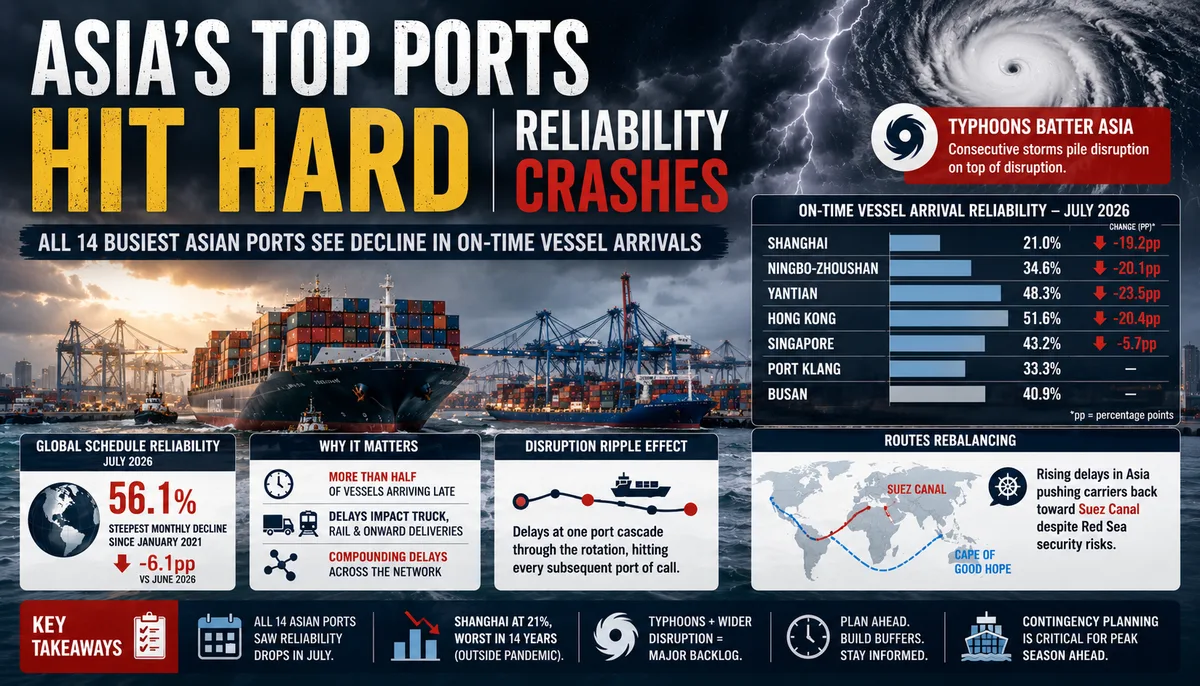
All 14 of Asia's busiest container ports have seen a decline in on-time vessel arrivals, according to new data from maritime analyst Sea-Intelligence. The drop has been driven primarily by extreme weather events, including a string of typhoons, layered on top of ongoing wider supply chain disruption across the region. The scale of the decline is significant enough that analysts are drawing direct comparisons to the darkest months of pandemic-era congestion.
Shanghai and Ningbo hit hardest
Shanghai and Ningbo-Zhoushan, the world's two largest container ports, have both been battered by consecutive typhoons this year, most recently Typhoon Saudel last week, which caused severe delays at both facilities. This is not an isolated weather event but part of a pattern, with China's eastern seaboard absorbing repeated storm systems throughout the summer that have each added fresh backlog on top of the last.
Ningbo, which became the world's second-largest container port in the first half of 2026, saw its reliability fall by 20.1 percentage points to just 34.6% in July, meaning roughly two out of every three vessels calling at the port arrived behind schedule. Shanghai's numbers were described by Sea-Intelligence as "particularly alarming," with a 19.2 percentage point drop leaving only 21% of vessels arriving on time in July. Sea-Intelligence CEO Alan Murphy said schedule reliability in Shanghai has never dropped this low in 14 years of recorded data, outside of extreme pandemic-era supply chain disruptions, underscoring just how unusual the current period is even by the standards of an industry accustomed to disruption.
Other major hubs also slipping
The decline was not confined to China's two largest gateways. Yantian in South China saw the steepest drop among all top Asian ports, plunging 23.5 percentage points to 48.3% reliability in July. Hong Kong fell 20.4 percentage points to 51.6%, while Singapore, the world's largest transhipment hub, dropped 5.7 percentage points to sit at just 43.2% reliability, a smaller percentage-point fall but still a historically weak result for one of the most tightly run ports in the world.
Elsewhere in the region, Port Klang recorded 33.3% reliability and Busan 40.9%, showing that the disruption has spread well beyond the ports directly hit by typhoons. Because container shipping networks are so tightly interconnected, delays at one hub port tend to ripple outward to nearby transhipment and feeder ports as vessels bunch up, miss connecting sailings, and are forced to skip scheduled calls to catch up.
Why it matters for the industry
The growth in delays at major Asian ports has pushed global container schedule reliability down to 56.1%, a 6.1 percentage point drop that marks the steepest single-month decline since January 2021, near the height of the pandemic. In practical terms, this means fewer than six in ten container vessels worldwide are now arriving at port when originally scheduled, a reliability level that creates real planning headaches for shippers, freight forwarders, and the trucking and rail networks waiting to move cargo onward from port.
Murphy warned that with the region's busiest ports now operating with more than half of incoming vessels delayed, the backlog will naturally cascade through the maritime network, likely triggering a fresh wave of delays on major head-haul trade lanes in the coming months. Because vessels operate on fixed rotational schedules, a delay at one port in the rotation tends to compound at every subsequent port of call, meaning the full effect of this month's disruption may not be felt until vessels reach destinations in Europe and North America several weeks from now.
How the disruption is reshaping routes
The congestion is also reshaping routing decisions across the industry. Rising delays in Asia are pushing carriers to end their two-and-a-half-year rerouting of Asia-Europe services via the Cape of Good Hope and return to the Suez Canal and Red Sea, despite the ongoing security threat from Houthi forces in Yemen and their continued blockade of Saudi Arabian ports. This marks a notable shift in carrier risk calculus: after years of avoiding the shorter Suez route in favor of the safer but far longer Cape of Good Hope detour, port-side congestion in Asia is now becoming enough of a drag on schedule reliability that some carriers are willing to reconsider Red Sea risk in order to claw back transit time elsewhere.
Key takeaways
- All 14 of Asia's busiest container ports recorded declining on-time vessel arrivals in July.
- Shanghai's on-time rate fell to just 21%, its worst in 14 years of recorded data.
- Ningbo, Yantian, and Hong Kong all posted reliability drops of 20 percentage points or more.
- Global container schedule reliability dropped to 56.1%, the steepest monthly decline since January 2021.
- Analysts warn the backlog is likely to cascade into further delays on major trade lanes in the coming months.
- Port congestion in Asia is pushing some carriers back toward the Suez Canal route despite ongoing Red Sea security risks.
For freight forwarders and shippers, this level of disruption at Asia's core hub ports means booking earlier, building in schedule buffers, and staying closely tied to vessel tracking data will be critical heading into the final stretch of peak season. With reliability at multi-year lows across nearly every major Asian gateway simultaneously, contingency planning is no longer optional for anyone moving time-sensitive cargo through the region.


Comments
No comments yet. Be the first to share your thoughts!