
What Happened This Week — September 3, 2026
Global container shipping rates held steady overall this week — but that headline number hides a much bigger story happening underneath it.
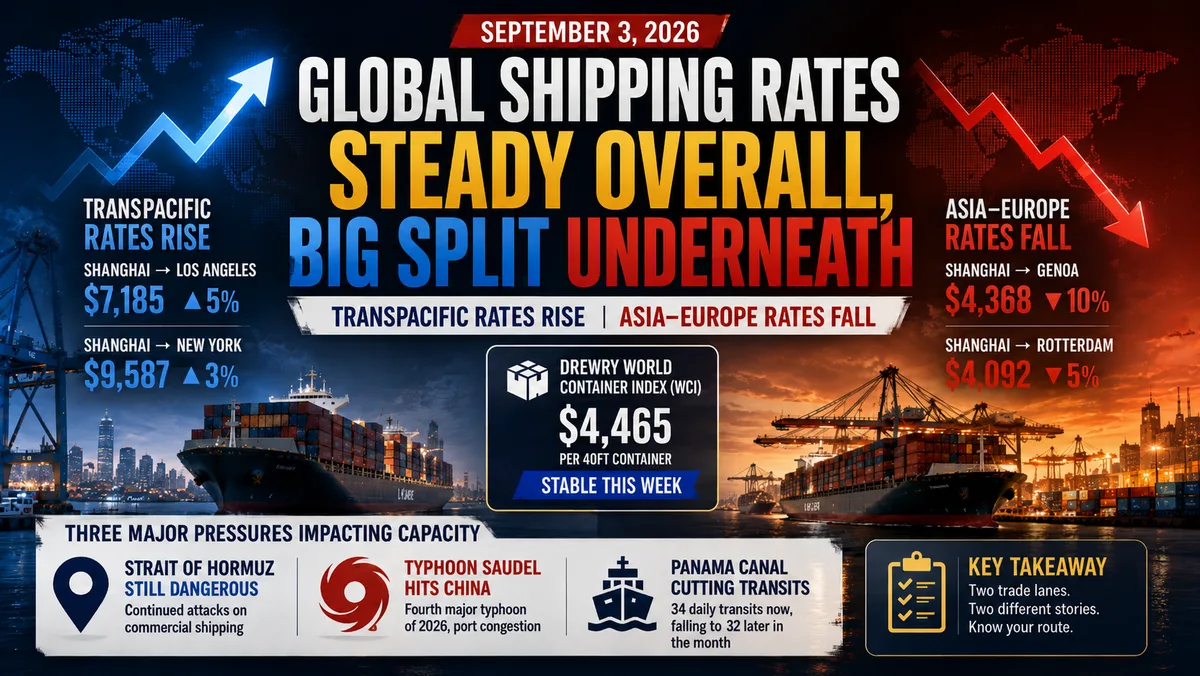
The Drewry World Container Index (WCI), remained stable at $4,465 per 40ft container, as the increase in Transpacific trade routes was offset by a decrease in the Asia–Europe trade routes.
In simple terms: rates on ships going to America are going up. Rates on ships going to Europe are going down. And when you average the two together, the overall global number looks unchanged. But if your cargo moves on one of these specific lanes, the reality is very different depending on which one.
Transpacific Rates Are Climbing
If you import from Asia to the United States, prices went up again this week:
- Shanghai to Los Angeles: up 5% to $7,185 per 40ft container
- Shanghai to New York: up 3% to $9,587 per 40ft container
Drewry expects rates on the trade to remain broadly stable next week as carriers continue to manage available capacity. Part of how carriers "manage" capacity is by cancelling sailings — known as blank sailings — to keep ships fuller and rates higher. Six blank sailings have been announced for next week, double the number this week, while cargo demand remains resilient.
What this means in plain English: demand for shipping goods from Asia to the US remains strong, and carriers are deliberately reducing the number of sailings to keep that demand pushing prices upward. If you are booking Transpacific cargo, expect rates to stay elevated for at least the next week or two.
Asia-Europe Rates Are Falling
The picture is the exact opposite for cargo moving between Asia and Europe:
- Shanghai to Genoa: down 10% to $4,368 per 40ft container
- Shanghai to Rotterdam: down 5% to $4,092 per 40ft container
Drewry expects further modest declines next week as demand softens and carriers add capacity. Unlike the Transpacific trade, carriers are pulling back on blank sailings here — blank sailings on the trade are expected to fall from four this week to just one next week. Fewer cancelled sailings means more ships running, which means more available space — and more available space pushes rates down.
Why Are the Two Trades Moving in Opposite Directions?
The main reason is the ongoing shift of carriers back to the Suez Canal on the Asia-Europe route.
Carriers are increasing transits through the Suez Canal, with more capacity expected to return as services shift away from the longer route around the Cape of Good Hope. The Cape diversion carries significantly higher fuel and operating costs while adding days to voyages, putting services that continue using the route at a competitive disadvantage.
As more carriers return to Suez — which we have been tracking closely over recent weeks — voyages get shorter. Shorter voyages mean each ship can complete more round trips per year, effectively adding capacity to the Asia-Europe trade without adding a single new vessel. More capacity, combined with softening demand, is pushing rates down on this lane.
The Transpacific trade does not benefit from this same effect — it does not use the Suez Canal at all — so its rates are being driven by different, still-tight, supply and demand dynamics.
Three Other Pressures Squeezing the Market Right Now
Beyond the Suez Canal shift, three other major disruptions are actively affecting global container capacity this week:
1. Strait of Hormuz — Still Dangerous
Geopolitical risks in the Middle East remain elevated, with continued attacks on commercial shipping adding to disruption around the Strait of Hormuz. This is not a new story, but it remains an active, ongoing risk factor that continues to affect vessel routing decisions and insurance costs across the industry.
2. Typhoon Saudel Hits China
Weather is also creating problems in Asia. Chinese ports remain constrained after Typhoon Saudel struck the country, compounding congestion following a series of recent storms. This is now the fourth major typhoon disruption to hit Chinese ports in 2026, following Bavi, Noul, and Dolphin earlier in the summer. Each new storm adds to an already-strained port system that has struggled with vessel bunching and extended waiting times for months.
3. Panama Canal Cutting Transits Again
Conditions at the Panama Canal are adding another capacity constraint. Drought-related restrictions are limiting the waterway to 34 daily transits in early September, falling to 32 later in the month, while Neopanamax capacity is capped at nine reservation slots per day.
This confirms what we reported back in July — the El Niño drought conditions at the Panama Canal have continued to worsen, not improve. The daily transit cap is now even lower than the initial July restrictions, and it is scheduled to tighten further later this month.
What Does This Mean for Shippers on Each Lane?
If You Ship Asia to US (Transpacific):
- Rates are rising and expected to stay elevated for at least the next week.
- Carriers are cutting sailings deliberately to maintain pricing power — book early to avoid last-minute rate spikes.
- If your cargo also depends on the Panama Canal for East Coast delivery, expect additional delays from the tightening transit restrictions.
If You Ship Asia to Europe:
- Rates are falling and expected to fall further next week — this may be a good window to negotiate spot bookings.
- Be aware that carriers returning to Suez means potentially faster transit times than recent Cape of Good Hope routings — check your specific carrier's current routing.
- Do not assume this trend continues indefinitely — Suez Canal security risk remains a factor that could reverse this trend if attacks increase.
If Your Cargo Touches China Directly:
- Factor in potential delays from Typhoon Saudel — this is the fourth major storm disruption of the year, and Chinese port recovery has been taking 2-3 weeks after each event.
- Confirm your specific port of loading is not experiencing elevated congestion before finalizing tight delivery schedules.
Key Takeaways — September 4, 2026
- Global freight rate benchmark (Drewry WCI) held steady at $4,465 per 40ft — but this hides a major split between trade lanes.
- Transpacific rates rising: Shanghai-LA up 5% to $7,185; Shanghai-New York up 3% to $9,587.
- Asia-Europe rates falling: Shanghai-Genoa down 10% to $4,368; Shanghai-Rotterdam down 5% to $4,092.
- Main driver of the split: carriers shifting back to the Suez Canal, adding capacity on Asia-Europe routes.
- Typhoon Saudel has struck China — the fourth major storm disruption of 2026, adding to port congestion.
- Panama Canal cutting daily transits to 34 in early September, falling to 32 later in the month — tighter than July's restrictions.
- Strait of Hormuz remains an active risk factor with continued attacks on commercial shipping.
- Six blank sailings planned next week on Transpacific (up from 3) — keeping rates elevated on that lane.
- Only one blank sailing planned next week on Asia-Europe (down from 4) — adding capacity and pushing rates down.
The global freight market headline number may look calm this week, but underneath it, two of the world's most important trade lanes are telling completely different stories. Shippers need to look past the average and focus on what is actually happening on their specific route — because right now, Transpacific and Asia-Europe shippers are living in two very different freight markets.


Comments
No comments yet. Be the first to share your thoughts!