
What Happened at Europe's Biggest Port?
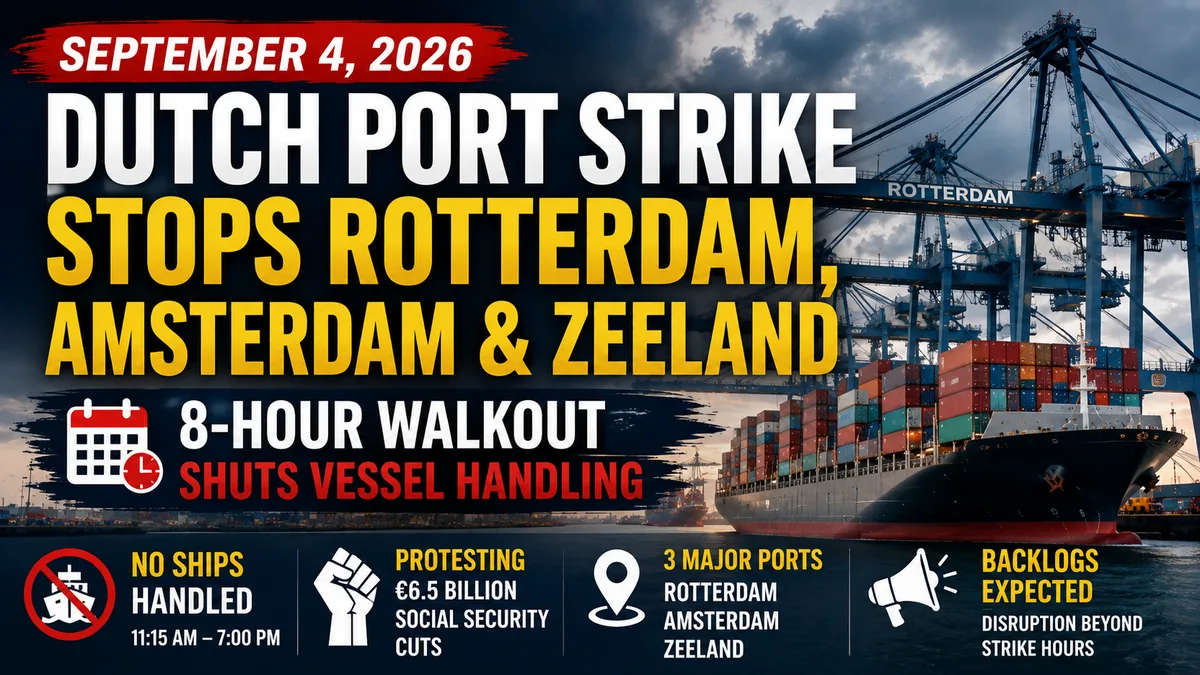
On Friday, September 4, 2026, dockworkers across three major Dutch seaports walked off the job in a coordinated strike that brought vessel handling to a complete stop for nearly eight hours.
Members of the FNV Havens union staged an eight-hour work stoppage from 11:15 a.m. to 7:00 p.m. to protest against the Dutch cabinet's plans for social security. The action affected the ports of Rotterdam, Amsterdam, and Zeeland — three of the most important gateways for cargo entering and leaving continental Europe.
At Rotterdam — Europe's largest container port, which handled 14.2 million TEU in 2025 — vessel-handling operations were disrupted during the strike, with no ships handled at all during the stoppage window.
Why Did Dockworkers Strike?
This was not a wage dispute — it was a political protest against the national government's budget plans.
FNV is protesting against proposed government cuts of €6.5 billion to social security, including changes to unemployment and disability benefits. Specifically, the government's plan includes a proposal to reduce the maximum unemployment benefit period from two years to one year.
The dispute concerns government budget and social welfare policies rather than a conventional wage negotiation. This distinction matters — it means the strike could continue or escalate depending on political developments, rather than being resolved through a simple pay negotiation between workers and employers.
Union representatives say members already signalled their readiness to strike during a general meeting attended by more than 700 port workers on March 31, 2026 — meaning this action had been building for months before it finally happened.
Exactly What Stopped Working?
The strike hit multiple layers of port operations simultaneously:
- Vessel handling — no ships were loaded or unloaded during the strike window
- Mooring and towing — tug service provider Svitzer confirmed its employees participated, resulting in reduced tugboat capacity, which directly affects the ability of ships to safely enter and leave port
- Lashing — the process of securing containers on ships was halted, affecting both departing and arriving vessels
- Cargo inspections — customs and safety inspection processes were also disrupted
FNV Havens has members among Rotterdam terminal operators, including ECT and APM Terminals Maasvlakte II — meaning the strike touched some of the port's largest and most modern container terminals, including the terminal Hapag-Lloyd recently bought a stake in.
How Long Did the Disruption Actually Last?
While the official strike window was 11:15 a.m. to 7:00 p.m. — seven hours and forty-five minutes — the real-world impact stretched considerably longer.
Logistics company Contargo warned that port operations could be affected over a wider window, from approximately 10:30 to 20:00. And the Dutch transport and logistics trade association (TLN) expected significantly higher activity in the port both before the stoppage and in the hours afterwards — as ships and trucks rushed to complete operations before the strike began, and then worked through a backlog once it ended.
A spokesperson for Deltalinqs, the association representing companies in the Port of Rotterdam, said: "It is evident that backlogs will develop and matters will pile up." That backlog does not disappear the moment the strike ends — it takes additional time, sometimes days, for a major port to fully clear a queue of delayed vessels, containers, and trucks.
Is This Strike Connected to Germany's Port Strikes?
No — and this is an important distinction for shippers to understand. Earlier in August 2026, six German ports — Hamburg, Bremerhaven, Bremen, Wilhelmshaven, Emden, and Brake — experienced wage strikes organized by the German union Ver.di, which was demanding an 8.2% pay increase or at least €2.50 per hour.
The Dutch action is not linked to the German wage dispute. The Rotterdam, Amsterdam, and Zeeland strikes are about government social security policy — a completely separate issue from the German pay negotiations. However, the timing means that shippers moving cargo through Northern Europe in late August and early September 2026 have faced disruption from two separate labour actions within a few weeks of each other.
Could This Happen Again?
This may not be the last disruption. The port strike is part of a wider series of union actions. On Wednesday, September 9, almost no trains are expected to run due to a nationwide public transport strike, as FNV Regional Transport, FNV Urban Transport, and FNV Rail — including DB Cargo employees — say they will strike on that date.
For freight forwarders moving cargo by rail from Dutch ports into Germany and beyond, the September 9 rail strike is a second disruption to plan around, coming just five days after the port strike.
Whether further port strikes follow will largely depend on how the Dutch government responds to the union's core demand: a full reversal of the proposed €6.5 billion social security cuts. If the government does not change course, FNV Havens retains the option to call further strikes.
What Does This Mean for Shippers and Freight Forwarders?
- Expect delays on shipments through Rotterdam, Amsterdam, or Zeeland around September 4-6. Even though the strike itself ended at 7:00 p.m. on September 4, the resulting backlog of vessels, containers, and trucks will take time to clear — likely affecting schedules into the following week.
- Check your vessel's actual berth time, not just the scheduled ETA. Ships waiting to enter or leave port during the strike window may have been held at anchor, pushing their actual arrival or departure later than originally planned.
- Inland connections may also be affected. With rail services facing a separate nationwide strike on September 9, any cargo relying on rail transport from Dutch ports into Germany, Belgium, or further into Europe should build in extra buffer time for that date as well.
- Watch for further strike announcements. Because this dispute is about government policy rather than a standard wage negotiation, it is not guaranteed to be resolved quickly. Monitor FNV Havens' official communications for any announcements of additional strike dates.
- Consider alternative routing for time-critical cargo. If you have time-sensitive shipments moving through Dutch ports in the coming weeks, discuss contingency options with your freight forwarder — including potential use of Antwerp, Hamburg, or other North Sea ports as alternatives if further disruption occurs.
Key Takeaways — September 5, 2026
- FNV Havens union staged an 8-hour dockworker strike at Rotterdam, Amsterdam, and Zeeland on September 4, 2026.
- Strike ran from 11:15 a.m. to 7:00 p.m. — vessel handling completely stopped during this window.
- Cause: protest against €6.5 billion in proposed Dutch government cuts to social security and unemployment benefits.
- Rotterdam — Europe's largest container port (14.2 million TEU in 2025) — was directly affected.
- Tugboat services, lashing, mooring, and cargo inspections were also disrupted.
- Real-world disruption window was wider than the official strike hours — roughly 10:30 a.m. to 8:00 p.m. per logistics providers.
- NOT connected to the separate German port wage strikes in August 2026.
- A second disruption — a nationwide Dutch rail strike — is planned for September 9, 2026.
- Further port strikes remain possible if the government does not reverse the proposed social security cuts.
Europe's busiest port just experienced a reminder of how quickly a single day of industrial action can ripple through global supply chains. For shippers and freight forwarders moving cargo through the Netherlands, the backlog from September 4 — combined with a nationwide rail strike just five days later — means this is a moment to build in extra buffer time and stay closely in touch with terminal and carrier updates over the coming week.


Comments
No comments yet. Be the first to share your thoughts!