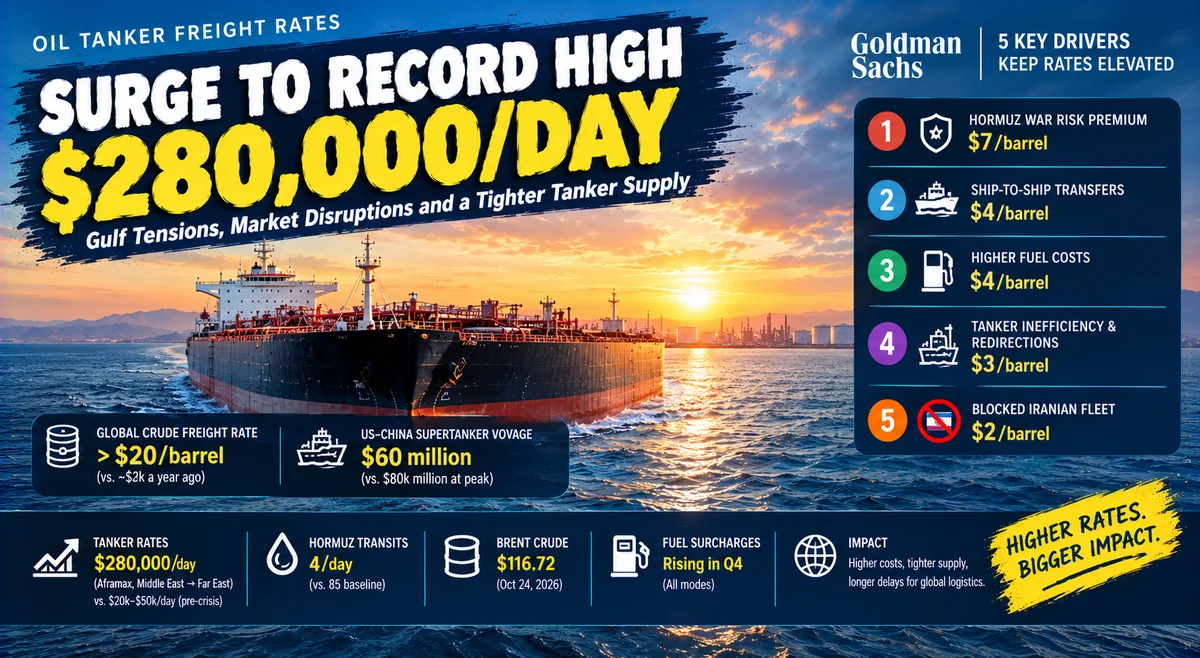

Oil tanker freight rates have surged to a record high of $280,000 per day for Aframax tankers on Middle East to Far East routes, driven by the ongoing Gulf conflict and a cascading set of market disruptions that analysts at Goldman Sachs say show no signs of reversing. The rate marks a staggering increase from the pre-crisis norm of $20,000 to $50,000 per day that held throughout 2022 to 2025.
The Numbers Behind the Surge
The scale of the rate spike is extraordinary by any historical standard. The global average crude freight rate has surpassed $20 per barrel — compared with approximately $3 per barrel a year ago. Goldman Sachs analysts, including Daan Struyven, noted in a report sent to Rigzone that the tanker rate rally began in the Very Large Crude Carrier (VLCC) segment and on Middle Eastern routes before spreading to all major crude trading routes globally — with particularly severe effects on long-haul voyages.
The most dramatic example: the cost of shipping crude oil from the US Gulf Coast to China soared to as high as $80 million earlier this month — ten times the tanker rates that prevailed before the Iran war. While rates have eased slightly from their October peak, the cost of a supertanker voyage from the US to Asia remained around $60 million this week — still so high that Asian refiners are refusing to order US crude for November delivery.
Goldman Sachs: Five Drivers Keeping Rates Elevated
Goldman Sachs analysts identified five structural factors driving the $20 per barrel increase in the global average crude freight rate — each of which remains in place today:
- War risk premium in Hormuz — $7/barrel (one-third of the total increase): Vessels transiting or approaching the Strait of Hormuz are pricing in a substantial risk of attack, mine strikes, or seizure. Insurance war risk premiums have multiplied and in many cases coverage is simply unavailable.
- Ship-to-ship transfers outside the Persian Gulf — $4/barrel: With Hormuz effectively closed to routine commercial shipping, crude is being transferred between vessels at offshore anchorages — a process that ties up tankers for significantly longer periods and reduces effective fleet availability.
- Higher maritime fuel prices — $4/barrel: Longer rerouting distances, increased idle time, and elevated bunker fuel costs resulting from the broader oil price environment are adding directly to voyage economics.
- Inefficient tanker allocation and increased redirections — $3/barrel: Vessels are being redirected mid-voyage, rerouted around alternative corridors, and repositioned at short notice — all of which reduces the effective productivity of the global tanker fleet.
- Blockage of the Iranian fleet — $2/barrel: With Iranian-flagged and Iran-linked tonnage effectively removed from the global market, demand for non-sanctioned tankers has increased, tightening available capacity further.
What This Means for the Broader Logistics Industry
While the immediate impact is felt most acutely in crude oil transportation, the consequences ripple across the entire global logistics and supply chain ecosystem. High tanker rates increase the cost of crude delivered to refineries, which in turn pushes up the price of refined petroleum products — including the bunker fuel that powers the container ships, bulk carriers, and general cargo vessels that move the world's manufactured goods.
Goldman Sachs analysts cautioned that elevated freight rates may reduce refiners' overall demand for crude and push them toward sourcing from geographically closer suppliers — a shift that would fundamentally redraw established crude trade flows and the shipping routes that serve them. For logistics operators and freight forwarders, this means continued upward pressure on fuel surcharges across all freight modes — ocean, air, and road.
The Strait of Hormuz recorded just 4 commercial ship transits on October 18 against a pre-crisis baseline of 85 per day, according to IMF PortWatch data. With Brent crude settled at $116.72 as of October 24 and ship attacks in Hormuz hitting a monthly record in October, there is no near-term relief in sight for tanker markets — or for the broader shipping economy they underpin.
Implications for Gulf-Region Shippers and Importers
For businesses operating supply chains through or into the Gulf region — including Pakistan, India, and South and Southeast Asia — the record tanker rates translate directly into higher delivered costs for energy, petrochemicals, and any goods whose production or transport depends on oil. Pakistani importers in particular, who rely heavily on Gulf crude and refined product imports, are exposed to both the freight rate surge and the elevated crude price it helps sustain.
Freight forwarders and logistics managers should expect fuel surcharges on all modes to remain elevated or increase further in Q4 2026. Budgets and contracts that assumed pre-crisis freight economics will need immediate revision.
🔑 Key Takeaways — October 25, 2026
- Record $280,000/day tanker rates — Aframax vessels on Middle East–Far East routes have hit an all-time high, up from $20,000–$50,000/day before the Gulf war.
- Global crude freight rate above $20/barrel — compared to $3/barrel a year ago. Goldman Sachs analysts say this will persist as long as the conflict continues.
- US–China supertanker voyage costs $60 million this week — down from an October peak of $80 million, but still ten times pre-war levels. Asian refiners are declining US crude for November.
- Five structural drivers identified by Goldman Sachs — Hormuz war risk premium ($7/bbl), ship-to-ship transfers ($4/bbl), higher fuel costs ($4/bbl), tanker inefficiency ($3/bbl), and blocked Iranian fleet ($2/bbl).
- Hormuz at 4 transits/day vs 85 baseline — the strait remains effectively closed to routine commercial shipping as of October 18.
- Brent crude at $116.72 — elevated oil prices and elevated tanker rates are reinforcing each other in a self-perpetuating cycle.
- Fuel surcharges will rise further in Q4 — logistics operators across all modes should expect continued upward pressure. Review contracts and budgets now.

Comments
No comments yet. Be the first to share your thoughts!