A.P. Moller-Maersk expects all its shipping services to resume transits through the Suez Canal by March 2027, according to a statement from the Suez Canal Authority (SCA). The announcement marks a significant step toward normalising one of the world's most critical trade corridors — and carries major implications for freight rates, vessel capacity, and supply chain planning globally.
What Was Said
The outlook emerged from a videoconference between SCA Chairman Admiral Ossama Rabiee and senior Maersk executives, including Rabab Boulos, Maersk's Chief Operating Officer. Boulos told the SCA that all Maersk shipping services should return to the canal by March 2027. Discussions focused on strengthening cooperation and reviewing sailing plans and schedules to accelerate the return of services.
Also attending from the Maersk side were Ahmed Hassan, Maersk's Vice President of Operations, and Hani El-Nady, Maersk's representative for the Middle East and North Africa. Hassan confirmed that Maersk is continuing to revise its sailing schedules to enable more services to transit the canal in the coming months. El-Nady said the group is actively working to accelerate the return process.
Both sides agreed to continue discussions on future cooperation as Maersk reviews its navigation plans. However, the SCA did not specify which individual services would return next or provide dates for specific route changes. The March 2027 timeline remains an expectation, not a confirmed schedule — and is subject to regional security conditions.
Maersk Transits Already Nearly Doubled in 2026
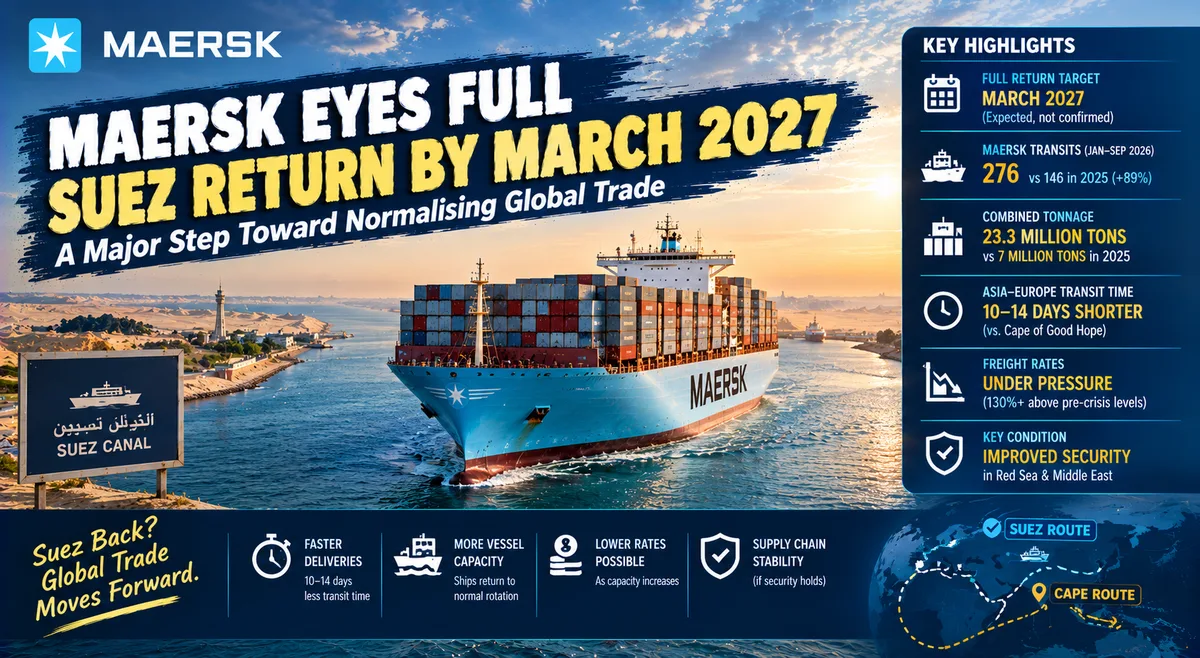
The announcement is backed by a significant recovery in actual transit numbers. The SCA reported 276 Maersk-affiliated vessel transits through the canal between January and September 2026, compared with just 146 during the same period in 2025 — an increase of approximately 89%. Combined net tonnage rose sharply from 7 million tons to 23.3 million tons over the same comparison period.
SCA Chairman Rabiee described this as a substantial and welcome recovery, attributing it to the strategic partnership and longstanding relationship between the two organisations. He also highlighted the canal's significant cost advantages over the Cape of Good Hope alternative route, particularly for large container vessels where fuel costs over the longer voyage are substantial.
Why This Matters for Global Freight
The Suez Canal is the fastest shipping route connecting Asia and Europe, and accounted for approximately 30% of global container trade before the 2024–2026 Red Sea and Hormuz disruptions forced carriers onto longer, more expensive diversions. The Cape of Good Hope route adds roughly 10–14 days to Asia-Europe voyages and requires significantly more vessel capacity to maintain the same service frequency.
A full return by Maersk — the world's second-largest container line — would have cascading positive effects across the global freight market:
- Asia-Europe transit times shortened by 10–14 days per voyage, improving delivery predictability for importers and exporters.
- Vessel capacity freed up as ships currently tied up on longer routes return to normal rotation, easing the tight supply that has driven up rates.
- Freight rates under downward pressure — container rates on Asia-Europe routes have surged over 130% since February 2026. Analysts have warned that a full carrier return to Suez, combined with new vessel deliveries expected in 2027–2028, could significantly compress rates.
- War risk insurance premiums may ease if the security situation stabilises sufficiently for Maersk to commit to full Suez transit.
The Security Caveat
The critical qualifier in all of this is security. Maersk's return to full Suez Canal operations is conditional on the security situation in the Red Sea and broader Middle East region improving sufficiently to allow safe, consistent passage. The Houthi threat in the Red Sea has been the primary barrier to full carrier returns — and while Maersk and Hapag-Lloyd resumed some services through the canal earlier in 2026 under naval escort, a complete return across all services remains contingent on a durable security environment.
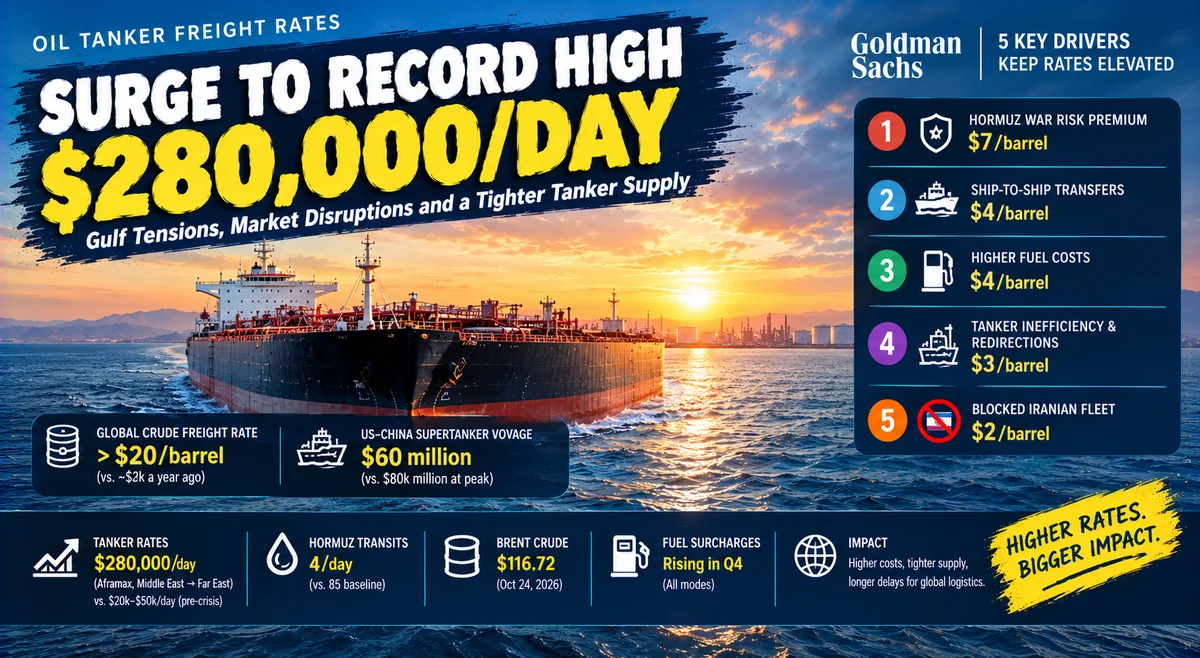
The Strait of Hormuz crisis — separate from the Red Sea situation — has added further complexity to Middle East shipping in 2026, with that waterway recording as few as four ship transits per day in mid-October versus a pre-crisis baseline of 85. Carriers and shippers will be watching both flashpoints closely as March 2027 approaches.
What Shippers and Forwarders Should Do Now
For logistics professionals, the Maersk announcement is a planning signal rather than a confirmed operational change. It is too early to restructure freight contracts or routing plans on the basis of this expectation alone. However, it is the right time to begin scenario planning: what does your Asia-Europe supply chain look like if Suez becomes fully operational again by Q1 2027? Which contracts, rates, and routings will need to be renegotiated? Which alternative routes will lose their justification?
The freight market in 2027 could look very different from 2026 — and the carriers, forwarders, and shippers who plan ahead will be best positioned to capture the benefits of a normalising trade corridor.
🔑 Key Takeaways — October 26, 2026
- Maersk targets full Suez Canal return by March 2027 — confirmed by SCA following a video meeting with Maersk COO Rabab Boulos. Timeline is an expectation, not a confirmed schedule.
- Maersk transits already up 89% year on year — 276 vessel transits Jan–Sep 2026 vs 146 in same period 2025. Combined tonnage up from 7M to 23.3M tons.
- Full return would shorten Asia-Europe voyages by 10–14 days — freeing vessel capacity currently absorbed by the Cape of Good Hope diversion.
- Freight rates face downward pressure — container rates are 130%+ above pre-crisis levels. A full Maersk Suez return, plus 2027–2028 newbuild deliveries, could significantly compress rates.
- Security remains the key variable — the return is conditional on Red Sea and Middle East security conditions improving. No guarantee yet.
- Individual service return dates not announced — no specific routes or timelines confirmed. Sailing schedule revisions are ongoing.
- Start scenario planning now — shippers and forwarders with Asia-Europe exposure should model a Q1 2027 Suez normalisation scenario in their freight procurement and routing strategy.
Source date: October 26, 2026 | Published: October 26, 2026
Comments
No comments yet. Be the first to share your thoughts!