
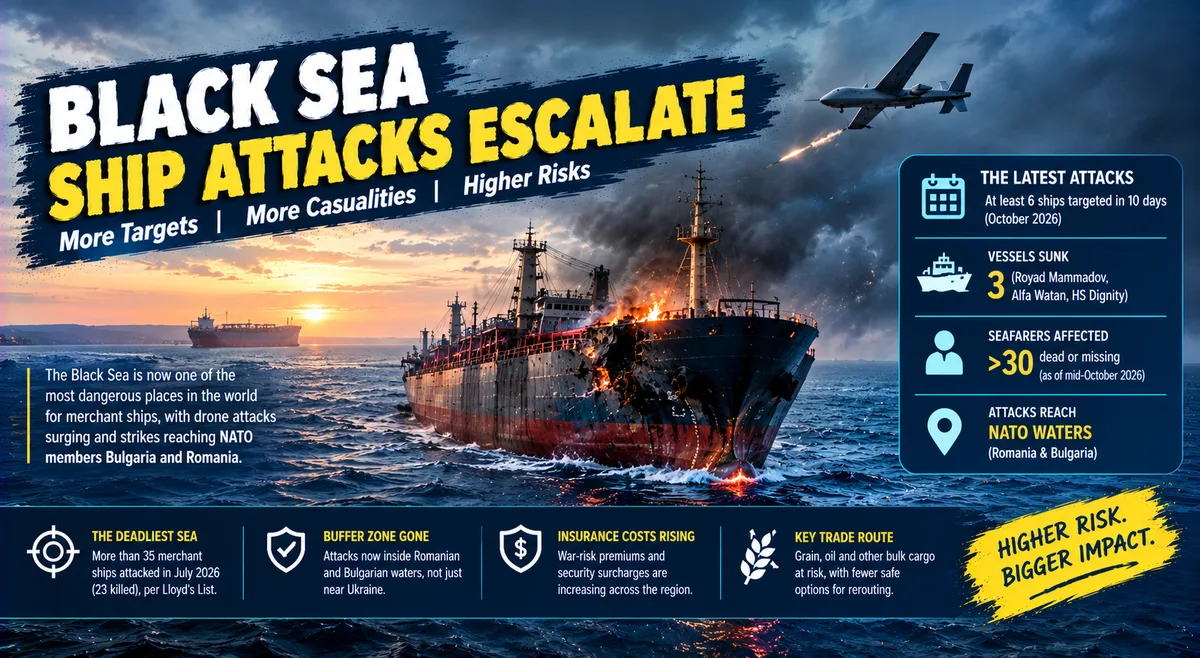

The Black Sea is now one of the most dangerous places in the world to operate a merchant ship. Drone attacks on commercial vessels have surged this month, with at least six ships targeted within ten days in October 2026 and strikes reaching the waters of NATO members Bulgaria and Romania. Shipping analysts say the death toll for seafarers is now climbing faster than in the Strait of Hormuz, which has dominated global shipping headlines since March.
What happened in October
The latest cluster of attacks began on October 5, when the grain and general cargo ship Royad Mammadov was hit inside Romania's territorial sea. Since then, ships including the Alfa Watan, the HS Dignity, and the chemical tanker Wine Trader have been struck. The targets have included general cargo vessels, grain ships, and chemical and oil tankers. Three vessels have been confirmed sunk: the Royad Mammadov, the Alfa Watan, and the HS Dignity.
The human cost is severe. Ten crew members are presumed dead aboard the Alfa Watan, while 11 are missing from the HS Dignity and seven from the Wine Trader, where only five of 12 crew were rescued and search operations resumed on October 16. Industry trackers counted more than 30 sailors dead or missing in just ten days as of mid-October. Diplomats have described the Black Sea as the "deadliest sea" for merchant crews.
A buffer zone that no longer exists
For years, shipping companies could rely on a geographic buffer around Romania and Bulgaria, with the worst risks concentrated near Ukraine's own coast. The October attacks have erased that assumption. Several ships were hit well inside Bulgarian economic-zone waters, and Romanian territorial waters have now been struck as well. Suspected Russian drones, both airborne and surface-based, are believed to be responsible, which has raised pressure on NATO to expand counter-drone defenses to protect commercial export routes.
Shipowners have long operated in the region despite mined waters, missile alerts, and port attacks. What makes this cluster different is how quickly the attack pattern has moved closer to NATO shores, leaving crews and operators with far less room to avoid danger by simply keeping their distance from the Ukrainian coast.
A deadly year for seafarers
The October attacks follow a brutal summer. According to Lloyd's List, citing the Turkish seafarers' union Deniz Iscileri, more than 35 merchant ships were attacked in the Black Sea in July alone, killing 23 seafarers and making it the deadliest month for merchant mariners since the Russia-Ukraine war began in February 2022. Maritime security specialists told Lloyd's List at the time that the Black Sea had overtaken both the Red Sea and the Strait of Hormuz as the world's highest-risk commercial shipping environment.
One of the worst single incidents came on July 20, when a Russian missile strike on a corn ship near Odesa killed 10 people. Crews from many countries have been affected, including Filipino and Indian seafarers killed in separate attacks over the summer. The International Chamber of Shipping and the International Maritime Organization have both publicly condemned the attacks and called on all parties to stop actions that endanger merchant seafarers.
Both sides are targeting shipping
The violence is not one-sided. Ukraine has also stepped up drone attacks on Russia-linked vessels in the Black Sea and the Sea of Azov, which has forced Russia to limit shipping on a route that handles about a quarter of its grain exports. The wider contest over the Black Sea has put merchant ships and port infrastructure on both sides under repeated attack, with civilian crews caught in the middle.
Insurance and costs are catching up
The insurance market has been forced to move quickly. The Joint War Committee expanded its listed area in September to cover almost the entire Black Sea, but the physical threat has kept shifting faster than the risk map. As attacks reach waters that were previously considered lower risk, the gap between insured zones and real danger zones is closing fast. War-risk premiums and security surcharges can now add materially to costs on a trade where freight rates had already risen because of congestion and route disruption.
Why it matters for the industry
The Black Sea is a key export corridor for grain, oil products, and other bulk cargo. Maritime exports account for more than two-thirds of Ukraine's agricultural exports, worth roughly $9 billion, so sustained attacks threaten both the country's economy and global food supply chains. With attacks now falling on the alternative routes used to get around the main danger zones, shipowners have fewer safe options. For supply chains already strained by the Hormuz crisis and the Red Sea, this adds another pressure point on food and energy flows, along with higher insurance and crew-safety costs.
Key takeaways
- At least six merchant ships were targeted by drones within ten days in October 2026.
- Three vessels have sunk, and more than 30 seafarers are dead or missing.
- Attacks have reached the waters of NATO members Romania and Bulgaria.
- July 2026 was already the deadliest month for merchant mariners since the war began, with 23 killed.
- Both Russia and Ukraine are striking commercial shipping, putting grain and energy exports at risk.
- War-risk insurance and security surcharges are rising across the region.
For shippers and forwarders with cargo moving through or near the Black Sea, crew safety, insurance cover, and routing contingencies now need to be checked before every booking, and rising war-risk costs should be built into freight quotes from the start.

Comments
No comments yet. Be the first to share your thoughts!