What Happened?
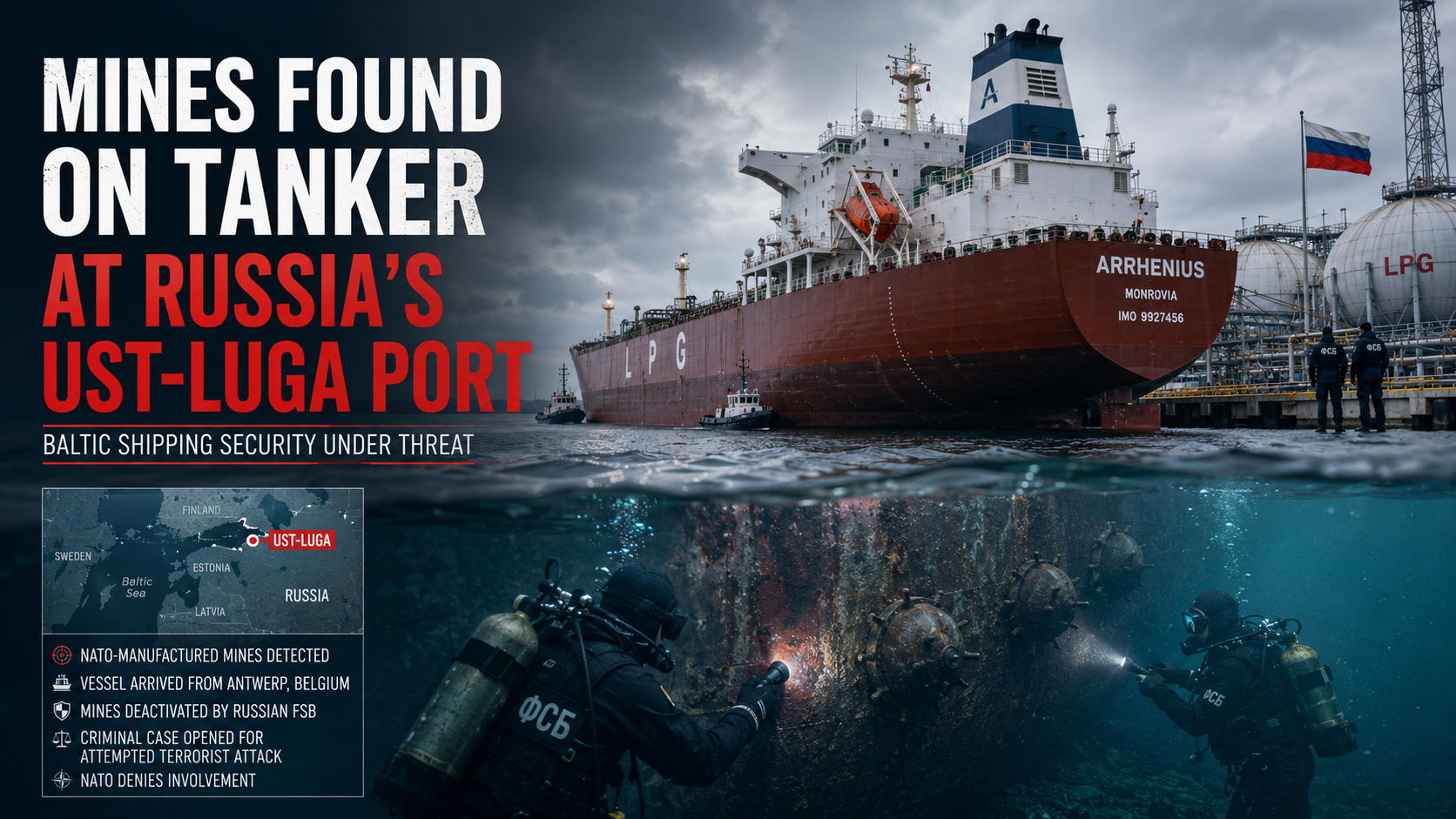
Several NATO-produced magnetic mines had been detected on a tanker in Russia's Baltic Sea port of Ust-Luga, Russia's Investigative Committee said on Monday, May 25, 2026. The mines were found by divers during an inspection of the hull of the tanker Arrhenius, which arrived from Belgium's port of Antwerp to load liquefied petroleum gas.
The Arrhenius is a Liberia-flagged vessel managed by Maple Mariner Holding in the UAE. According to investigators, the vessel entered the port of Ust-Luga on May 20, with a delay of several days from its planned arrival date. Russian authorities believe the delay is significant — suggesting the mines may have been attached during transit before the ship reached Russian waters.
Russia's Investigative Committee concluded that the mines could not have been installed in Russian territorial waters. The mines were successfully deactivated by Russian FSB specialists working alongside the Ministry of Defense. A criminal case has been opened on charges of an attempted terrorist attack.
NATO has denied any involvement, with a NATO official stating in an emailed statement: "NATO has not mined any tanker."
Why Ust-Luga and Why Now?
Ust-Luga is Russia's largest port on the Baltic Sea and one of its most strategically important energy export terminals. It handles large volumes of crude oil, petroleum products, coal, and — critically — liquefied petroleum gas (LPG). Disrupting Ust-Luga means disrupting Russian energy exports to global markets.
This is not the first time the port has been targeted. Russia has beefed up safety measures in its ports following suspected acts of sabotage aimed at undermining its energy infrastructure. Last year, Russia ordered divers to inspect ships in its ports after suspected attacks on four oil tankers. The Suezmax tanker Koala ran aground at Ust-Luga after a blast in its engine room in February 2025.
The pattern is clear: Russia's Baltic energy infrastructure has been under sustained pressure from covert attacks for over a year — and the Arrhenius incident suggests that pressure is intensifying.
What Does This Mean for Baltic Sea Shipping?
For shipping companies, port operators, and freight forwarders operating in the Baltic region, the Arrhenius incident sends a serious warning. Here's what the industry needs to understand:
- Hull inspections are becoming mandatory at Russian ports. Russia has already required all vessels entering its Baltic ports to undergo underwater hull inspections by divers. This adds time, cost, and operational complexity to port calls at Ust-Luga, Primorsk, and other Russian Baltic terminals.
- Ships sailing from Western European ports face heightened scrutiny. The Arrhenius arrived directly from Antwerp — one of Europe's largest and busiest ports. Any vessel departing a NATO-country port and heading to a Russian terminal will now face intensive inspection upon arrival.
- Insurance and war-risk premiums will rise further. The Baltic region was already seeing elevated insurance costs due to the broader geopolitical environment. An incident of this nature — involving mines attached to a commercial vessel — will push war-risk premiums higher on Baltic routing.
- Shipping companies face difficult choices. Vessels trading between Western European ports and Russian terminals are now operating in a zone where their ships could be used — knowingly or unknowingly — as vectors for acts of sabotage. This raises serious liability and compliance questions for shipowners and operators.
The Bigger Picture: Maritime Security Is Deteriorating Globally
The Arrhenius incident is the latest in a string of maritime security events that are reshaping risk for the global shipping industry in 2026. Within the past few months alone:
- The Strait of Hormuz has been effectively closed by Iran, with traffic collapsing from 135 to around 26 ships per day.
- A tanker in the Gulf of Aden reported its security team fired warning shots during a suspicious approach on May 22.
- Ukraine struck Russia's Sheskharis oil terminal on May 23 — one of the largest on the Black Sea.
- And now mines have been found on a commercial vessel in the Baltic Sea.
The message for shipping companies is uncomfortable but unavoidable: no major waterway is entirely safe right now. The era of taking maritime security for granted is over.
Key Takeaways for Logistics Professionals
- NATO-manufactured mines found on LPG tanker Arrhenius at Russia's Ust-Luga port — May 25, 2026.
- Vessel arrived from Antwerp, Belgium; mines were deactivated by Russian FSB.
- Russia has opened a criminal case for attempted terrorist attack.
- NATO denies involvement.
- Hull inspections now required at all Russian Baltic ports — adding delays and costs.
- War-risk insurance premiums expected to rise further on Baltic routes.
- Maritime security incidents now span the Baltic, Black Sea, Gulf of Aden, and Strait of Hormuz simultaneously.
For logistics professionals routing cargo through European waters, this incident is a reminder to review maritime security protocols, insurance coverage, and route risk assessments — not just for Middle Eastern lanes, but across all major European waterways as well.



Comments
No comments yet. Be the first to share your thoughts!
Join the conversation
You need an account to comment on articles.