What Did Maersk Just Announce?
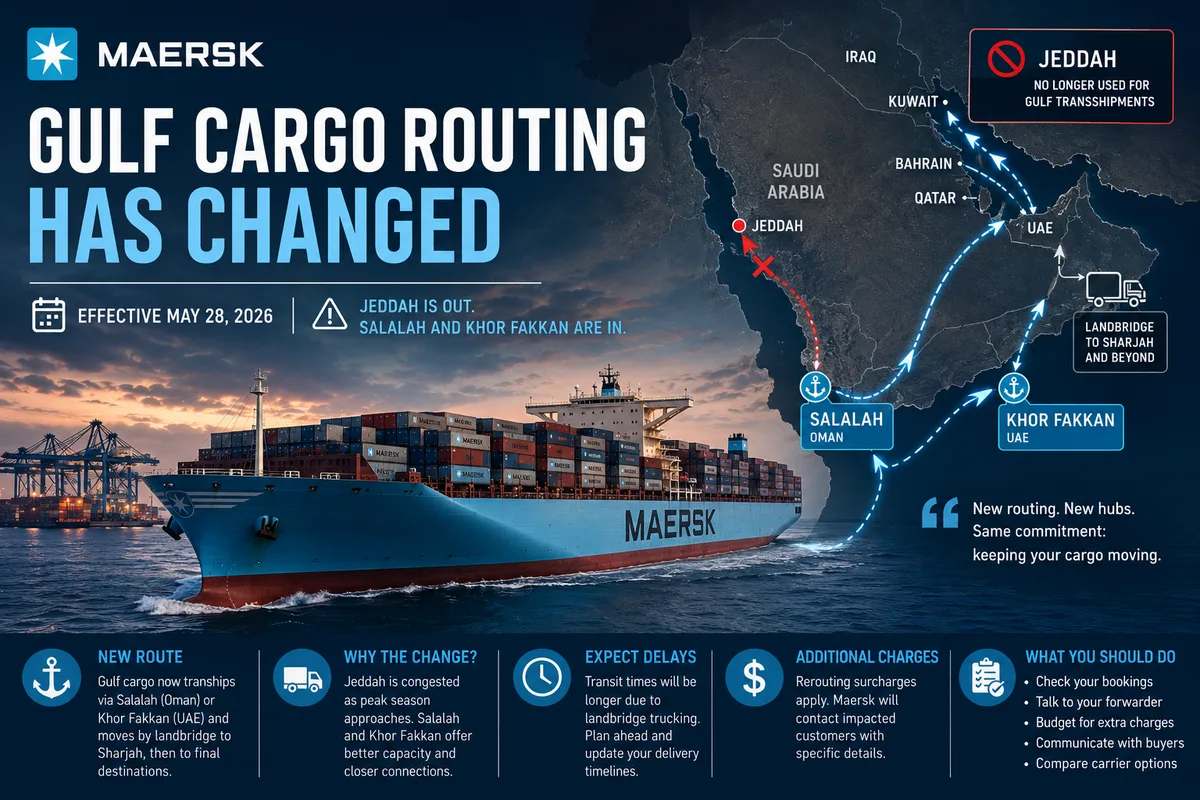
On May 28, 2026, Maersk — the world's second largest shipping line — sent an official advisory to its customers with a clear message: Gulf cargo routing has changed.
The port of Jeddah on Saudi Arabia's Red Sea coast had been serving as an alternative route for containers into Gulf countries avoiding the Strait of Hormuz. However, with peak season approaching, Maersk said it would no longer be transhipping cargo bound for Kuwait, Iraq, Qatar, Bahrain and the UAE via Jeddah.
In plain English: Jeddah is out. Salalah and Khor Fakkan are in.
What Is the New Route?
Here is exactly how your cargo will now move depending on where it is going:
- UAE, Kuwait, Iraq, Qatar, Bahrain: Cargo will now transship via Salalah (Oman) and Khor Fakkan (UAE), then move by landbridge to Sharjah, before connecting to the final destination through Maersk's intra-Gulf feeder network.
- Already booked to Jeddah but your consignee is NOT in Saudi Arabia: Your cargo will not be discharged in Jeddah. It will instead be routed to the consignee's country via Khor Fakkan.
- Saudi Arabia cargo only: If your cargo is going to Riyadh or Dammam inside Saudi Arabia, it will continue to move through Jeddah as normal via the existing landbridge solution. Nothing changes for you.
Please note there may be additional charges in connection with rerouting. All impacted customers will receive a separate email with the details.
Why Did Maersk Make This Change?
The reason goes back to the Strait of Hormuz closure — the single biggest disruption in global shipping right now.
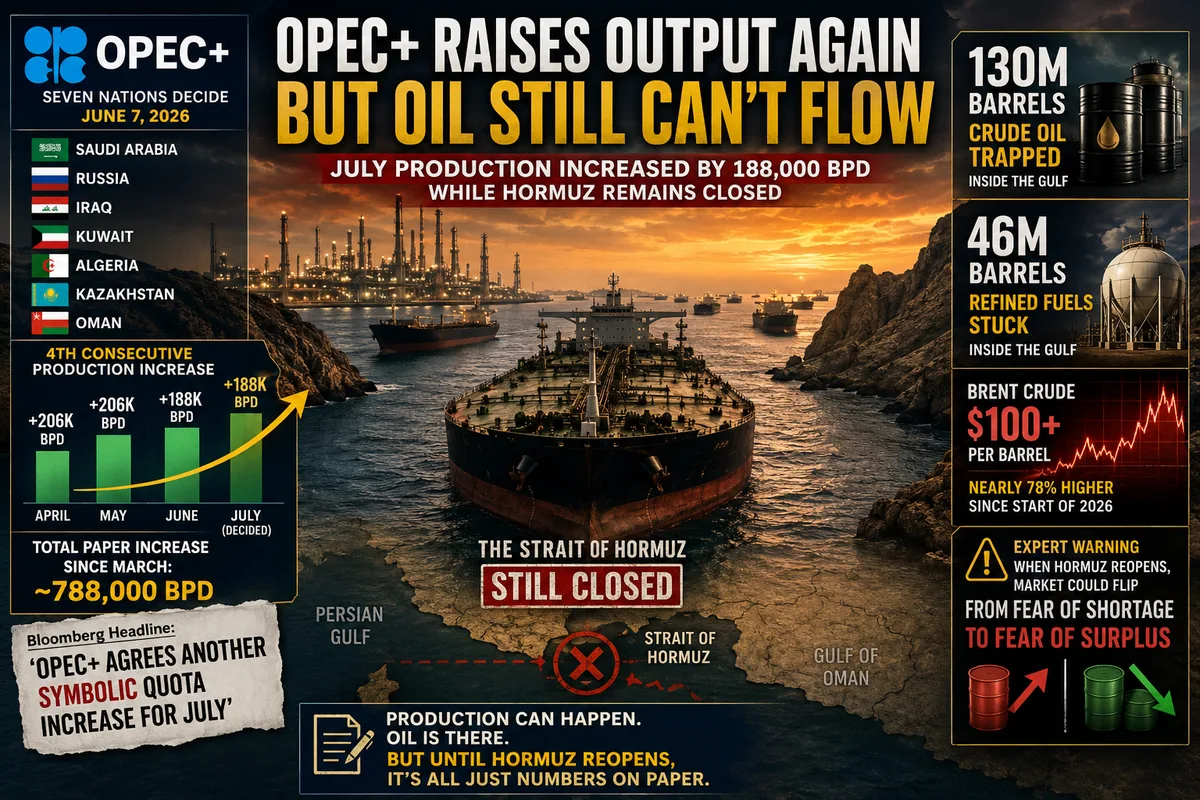
Since the Iran war began in late February 2026, the Strait of Hormuz has been effectively closed to most commercial shipping. This is the waterway that connects the Gulf to the rest of the world — meaning cargo that normally sailed directly into Dubai's Jebel Ali port, Kuwait, Qatar, and other Gulf destinations can no longer do so by sea.
For months, Jeddah on Saudi Arabia's Red Sea coast was being used as a workaround — ships would dock there and cargo would be trucked overland into the Gulf. But with peak season starting early and volumes rising, Jeddah is getting congested. Normal maritime flows remain constrained for cargo linked to parts of the UAE, Iraq, Kuwait, Qatar, Bahrain and eastern Saudi Arabia.
Maersk's solution is to shift the transshipment hub further east — to Salalah in Oman and Khor Fakkan in the UAE — which are closer to the final destinations and better positioned to handle the landbridge connections into the Gulf.
Where Exactly Are Salalah and Khor Fakkan?
Not everyone is familiar with these ports — so here's a quick guide:
- Salalah, Oman — Located on Oman's southern coast on the Arabian Sea, outside the Strait of Hormuz. It is one of the largest transshipment hubs in the region and is operated by APM Terminals (Maersk's port arm). Ships coming from Asia or Europe via the Cape of Good Hope can reach Salalah without entering the Hormuz danger zone.
- Khor Fakkan, UAE — Located on the east coast of the UAE on the Gulf of Oman — again, outside the Strait of Hormuz. Cargo arriving here can be trucked via landbridge to Sharjah and then distributed across the UAE and wider Gulf by feeder vessels or road.
What Does This Mean for Delivery Times and Costs?
The honest answer is: longer times and higher costs — but Maersk's new routing is designed to keep cargo moving as reliably as possible given the circumstances.
- Transit times will be longer than pre-war direct sailings into Jebel Ali or other Gulf ports. Landbridge trucking adds days to the journey.
- Additional charges are being applied — Maersk has confirmed impacted customers will be contacted individually with rerouting surcharge details.
- Reliability should improve compared to the Jeddah routing, which was becoming increasingly congested as more cargo was funnelled through it.
What Should You Do Right Now?
If you have shipments booked with Maersk going to the UAE, Kuwait, Qatar, Bahrain, or Iraq — here is your action list:
- Check your bookings immediately. If Jeddah is listed as your port of discharge but your cargo is actually going to a Gulf country — your routing has changed. You will receive an email from Maersk with details.
- Talk to your freight forwarder. If you use a freight forwarder to manage your Maersk bookings, contact them today to confirm how this change affects your specific shipments.
- Budget for extra charges. Rerouting surcharges are being applied. Ask Maersk or your forwarder for the specific amounts so you can update your landed cost calculations.
- Communicate with your buyers or consignees. If you have buyers in the UAE or Gulf states expecting delivery on a specific date — let them know now. The new routing may add a few days to transit times.
- Consider alternative carriers. CMA CGM, MSC, and other lines are also operating emergency Gulf routing via similar corridors. Your forwarder can help compare options.
The Bigger Picture
Maersk's route change is not a standalone event — it is the latest in a series of operational adjustments being made by every major carrier as they adapt to a Gulf region that has been effectively cut off from normal maritime access since February 2026.
In March, CMA CGM launched emergency multimodal corridors to bypass the Strait of Hormuz, routing cargo through alternative gateways including Jeddah, Khor Fakkan, Fujairah and Sohar, with onward feeder, landbridge and trucking connections to the UAE, Iraq, Kuwait, Qatar and Bahrain.
The industry consensus is that the Strait of Hormuz will remain restricted to commercial shipping well into 2027. That means these alternative routing solutions — Salalah, Khor Fakkan, landbridge trucking — are not temporary fixes. They are becoming the new normal for Gulf logistics.
Key Takeaways
- Maersk stopped routing Gulf cargo (UAE, Kuwait, Qatar, Bahrain, Iraq) via Jeddah — effective May 28, 2026.
- New routing: via Salalah (Oman) or Khor Fakkan (UAE) + landbridge to final destination.
- Saudi Arabia-only cargo continues through Jeddah — no change.
- Additional rerouting charges apply — Maersk will contact affected customers directly.
- Strait of Hormuz expected to remain restricted well into 2027.
- Action needed now: check bookings, talk to your forwarder, update delivery timelines.
Comments
No comments yet. Be the first to share your thoughts!
Join the conversation
You need an account to comment on articles.