What Is the EU Planning?
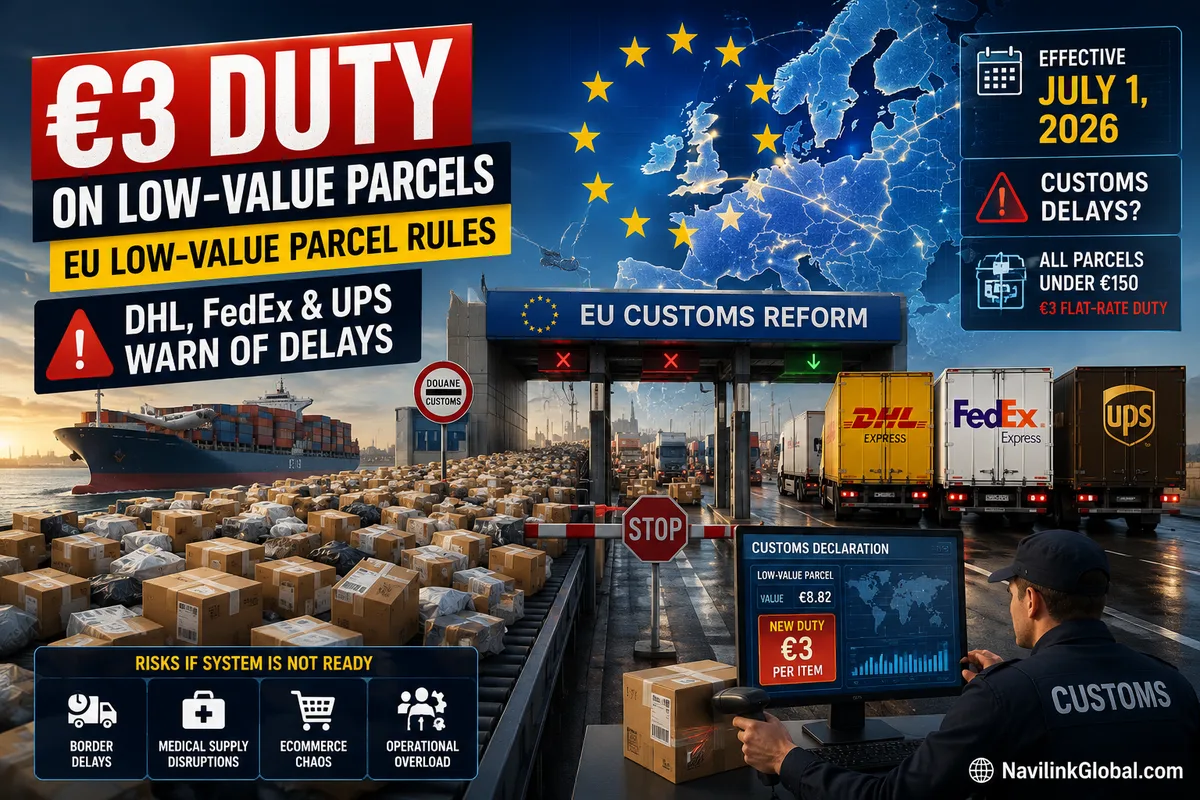
Starting July 1, 2026, the European Union wants to charge a €3 flat-rate duty on every low-value parcel entering the EU — specifically packages valued under €150. This is aimed directly at cheap ecommerce shipments coming from platforms like Shein, Temu, and other Chinese online marketplaces that have flooded Europe with low-cost goods.
For context: the European Commission's own figure for low-value imports shows an average item value of €8.82 in 2025 — meaning the €3 charge amounts to about 34% of the average declared value before shipping, handling and any other fees are added. That is a significant tax on inexpensive goods.
The EU says the rule is needed to level the playing field — European retailers pay full customs duties while foreign ecommerce sellers have been sending billions of parcels into Europe largely duty-free. The new rule aims to fix that.
What Are DHL, FedEx, and UPS Saying?
DHL, FedEx and UPS have written jointly to EU finance ministers urging a phased approach to the bloc's new customs rules for low-value parcels, warning that key elements of the framework are not ready for the July 1, 2026 start date.
The letter was signed by three of the most senior logistics executives in Europe:
- Mike Parra — CEO of DHL Express Europe
- Wouter Roels — President of FedEx Europe
- Daniel Carrera — President of UPS EMEA
Their message was direct. The companies said: "We therefore call on Ministers to endorse a phased approach: proceed with the EUR 3 flat-rate duty per item from 1 July 2026, while deferring the more complex and unresolved elements until they are legally certain and operationally viable."
In simple terms: they are not against the tax itself — they are saying the systems needed to implement it properly are simply not ready in time.
What Exactly Could Go Wrong?
The three CEOs said in the letter they foresaw a "real risk" of shipments being held up at EU borders "without a stable and workable legal framework."
Here is what that could look like in practice:
- Border delays. Every parcel under €150 entering the EU would need to be processed under the new system. If the customs IT infrastructure is not ready, millions of parcels per day get stuck at borders waiting for manual processing.
- Medical supply disruptions. "Such disruption could affect medical supply availability, delay industrial production, and create bottlenecks across European supply chains, all risks that are particularly significant in the current geopolitical context," the executives wrote. Small but critical medical items — test kits, replacement parts, medications — are frequently shipped as low-value parcels.
- Ecommerce chaos. European consumers buying from international online stores could face delayed deliveries and unexpected charges — just as the peak summer shopping season begins.
- Operational overload for carriers. DHL, FedEx, and UPS collectively handle hundreds of millions of parcels in Europe every year. If the new declaration and data requirements are not properly defined, their staff and systems simply cannot process the volume in time.
Why Is the System Not Ready?
The new data requirements and other changes required by the new rules result in a level of complexity that cannot realistically be implemented by the July 1 deadline, the three carriers wrote. The EU's full customs overhaul — called the EU Customs Data Hub — is not actually scheduled to be in place until 2028. July 1 is essentially a partial implementation while the full system is still being built.
This creates a gap: the tax starts, but the complete technical and legal infrastructure to manage it properly does not yet exist. That gap is exactly what the carriers are warning about.
What About the Shein and Temu Effect?
The rule is widely understood as a direct response to the explosion of ultra-cheap Chinese ecommerce. Shein and Temu have built their entire business model on shipping low-cost items directly to European consumers — largely tax-free under the previous €150 de minimis threshold.
Under the new rule, a €5 item from Temu would now attract a €3 duty — effectively a 60% tax rate on the item itself. This is designed to make ultra-cheap imports less competitive and protect European retailers who pay full customs duties.
For logistics companies, however, the issue is not whether the policy is right — it is whether the operational reality can support it from day one. The answer, according to DHL, FedEx, and UPS, is no.
What Is Happening on the Investment Side?
Despite their concerns about the July 1 deadline, the major carriers are clearly preparing for a future of higher European parcel volumes — not lower. FedEx said this week it was investing €46 million to expand its Duiven road hub in the Netherlands, boosting palletised freight capacity by more than 50%, as it prepares for continued growth in European parcel and freight volumes.
DHL eCommerce also announced a new exclusive multi-year contract with the United States Postal Service (USPS), with an expected value of well over $10 billion, for last-mile parcel delivery services in the US. Long-term, everyone in logistics believes cross-border ecommerce volumes will keep growing — the question is just how to manage the transition to the new regulatory environment.
What Should Shippers and Freight Forwarders Do Now?
- If you ship low-value goods to European consumers — review your pricing, landed cost calculations, and customer communications now. A €3 duty per item goes live July 1 whether the system is smooth or not.
- If you use DHL, FedEx, or UPS for EU parcel delivery — watch for updates from your carrier in June on how they are implementing the new declaration requirements.
- If you are a European importer of small goods — budget for delays at borders in July and August as the new system beds in. Build extra lead time into your procurement planning.
- If you are in ecommerce — communicate clearly with your customers about potential delivery delays and any price changes caused by the new duty from July 1.
Key Takeaways
- EU plans €3 flat-rate duty on all parcels under €150 — effective July 1, 2026.
- DHL, FedEx, and UPS jointly wrote to EU ministers on May 22, 2026 warning the system is not ready.
- Risks include: border delays, medical supply disruption, ecommerce chaos, and carrier overload.
- Carriers are asking for a phased approach — start the €3 duty but delay the complex data requirements.
- The EU Customs Data Hub — the full technical solution — won't be ready until 2028.
- FedEx investing €46M to expand its Dutch hub; DHL signs $10B+ USPS deal — long-term confidence remains high.
July 1 is five weeks away. Whether the EU listens to DHL, FedEx, and UPS or pushes ahead as planned will determine whether European borders run smoothly this summer — or face a very chaotic few weeks.


Comments
No comments yet. Be the first to share your thoughts!
Join the conversation
You need an account to comment on articles.