
What Happened at JNPA This Past Weekend?
Traffic at Jawaharlal Nehru Port has returned to normal after a surge in export cargo triggered congestion, truck queues and container delays last week, the Jawaharlal Nehru Port Authority (JNPA) said in a trade advisory issued on Tuesday, October 6, 2026, from Navi Mumbai.
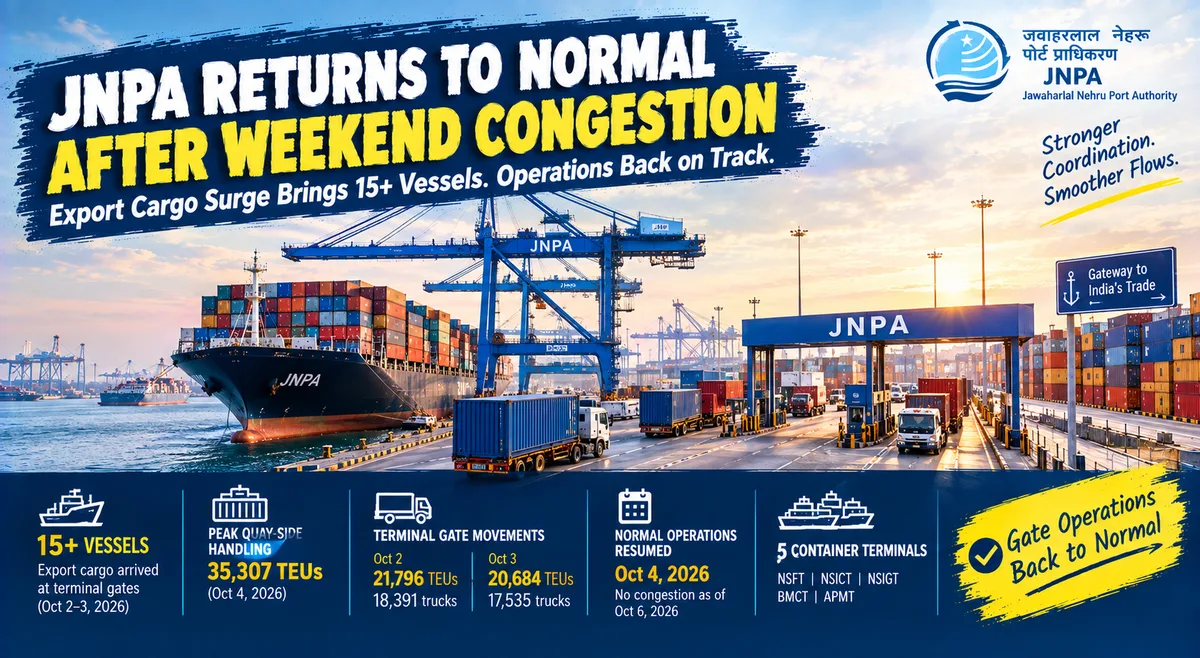
The cause was a sudden convergence of vessel traffic: export cargo for more than 15 vessels arrived at terminal gates around the same time on Friday, October 2, and Saturday, October 3 — a pattern known in the industry as vessel bunching, where ships that were delayed elsewhere end up arriving at a port in clusters rather than at their originally spaced-out intervals.
This resulted in concentrated movement of container trailers and temporary congestion, with queues and slight delays in the movement of container trucks at terminal gates over the weekend.
How Big Was the Volume Spike?
The scale of the surge is clear in JNPA's own operational data. Quay-side handling — the movement of containers directly at the ship berths — scaled up to 35,307 TEUs on October 4 and 32,972 TEUs on October 5, operating significantly higher than the port's standard daily average benchmark.
Over 16 to 17 container vessels were simultaneously berthed and handled across terminals during peak weekend operations — an unusually high number of ships being worked at once.
Terminal gate movements during the peak cargo ingress period reached:
- October 2: 21,796 TEUs involving 18,391 trucks
- October 3: 20,684 TEUs involving 17,535 trucks
How Did JNPA Resolve the Congestion?
JNPA and terminal operators, in coordination with Container Freight Stations (CFSs) and local traffic authorities, took additional measures to manage the surge. These coordinated interventions, combined with enhanced gate automation and additional deployment, allowed gate movements to decline in a controlled manner over the following days:
- October 4: 19,294 TEUs involving 16,332 trucks
- October 5: 16,972 TEUs involving 15,045 trucks
Pending Container Freight Station-bound import cargo also fell steadily, dropping from 22,622 TEUs on October 4 to 15,770 TEUs by the morning of October 6 — a clear sign that the backlog was being actively worked through rather than simply accumulating.
Operations returned to normal from the morning of October 4, and as of Tuesday, October 6, there was no congestion at any terminal gate, with traffic moving smoothly across the port.
Why Does This Matter Beyond JNPA Itself?
This localized episode at India's largest container port fits into a much larger pattern we have been tracking across Asia throughout the autumn. Vessel bunching caused by port congestion has inflated the amount of capacity appearing to be deployed, with ships accumulating around ports and subsequently arriving in clusters — exactly the dynamic JNPA experienced this past weekend.
Separately, maritime analyst Sam Chambers has reported that congestion at key Asian container ports has absorbed approximately 8.5 percent of the global fleet — roughly 3 million TEUs — a disruption that Sea-Intelligence data suggests could take seven to ten months to clear back to June 2025 levels, potentially extending into late 2027. While that broader analysis focuses primarily on Chinese ports hit by repeated typhoons, the JNPA episode demonstrates how bunching effects can cascade across the wider shipping network, including major ports well outside the directly affected region.
This Is Not JNPA's First Bunching Episode This Year
This weekend's congestion follows a pattern JNPA has dealt with before in 2026. Earlier in the year, carriers calling JNPA made last-minute terminal berthing adjustments amid pressure from terminal congestion, with port stakeholders working through what was described at the time as "finger-pointing" over responsibility for cargo gate-in and gate-out disruptions. JNPA has since continued coordinated efforts with Customs, terminal operators, container freight stations, and transporting companies to improve cargo flows.
JNPA currently operates five container terminals — NSFT, NSICT, NSIGT, BMCT and APMT — giving the port substantial overall capacity, but also multiple separate operators that need to coordinate closely during surge events like this one.
What Does This Mean for Shippers Using JNPA?
- This specific episode is already resolved. As of JNPA's October 6 advisory, gate operations have returned to normal and there is no current congestion. Shippers with cargo moving through JNPA this week should not expect continued delays from this particular event.
- Build buffer time around weekend cargo cutoffs going forward. This episode and JNPA's earlier bunching-related disruptions this year suggest that weekend periods, when multiple vessels can arrive simultaneously, carry a higher risk of temporary gate congestion. Consider this when planning time-sensitive shipments through JNPA.
- JNPA's coordinated response model appears effective. The combination of CFS coordination, traffic authority involvement, and gate automation allowed the port to clear a significant backlog within roughly four days — a reasonably fast resolution for a surge involving 15+ vessels arriving simultaneously.
- Watch for recurring bunching risk amid broader Asian congestion. With wider regional port congestion potentially persisting into 2027, according to recent Sea-Intelligence analysis, JNPA and other major Indian ports may continue to see occasional bunching episodes as delayed vessels from elsewhere in Asia arrive in clusters rather than at normal intervals.
- Consider this in the context of JNPA's Digital Twin investment. As we reported in late September, JNPA has committed ₹92.95 crore to a Digital Twin platform specifically designed to improve vessel traffic management and reduce vehicular decongestion — functionality directly aimed at managing exactly this kind of bunching-driven surge more smoothly in the future, once operational by 2027-2028.
Key Takeaways — October 7, 2026
- JNPA experienced temporary congestion after export cargo for 15+ vessels arrived at terminal gates simultaneously on October 2-3, 2026.
- Quay-side handling peaked at 35,307 TEUs on October 4 — well above the port's normal daily average.
- 16-17 container vessels were simultaneously berthed during peak weekend operations.
- JNPA, terminal operators, CFSs, and local traffic authorities coordinated to manage the surge.
- Normal gate operations resumed from the morning of October 4; no congestion remained as of October 6.
- Pending CFS-bound import cargo fell from 22,622 TEUs to 15,770 TEUs between October 4 and October 6.
- This fits a broader pattern of vessel bunching affecting ports across Asia, which analysts say could persist into 2027.
- JNPA's ongoing Digital Twin project, announced in September, is specifically designed to improve vessel traffic management for situations like this.
JNPA's handling of this weekend's surge shows a port that, while briefly strained by an unusually large cluster of simultaneous vessel arrivals, was able to coordinate across multiple stakeholders and restore normal operations within days. For shippers, the key takeaway is less about this specific resolved incident and more about the underlying pattern — as broader Asian port congestion continues to ripple outward, occasional bunching-driven surges at major gateways like JNPA may become a recurring, if temporary, feature of the shipping landscape heading into 2027.


Comments
No comments yet. Be the first to share your thoughts!