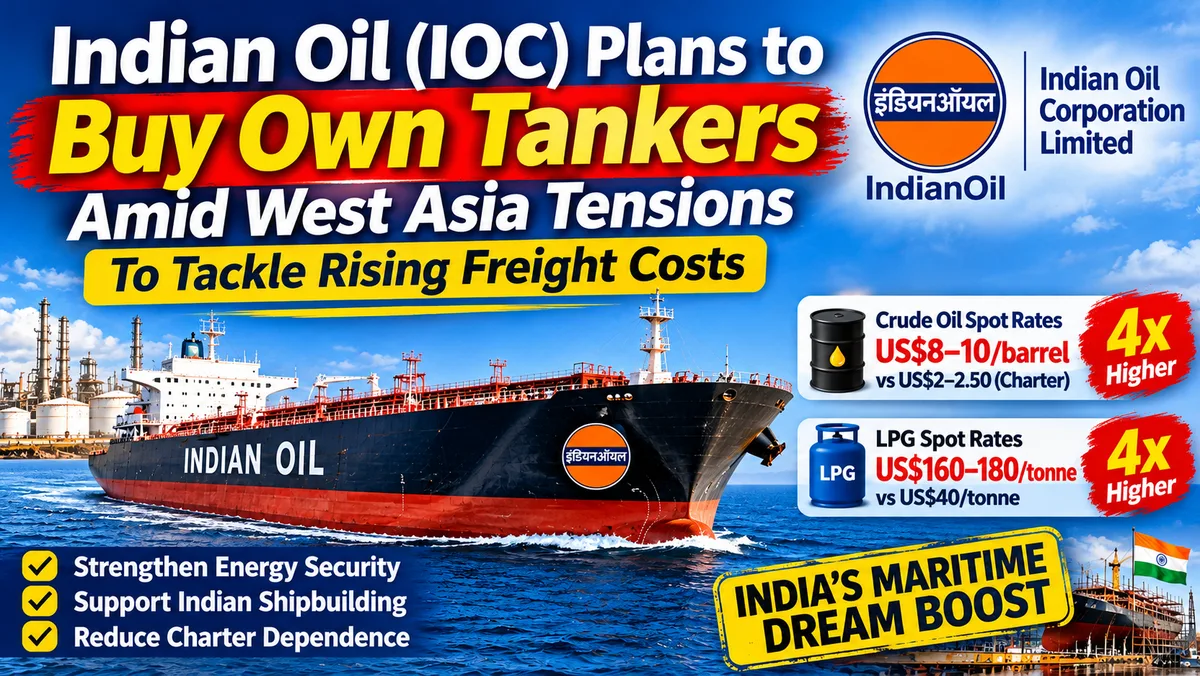
Indian Oil Corporation (IOC), India's largest oil refining and marketing company, is planning to acquire its own crude oil and liquefied petroleum gas (LPG) carriers as escalating geopolitical tensions in West Asia expose the vulnerabilities of India's heavy reliance on chartered vessels and the international shipping market.
According to a Press Trust of India (PTI) report, IOC's board has already approved the purchase of a number of vessels, with tenders for the proposed acquisitions issued several months ago. The company is also exploring opportunities to have ships built domestically in India — a move that would directly support the government's ambition to build a competitive maritime manufacturing hub and strengthen India's domestic shipping fleet.
The Numbers Tell the Story
The financial case for vessel ownership has become overwhelming. IOC currently operates three crude oil carriers and nine LPG vessels under time-charter arrangements. However, the surge in spot-market freight rates triggered by the West Asia crisis has dramatically widened the cost gap between owning and chartering.
For crude oil transport, time-chartered vessels cost approximately US$2–2.50 per barrel. During peak market volatility, spot-market rates climbed to US$8–10 per barrel — four times higher. The LPG market has seen an even sharper spike: spot freight rates that normally stand at around US$40 per tonne surged to US$160–180 per tonne at the height of the disruption — a fourfold increase.
These figures make the strategic logic clear: at spot rates four times above the time-charter equivalent, every cargo movement on the open market becomes a significant unbudgeted cost. For a company of IOC's scale — which imports crude and LPG in enormous volumes — the cumulative impact runs into hundreds of millions of dollars annually.
The Hormuz Factor
The trigger for this strategic review is unambiguous. The Strait of Hormuz — through which approximately 20% of the world's traded oil passes — has remained severely disrupted since the US-Iran conflict began on February 28, 2026. The resulting rerouting, insurance cost explosion, and tanker availability squeeze have exposed every country that depends on Middle Eastern energy imports to sharp and unpredictable freight costs.
India is particularly exposed. The country is the world's third-largest crude oil importer, and while it has diversified its sourcing — with Russian crude accounting for approximately 55% of IOC's procurement in H1 FY2026–27 and Middle Eastern supplies contributing around 24% — that diversification itself demands flexible, reliable shipping capacity across multiple long-haul routes simultaneously.
When the international tanker market is in disruption, a company without its own fleet has no choice but to pay whatever the market demands. IOC's plan is to change that equation permanently.
The Domestic Shipbuilding Dimension
Beyond the immediate commercial rationale, IOC's vessel acquisition plan has a second strategic dimension: domestic shipbuilding. The company is actively exploring having ships constructed in India rather than purchasing foreign-built vessels — a decision that would align directly with the Indian government's broader maritime industrial ambitions.
India's domestic shipbuilding sector has long been a fraction of the size of South Korean, Chinese, and Japanese competitors. A major state-owned energy company commissioning crude oil and LPG carriers from Indian yards would create significant demand for specialised vessel manufacturing, marine engineering, equipment supply, and skilled employment — supporting the government's vision of India as a maritime manufacturing hub.
What This Means for the Tanker Market and Regional Freight
IOC is not alone in this reassessment. The West Asia crisis has prompted a broader rethink of shipping strategy among Asia's large energy importers. When spot rates reach four to five times their normalised levels, the case for asset ownership over market dependency becomes commercially unarguable.
For the global tanker market, a wave of strategic vessel acquisitions by state-owned energy companies — if IOC's move is replicated by peers in India and elsewhere — would represent a structural shift in tanker demand. Ships moving from the spot market to long-term dedicated fleet arrangements reduce available spot capacity, which in turn supports elevated freight rates for remaining spot market participants.
For logistics professionals, freight forwarders and shippers with energy-related cargo exposure in South Asia and the Gulf, IOC's announcement is a clear signal: the era of assuming cheap, readily available tanker capacity on the spot market is over for the foreseeable future. Building owned capacity, securing long-term contracts, and planning for sustained elevated freight costs is the new operating reality.
🔑 Key Takeaways — November 11, 2026
- IOC board has approved vessel purchases — tenders already issued; this is not a proposal, it is an active procurement process.
- Crude oil spot rates hit US$8–10/barrel vs US$2–2.50 on time-charter — a 4x gap that makes ownership the only commercially rational long-term answer.
- LPG spot rates surged to US$160–180/tonne from a normal level of US$40/tonne — a fourfold spike driven entirely by Hormuz disruption.
- IOC currently operates 3 crude carriers and 9 LPG vessels on time-charter — the new fleet will add owned tonnage to this base.
- Russia supplies 55% of IOC's crude in H1 FY2026–27 — Middle East at 24%; diversified sourcing demands flexible shipping across multiple routes.
- Domestic shipbuilding on the table — IOC exploring Indian-built vessels, which could boost India's maritime manufacturing sector significantly.
- The broader signal: State-owned energy companies across Asia are moving toward fleet ownership — a structural shift that will reduce spot tanker availability and support elevated freight rates long-term.
Source date: November 11, 2026 | Published: November 11, 2026
Comments
No comments yet. Be the first to share your thoughts!