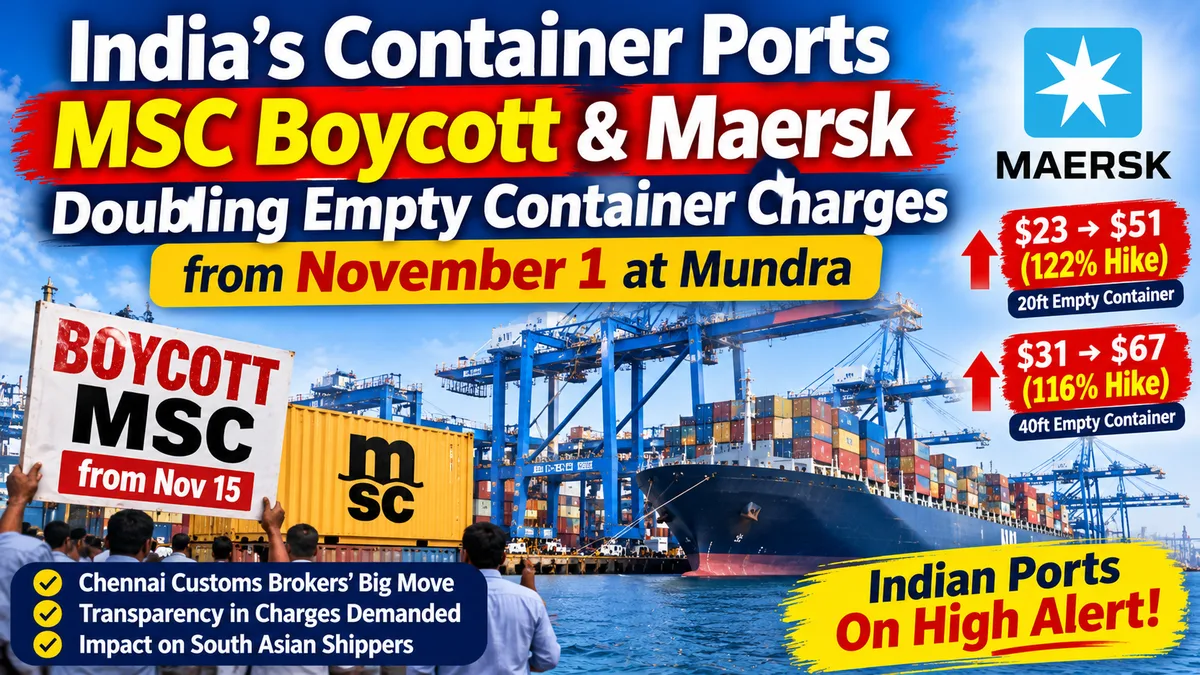

A significant industry dispute is unfolding across India's major container ports, with customs brokers raising formal objections to the way global shipping lines are levying and collecting empty container handling charges. The controversy centres on two separate but related developments: a threatened cargo boycott against MSC in Chennai and a major tariff revision by Maersk at Mundra Port — both directly affecting exporters, importers and logistics providers operating in South Asia.
Maersk More Than Doubles Empty Container Charges at Mundra
With effect from November 1, 2026, Maersk has substantially revised its lift-on/lift-off (LO-LO) charges for empty containers at Mundra Port — India's largest container port by volume. The new tariff structure represents increases of over 120%:
- 20-foot empty container: increased from US$23 to US$51 — a rise of approximately 122%
- 40-foot empty container: increased from US$31 to US$67 — a rise of approximately 116%
The revised arrangement also requires customers to make payments directly to nominated third-party depot service providers responsible for handling the empty containers — rather than paying Maersk directly. Industry stakeholders have raised concerns about the lack of transparency in this arrangement, questioning who sets the rates, who is accountable when charges are disputed, and what recourse exporters have when they disagree with the amounts levied.
Industry reports indicate that similar third-party collection arrangements are also being operated at Jawaharlal Nehru Port Authority (JNPA), Nhava Sheva, with concerns that other shipping lines including Hapag-Lloyd and CMA CGM may introduce comparable mechanisms at Mundra.
Chennai Customs Brokers Vote to Boycott MSC from November 15
In Chennai, the dispute has escalated to a formal industry standoff. The Chennai Customs Brokers Association (CCBA) held an Extraordinary General Body Meeting on October 29, 2026, at which members unanimously resolved to boycott all MSC export shipments from November 15, 2026 — four days from today — if MSC does not withdraw its existing arrangement for collecting LO-LO charges through nominated third-party container yards.
The association has further indicated it may extend the proposed boycott to MSC import consignments from December 15, 2026 if the matter remains unresolved.
CCBA President S. Natarajan clarified that the association's objection is not to the payment of legitimate operational charges, but to the mechanism by which those charges are determined and collected. The core demand is straightforward: shipping lines should invoice and collect charges directly through their own authorised systems — not through privately operated third-party depots.
The Financial Pressure on Customs Brokers
Beyond the structural transparency concerns, the CCBA has highlighted the direct financial burden these arrangements place on customs brokers. Brokers typically extend credit periods of up to two months or more after cargo clearance to their clients — meaning they frequently pay charges upfront on behalf of exporters and importers before recovering those costs. When additional charges are imposed by third-party operators with little notice or explanation, brokers absorb the working-capital risk.
The association cited a stark example of charge escalation over time: empty container handling fees that stood at approximately ₹1,000 five years ago have reportedly risen to ₹7,500–₹8,000 at some Indian ports — an increase of 650–700%. In Chennai, the current rate remains comparatively lower at approximately ₹800–₹1,000, but brokers fear upward pressure from the precedents being set elsewhere.
Why This Matters for South Asia Shippers
The dispute is not merely a domestic Indian issue — it has direct implications for the broader South Asian trade ecosystem, including Pakistani, Sri Lankan and Bangladeshi shippers who routinely tranship cargo through Indian gateway ports such as Mundra, Chennai and JNPA.
Container handling costs and empty repositioning charges form a significant part of total logistics costs for exporters operating on thin margins. A 120% increase in empty container handling fees, applied without adequate notice or transparency, can materially affect shipment economics — particularly for small and mid-sized exporters in sectors such as textiles, pharmaceuticals, engineering goods and agricultural products.
If the proposed MSC boycott in Chennai proceeds from November 15, it could create immediate operational disruption for exporters using MSC services through the port. Alternative carrier arrangements may not be available at short notice, and any delay in cargo movement carries its own cost and risk.
Industry Calling for Transparent, Direct Invoicing
The CCBA's position reflects a wider industry consensus: shipping lines should communicate tariff revisions in advance, invoice charges directly under their own authorised systems, and provide clear and accessible grievance mechanisms when disputes arise. The association has stated that if comparable third-party collection arrangements are adopted by other major lines, its objections — and potential action — could extend beyond MSC.
India's government has separately begun consultations with exporters on relief measures related to inland freight costs and the ongoing container availability crunch — a parallel process that underscores how seriously the country's trade authorities are taking the rising cost burden on its export sector.
🔑 Key Takeaways — November 11, 2026
- MSC boycott deadline: November 15 — Chennai Customs Brokers Association will halt all MSC export shipments in four days unless MSC withdraws its third-party charge collection arrangement.
- Maersk doubles Mundra charges from November 1 — 20ft empty container up 122% ($23→$51); 40ft up 116% ($31→$67).
- Core issue: transparency, not just cost — industry objects to charges being collected by private third-party depots outside shipping line invoicing systems.
- Boycott could extend to MSC imports from December 15 — if the dispute is not resolved, the action escalates to inbound cargo as well.
- Issue spreads beyond Chennai and Mundra — similar arrangements reported at JNPA Nhava Sheva; concerns Hapag-Lloyd and CMA CGM may follow Maersk's lead at Mundra.
- Direct impact on South Asian exporters — higher charges affect shipment economics for textiles, pharma, engineering and agri exporters across India, Pakistan, Sri Lanka and Bangladesh.
- Indian government now consulting exporters — separate consultation launched on inland freight cost relief and container crunch, signalling official recognition of the pressure on the trade sector.
Source date: November 11, 2026 | Published: November 11, 2026

Comments
No comments yet. Be the first to share your thoughts!