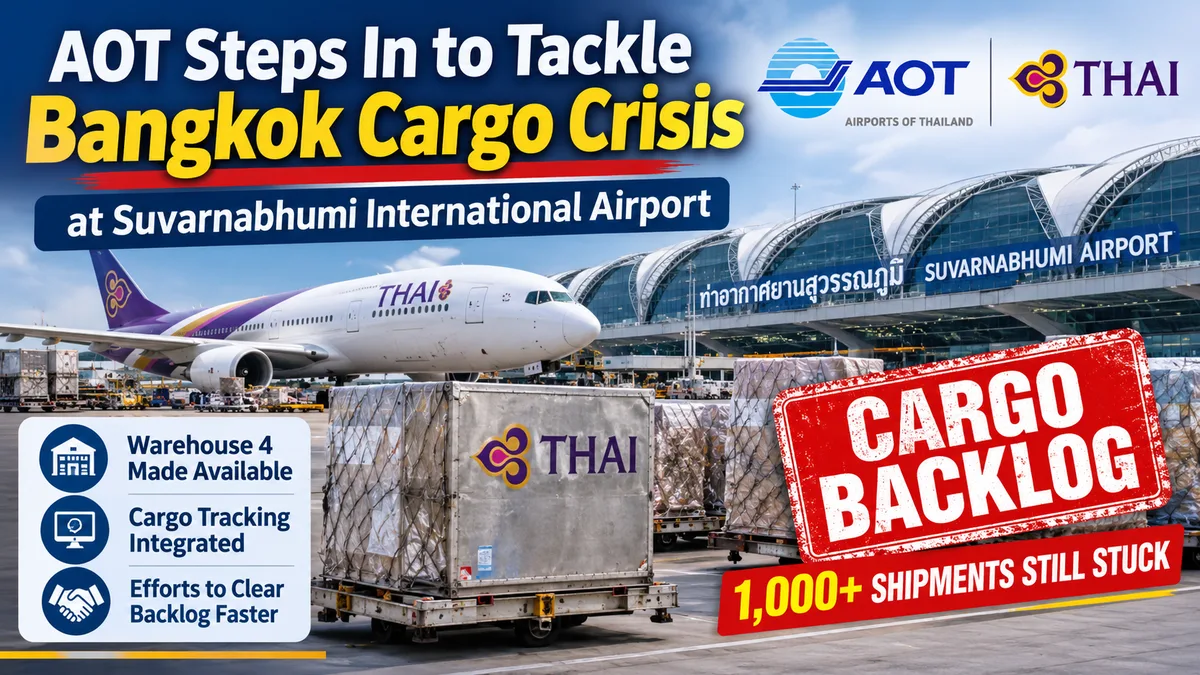

Airports of Thailand (AOT) has stepped in directly to help resolve a deepening cargo crisis at Suvarnabhumi International Airport, announcing on November 9 that it is providing Thai Airways with extra warehouse space and integrating the airline's cargo tracking with its own AOT Cargo Clearhouse platform. The crisis, which began in late September following severe Bangkok flooding, has now entered its seventh week — with some inbound shipments that arrived on October 10 still stuck in the warehouse as of last week.
How the Crisis Started
The backlog originated on September 30, 2026, when flooding across Bangkok left Thai Airways critically short of warehouse staff, forcing the airline to suspend all cargo acceptance — inbound, outbound, and transit — at its Suvarnabhumi warehouse for six days, through October 6. While cargo intake eventually resumed, the airline was unable to clear the backlog that had built up during the suspension, and congestion has compounded steadily in the weeks since.
The disruption was further complicated by a failure in Thai Airways' warehouse management system, which stopped recording the storage locations of individual shipments in real time. Without accurate location data, freight forwarders and customs brokers were unable to pay duties and collect consignments — leaving cargo physically present in the warehouse but effectively inaccessible. The Thai Airfreight Forwarders Association (TAFA) raised this issue formally at an emergency AOT meeting on November 5, stating that the Cargo Clearhouse platform was failing to show correct shipment status and storage locations.
What AOT Is Doing Now
Following a directive from Deputy Prime Minister and Transport Minister Phiphat Ratchakitprakarn, AOT President Pavina Jariyathitipong announced on November 9 that the airport operator is taking concrete steps to accelerate the clearance:
- Warehouse 4 (WH-4), located inside Suvarnabhumi's duty-free zone, is being made available to Thai Airways for oversized cargo — freeing critical space in the main inbound warehouse and allowing backlogged goods to be moved out faster.
- AOT is integrating Thai Airways' cargo tags directly with its own Cargo Clearhouse tracking platform, restoring the real-time visibility that forwarders and customs brokers need to locate and release shipments.
- AOT is in discussions with Thai Airways and the Customs Department about whether domestic warehouse space at the airport could be repurposed to accommodate the overflow of international cargo — a measure still under consideration.
AOT said it is monitoring inbound and outbound volumes and the size of the remaining backlog on a continuous basis so it can intervene further where needed.
Scale of the Disruption
Accounts circulating among airlines and freight agents put the number of cargo lots still awaiting release at more than 1,000, though no official figure has been confirmed publicly. Thai Airways told businesses waiting on shipments that goods which arrived before October 23 are being prioritised for clearance first.
The human and commercial impact is significant. The Thai National Shippers' Council (TNSC) has warned that the disruption is severely affecting export supply chains, with businesses that depend on air freight for schedule reliability facing costly downstream delays. At least one factory reported halting production while waiting for components held in the warehouse. The electronics sector has been particularly exposed — rapid growth in chip, hard disk drive, and component shipments through 2026 had already increased pressure on cargo handling and inspection systems at Suvarnabhumi before the crisis began.
Airlines have responded by restricting inbound Bangkok freight on a rolling basis, with The Loadstar reporting on November 9 that the backlog has now spread from imports to exports, as the warehouse congestion prevents outbound cargo from being processed efficiently.
Thai Airways' Response
Thai Airways issued a public apology on November 5 and outlined a recovery plan. The airline said it had been adding staff, forklifts, and equipment since November 1. It is also installing 100 additional Wi-Fi access points throughout the warehouse and developing a new application to scan and record cargo locations in real time — the fix for the warehouse management failure that has been the central bottleneck in the clearance effort.
Suvarnabhumi Airport handled 133,992 tonnes of cargo in September 2026, up 2.2% year on year, according to CAPA data — underlining that the crisis is an operational failure at the Thai Airways warehouse level rather than an airport-wide capacity problem.
What This Means for Freight Forwarders and Shippers
For logistics professionals routing time-sensitive cargo through Bangkok, the situation remains actively disruptive as of November 10. With no confirmed resolution date from AOT or Thai Airways, shippers with pending inbound shipments via Thai Airways' Suvarnabhumi warehouse should contact their freight forwarders immediately to assess the status of specific consignments and explore rerouting options via alternative Thai Airways gateways or competing airlines. Outbound cargo bound for Bangkok should factor in extended processing times until the warehouse tracking system is fully restored.
🔑 Key Takeaways — November 10, 2026
- AOT intervenes directly — providing Warehouse 4 and cargo tracking integration to help Thai Airways clear the backlog. Deputy PM personally directed the intervention.
- Crisis is now in its 7th week — started September 30 with Bangkok flooding. Some October 10 shipments still stuck as of last week.
- 1,000+ cargo lots outstanding — no official count confirmed, but airline industry accounts point to over 1,000 consignments awaiting release.
- Root cause: warehouse management system failure — cargo locations not being recorded correctly, preventing forwarders from locating and clearing goods.
- Backlog now spreading to exports — airlines restricting inbound Bangkok freight as congestion hits outbound cargo processing too.
- Thai Airways priority order: October 23 arrivals and earlier — businesses with later shipments may face continued delays.
- Action for shippers now — contact your forwarder, check consignment status, and consider rerouting time-sensitive cargo to alternative gateways until resolution is confirmed.
Source date: November 9, 2026 | Published: November 10, 2026



Comments
No comments yet. Be the first to share your thoughts!