
Traffic Through Hormuz Has Nearly Vanished
New ship-tracking data confirms just how severely the Strait of Hormuz crisis has strangled commercial shipping through one of the world's most important oil chokepoints.
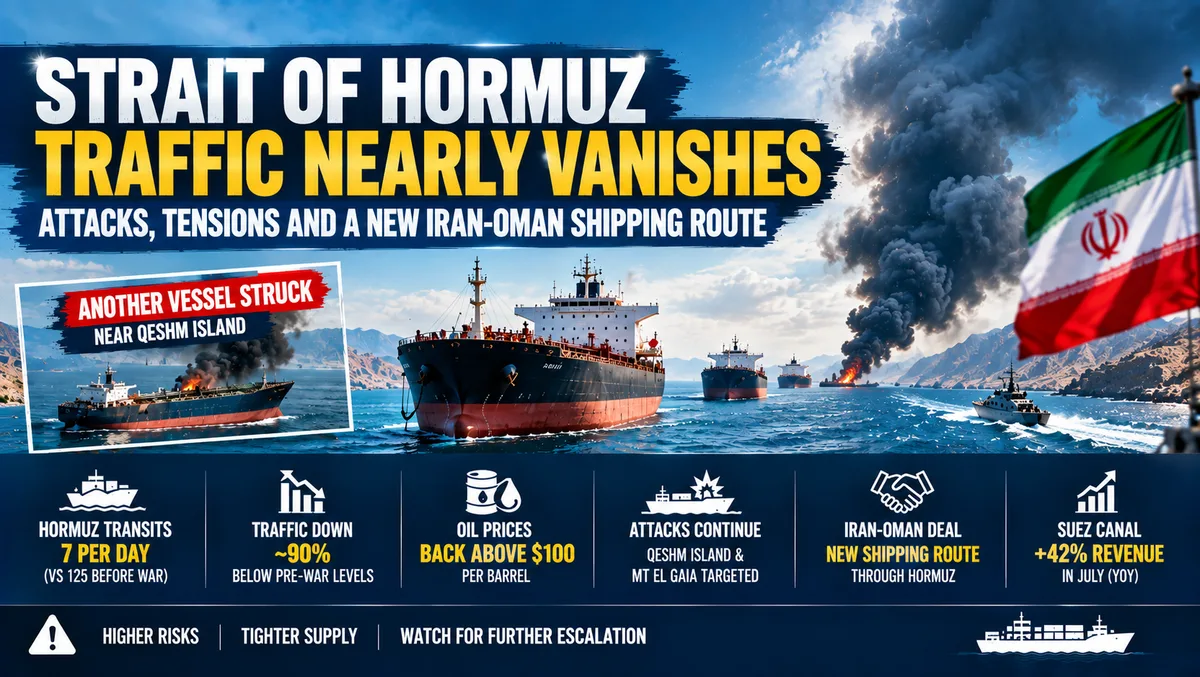
Vessel transits at the Strait of Hormuz fell to seven on Thursday, September 10, from 11 the previous day, according to preliminary ship-tracking data — well below the 10-day average of 15. Of the seven vessels, two Panamax ships exited the strait, one carrying fertiliser and the other sailing in ballast (empty), while five vessels entered, including bulk carriers loaded with steel and grains, and a tanker carrying refined petroleum products.
These figures exclude any vessels that might have crossed the strait with their AIS tracking transponders turned off to avoid detection — meaning actual traffic, including "dark" shuttle transits, may be somewhat higher than the official count.
Before the Iran war started on February 28, 2026, the strait typically handled about 125 large commercial vessels per day — tankers, gas carriers, bulkers, and container vessels — accounting for roughly 20% of the world's daily crude oil and LNG supply. Traffic today remains approximately 90% below pre-conflict levels.
Another Vessel Struck — This Time Near Qeshm Island
The traffic collapse comes as attacks on commercial shipping in the strait continue. Iranian state media claimed an Iranian commercial vessel was struck in the Strait of Hormuz late Saturday, September 12, killing one person, amid the ongoing battle between the US and Iran for control over the crucial energy chokepoint.
The attack, which Iran's state broadcaster IRIB said injured four people, took place near Qeshm Island in the strait. Qeshm Island sits about 14 miles from the Iranian port city of Bandar Abbas and is considered key to Iran's efforts to assert control over traffic through the waterway.
The United Kingdom Maritime Trade Operations Centre (UKMTO) independently confirmed the incident, saying it received a report of an attack late Saturday by an unknown projectile while a vessel was transiting the strait. A fire broke out onboard, and local authorities were on the scene helping to evacuate crew members, UKMTO said.
Separately, India's Ministry of External Affairs said the MT El Gaia — a Panamanian-flagged vessel with 14 Indian crew members onboard — was also attacked in the region around the same time. As of the latest reporting, the US has not commented on the reported attack, and CNN has reached out to US Central Command for comment.
A Second Front Adds to the Pressure
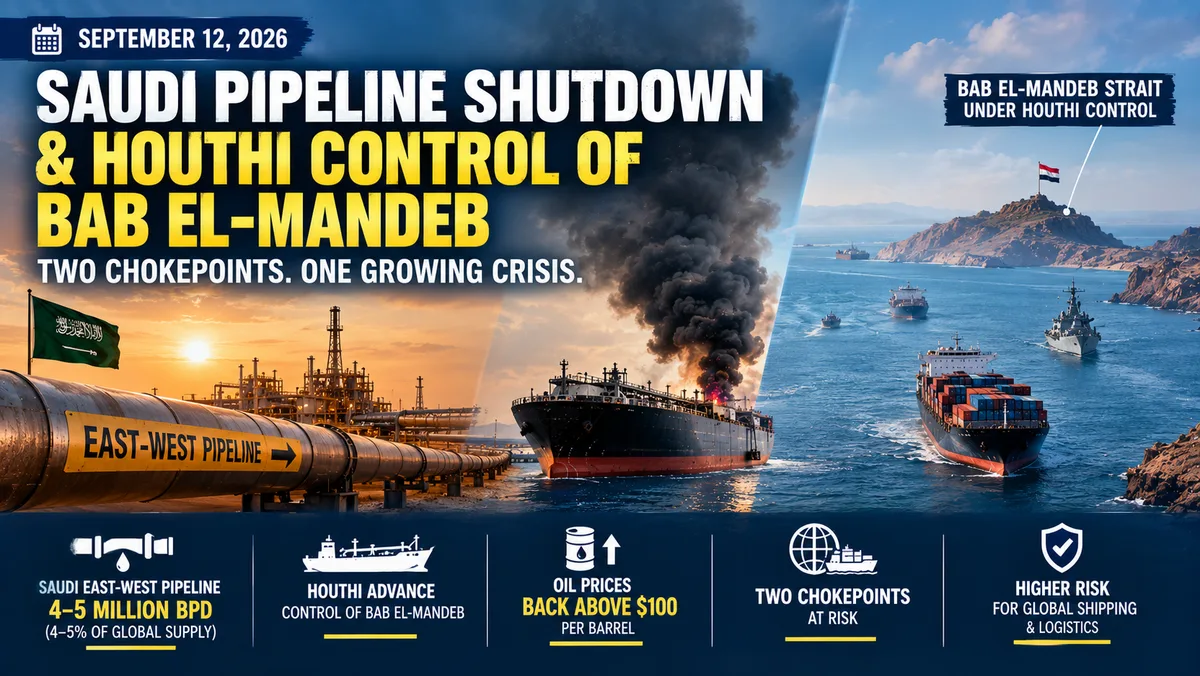
This latest Hormuz attack comes at the same time as Iran-backed rebels in Yemen step up attacks and advance their efforts to control a second vital waterway in the region — the Bab el-Mandeb Strait, which we covered in our previous reporting on the Houthi advance to Perim Island. Together, these two developments could put further pressure on global oil prices as Iran-aligned forces gain influence over chokepoints on both sides of the Arabian Peninsula.
Today's Big Development: Iran and Oman Sign a Shipping Agreement
Perhaps the most significant development is happening today. A senior Iranian government official and Gulf diplomat said officials from Iran and Gulf countries were set to meet in Oman's capital, Muscat, on Monday, September 14 — today — to sign an agreement establishing an Iran-Oman shipping route through the Strait of Hormuz.
The official added that there are currently no negotiations taking place directly with the United States. This suggests Iran is pursuing a regional, bilateral approach to managing Gulf shipping — coordinating with neighbouring Oman rather than reaching a broader deal with Washington.
Meanwhile, a senior Iranian official dismissed hopes of fresh talks with the US resuming any time soon, according to multiple reports. Iranian President Masoud Pezeshkian also met with Abu Dhabi Crown Prince Sheikh Khaled bin Mohamed bin Zayed Al Nahyan on the sidelines of the BRICS Summit in New Delhi on September 12 — suggesting Iran is actively working multiple regional diplomatic channels around the Gulf shipping crisis, even as talks with the US remain stalled.
What Might the Iran-Oman Route Mean?
While full details of the agreement have not yet been published, the framing — an "Iran-Oman shipping route through the Strait of Hormuz" — suggests Iran may be trying to establish some form of officially sanctioned, jointly managed transit corridor with a neighbouring Gulf state, separate from any arrangement involving the US or other Western powers.
For shippers, this raises important questions that remain unanswered as of today:
- Would vessels using this Iran-Oman route be treated differently than others by Iranian forces?
- Would this arrangement offer any additional security guarantees, or simply formalise existing informal shuttle patterns?
- How would this interact with the US naval blockade currently enforced on the other side of the strait?
Shippers and freight forwarders should watch for official details following today's signing before drawing conclusions about what practical difference this agreement might make to vessel safety or transit approval processes.
Some Signs of Adaptation: Saudi Arabia's Red Sea Pivot
Amid the ongoing disruption, there are signs that oil producers are successfully adapting their routing to avoid Hormuz. Saudi Arabia's crude and condensate loadings at the Red Sea port of Yanbu — a key hub used to bypass the Strait of Hormuz entirely — have rebounded in September after hitting a six-month low in August.
Yanbu loadings rose to 3.7 million barrels per day in September, up from 3.2 million bpd in August (the lowest level since the war began), according to Vortexa data. Kpler's estimates show an even sharper rebound — from 1.5 million bpd in August to 2.9 million bpd in September.
The August dip in Yanbu loadings was itself caused by intensifying Houthi attacks near the Bab el-Mandeb Strait — showing how disruption at one chokepoint can quickly affect routing decisions at the other, even when they are hundreds of miles apart.
Suez Canal Benefiting From the Crisis
One clear winner from this ongoing disruption has been the Suez Canal. Suez Canal revenue rose 42% in July compared to the same month a year earlier, as the effective closure of the Strait of Hormuz and Houthi threats in the southern Red Sea led more ships to use the Egyptian waterway as an alternative routing option — despite the Red Sea's own security risks.
What Does This Mean for Global Shipping and Logistics?
For freight forwarders, shippers, and anyone connected to Gulf energy markets, today's developments carry several practical implications:
- Traffic remains severely depressed — plan accordingly. With transits running at roughly 7-11 vessels per day against a pre-war baseline of 125, any Gulf-dependent supply chain should assume continued severe capacity constraints for the foreseeable future.
- Attacks on commercial vessels continue regularly. The Qeshm Island incident is only the latest in a long series of strikes on merchant shipping since the war began. This is not a one-off event — it reflects an ongoing, active risk environment.
- Watch for details of the Iran-Oman agreement. Signed today, this could introduce new routing options or procedures — but specifics are not yet public. Confirm with your carrier or forwarder whether this affects any planned Gulf transits.
- Red Sea alternative routing carries its own risks. As Saudi Arabia's Yanbu experience shows, shifting to Red Sea routes to avoid Hormuz does not eliminate risk — it exposes cargo to Houthi activity near Bab el-Mandeb instead, especially given the recent escalation there.
- Suez Canal remains the primary beneficiary. With revenue up 42% year-on-year in July, the Suez Canal continues to absorb diverted traffic — though at higher transit costs and with its own evolving security considerations.
- US-Iran diplomacy remains stalled. With Iranian officials indicating no current negotiations with Washington, and pursuing bilateral arrangements with Oman instead, a broader resolution to the Hormuz crisis does not appear imminent.
Key Takeaways — September 14, 2026
- Vessel transits through Hormuz fell to 7 on September 10 — well below the 10-day average of 14-15.
- Pre-war traffic was approximately 125 vessels/day; current traffic is roughly 90% below that level.
- An Iranian commercial vessel was struck near Qeshm Island late September 12, killing 1 and injuring 4 (per Iranian state media).
- UKMTO independently confirmed the attack; a fire broke out and crew were evacuated.
- India confirmed a separate attack on the Panamanian-flagged MT El Gaia, carrying 14 Indian crew.
- Today, September 14, Iran and Oman are set to sign an agreement establishing a joint shipping route through Hormuz.
- No current negotiations are taking place between Iran and the US, according to Iranian officials.
- Saudi Arabia's Yanbu Red Sea exports have rebounded in September after an August low tied to Houthi activity.
- Suez Canal revenue rose 42% year-on-year in July as ships divert from both Hormuz and parts of the Red Sea.
The Strait of Hormuz crisis shows no signs of resolution nearly seven months after it began. With traffic near historic lows, attacks on commercial vessels continuing, and today's Iran-Oman shipping agreement adding a new and still-unclear dimension to the situation, shippers and freight forwarders should continue treating Gulf routing as a high-risk, actively evolving situation requiring daily monitoring.


Comments
No comments yet. Be the first to share your thoughts!