A Major Investment Moment for Beirut's Port
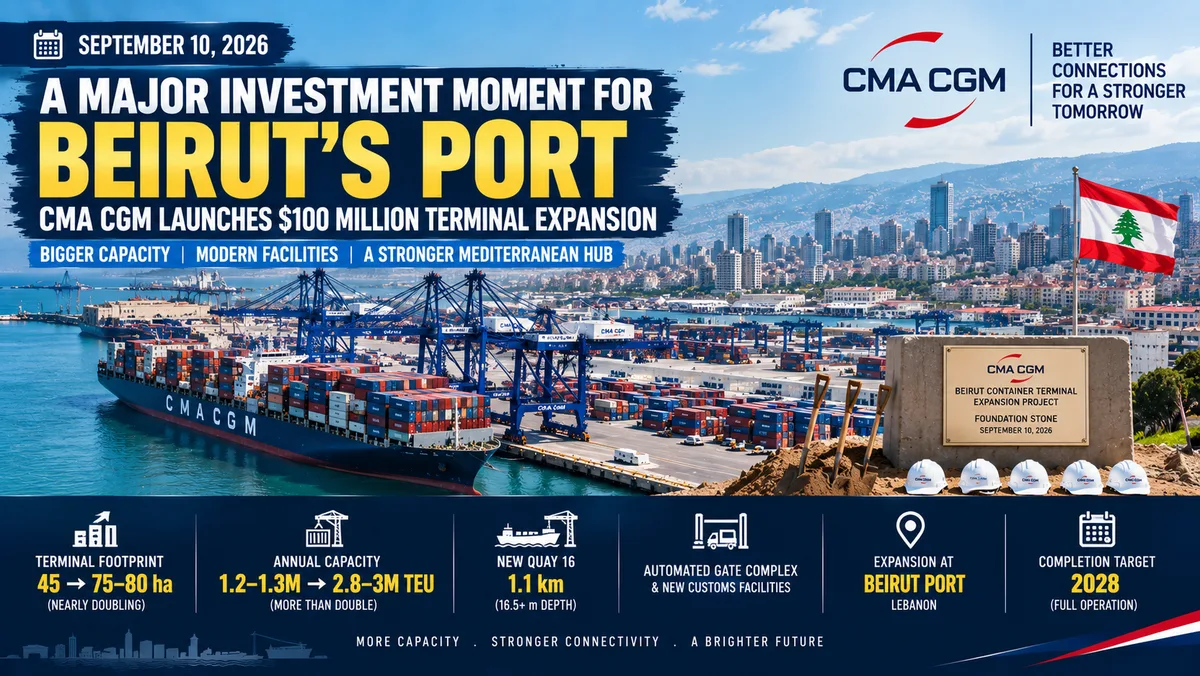
On September 10, 2026, CMA CGM laid the foundation stone for a significant expansion and modernization project at the container terminal of the Port of Beirut — a $100 million investment that will reshape one of Lebanon's most important pieces of trade infrastructure.
The French shipping and logistics giant has broken ground on a project that will substantially increase both the physical size and the operating capacity of the terminal, marking the third and largest expansion phase in the terminal's history.
What Exactly Is Being Built?
The scale of the expansion is significant. According to figures shared by CMA CGM and confirmed at the ceremony, the project will:
- Nearly double the terminal's footprint — growing from approximately 45 hectares to somewhere between 75 and 80 hectares, depending on the specific reporting
- More than double annual handling capacity — rising from about 1.2-1.3 million TEUs today to a target of 2.8 to 3 million TEUs by 2028
- Add a new quay for feeder vessels — including the development of Quay 16, a 1.1-kilometre berth with more than 16.5 metres of depth
- Build an automated gate complex — modernizing how trucks and cargo enter and exit the terminal
- Add new customs inspection facilities — improving the speed and efficiency of cargo clearance
- Optimize storage areas and add additional handling equipment across the yard
The work is being implemented in phases between 2026 and 2028, with the fully expanded facility expected to be operational by 2028 — a construction timeline of roughly 16 to 18 months for the core works.
Who Attended the Foundation Stone Ceremony?
The ceremony brought together senior figures from both the Lebanese government and CMA CGM:
- Rodolphe Saadé — Chairman and CEO of the CMA CGM Group
- Nawaf Salam — Prime Minister of Lebanon
- Fayez Rasamny — Minister of Public Works and Transport
- Marwan Naffi — Chairman and General Manager of the Port of Beirut
- Tanya Saadé Zeenny — CMA CGM Executive Officer and President of the CMA CGM Foundation
The presence of Lebanon's Prime Minister alongside CMA CGM's top leadership signals how significant this investment is considered for the country — not just as a port upgrade, but as a broader statement about confidence in Lebanon's economic recovery.
What Did the Officials Say?
Prime Minister Nawaf Salam framed the project as more than a simple infrastructure upgrade. He described it as a step toward restoring Beirut port's historic role as one of the main ports of the eastern Mediterranean — a reference to the period before Lebanon's economic crisis and the 2020 port explosion, when Beirut was a significantly more prominent regional trade hub.
Minister Fayez Rasamny said investment in Lebanon should be seen as "a decision of confidence," adding that an investment from a global company of CMA CGM's size carries particular significance for how international investors view Lebanon's trajectory. He also noted that the government is examining proposals to restore railway links with Syria and potentially revive part of the historic Hejaz Railway — and that Lebanon is seeking a role in major regional transport initiatives, including the India-Middle East-Europe Economic Corridor (IMEC).
Port Chairman and General Manager Marwan Naffi called the expansion the third and largest phase of development in the container terminal's history, and said the new capacity would place Beirut among the larger container terminals in the Mediterranean — strengthening its potential as a regional logistics hub.
The Background: CMA CGM's Role at Beirut Since 2022
CMA Terminals — CMA CGM's terminal operating subsidiary — took over the management, operation, and maintenance of the Beirut container terminal in March 2022, under a 10-year concession agreement. That original arrangement included an initial $33 million investment plan targeting 1.4 million TEUs of capacity.
Since then, according to officials at this week's ceremony, the focus has been on strengthening the terminal's capacity and performance. This new $100 million phase goes considerably further — aiming not just to maintain the terminal, but to fundamentally transform its scale and role in regional shipping.
CMA CGM has maintained a strong commercial presence in Lebanon throughout this period, historically accounting for a majority share of the terminal's container volumes through its regular weekly service calls and transshipment operations.
Why Does This Matter for Regional Shipping?
Beirut's port sits at a strategically interesting point in the eastern Mediterranean, and this expansion has implications beyond Lebanon's own trade:
- Transshipment potential. A larger, more efficient terminal with deeper berths (Quay 16 at over 16.5 metres depth) allows Beirut to handle larger vessels and compete more effectively for transshipment cargo — containers that arrive on one ship and are transferred to another for onward delivery, rather than being a purely local trade gateway.
- Regional connectivity ambitions. Lebanese officials explicitly linked this investment to broader regional transport ambitions, including a potential role in the IMEC corridor — the India-Middle East-Europe trade route initiative that has been gaining international attention as an alternative to traditional Suez-dependent shipping patterns.
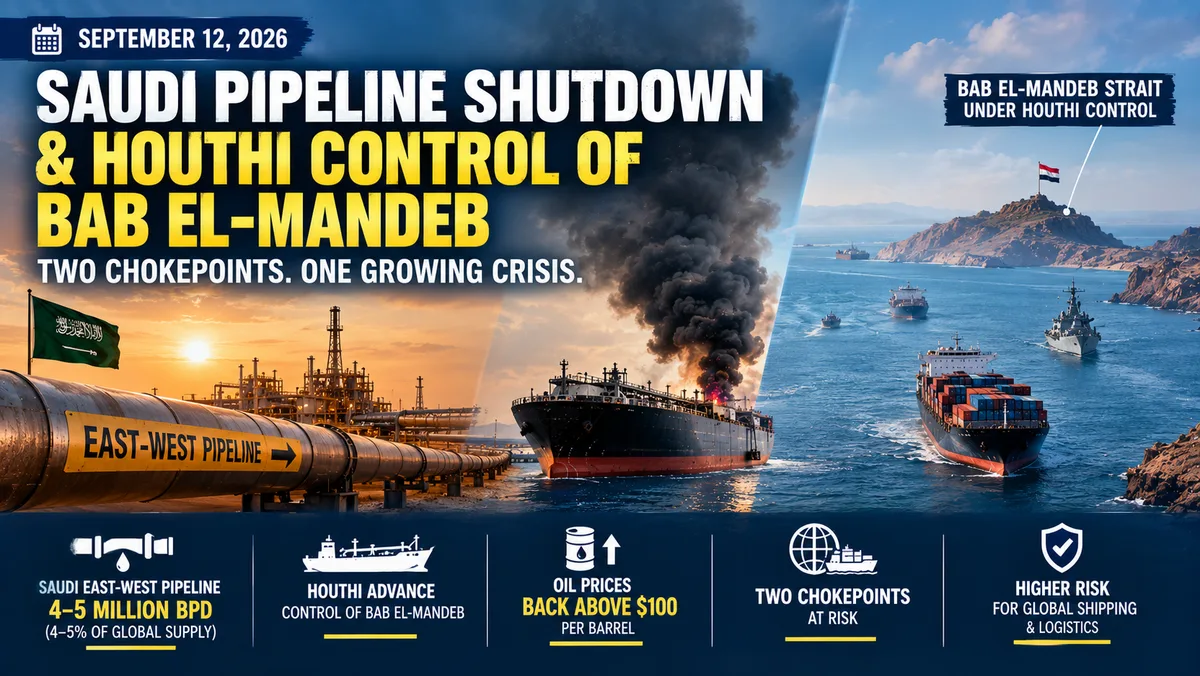
- Signal of confidence amid regional instability. This investment comes at a moment when the wider Middle East is experiencing significant shipping disruption — from the Strait of Hormuz crisis to escalating tension around the Bab el-Mandeb Strait. A major carrier committing $100 million to a multi-year Mediterranean port project sends a signal of longer-term confidence even amid short-term regional turbulence.
- Lebanon's broader economic recovery narrative. Following years of economic crisis, the 2020 port explosion, and regional conflict spillover, this expansion is being positioned by Lebanese officials as tangible evidence of renewed international investor confidence in the country.
What Does This Mean for Shippers and Freight Forwarders?
- More capacity coming to the eastern Mediterranean by 2028. Shippers routing cargo through the eastern Mediterranean or considering Beirut as a transshipment or gateway option should factor in this capacity expansion when planning multi-year supply chain strategies.
- Improved customs and gate efficiency expected. The addition of an automated gate complex and new customs inspection facilities should, over time, reduce truck turnaround times and cargo clearance delays at the terminal — a common pain point at older, capacity-constrained ports.
- Deeper berths mean larger vessel capability. Quay 16's depth of more than 16.5 metres will allow Beirut to accommodate larger container vessels than it currently can — potentially opening the port to bigger mainline services rather than only feeder vessels.
- This is a multi-year project, not an immediate change. With completion targeted for 2028, shippers should not expect immediate operational changes. This is relevant for medium-to-long-term network planning rather than near-term booking decisions.
- Watch for IMEC-related developments. If Lebanon does secure a formal role in the India-Middle East-Europe Economic Corridor, Beirut's strategic relevance to global shippers could increase further — a trend worth monitoring alongside this physical expansion.
Key Takeaways — September 12, 2026
- CMA CGM laid the foundation stone for a $100 million Beirut container terminal expansion on September 10, 2026.
- Terminal footprint will grow from ~45 hectares to 75-80 hectares.
- Annual handling capacity will more than double, from ~1.2-1.3 million TEUs to 2.8-3 million TEUs.
- New Quay 16 will offer a 1.1km berth with 16.5+ metres of depth for larger vessels.
- Project includes an automated gate complex, new customs facilities, and optimized storage areas.
- Expected completion and full operation by 2028.
- This is the third and largest expansion phase in the terminal's history since CMA Terminals took over management in 2022.
- Lebanese officials linked the project to broader ambitions around the India-Middle East-Europe Economic Corridor (IMEC).
- Ceremony attended by Lebanese PM Nawaf Salam, CMA CGM CEO Rodolphe Saadé, and senior government and port officials.
CMA CGM's $100 million commitment to Beirut is a significant vote of confidence in Lebanon's port infrastructure at a time of considerable regional uncertainty. For shippers and freight forwarders looking at eastern Mediterranean routing options over the next several years, Beirut's expanded capacity, deeper berths, and modernized facilities are worth tracking as the project moves through construction toward its 2028 completion target.


Comments
No comments yet. Be the first to share your thoughts!