What Was Just Announced?
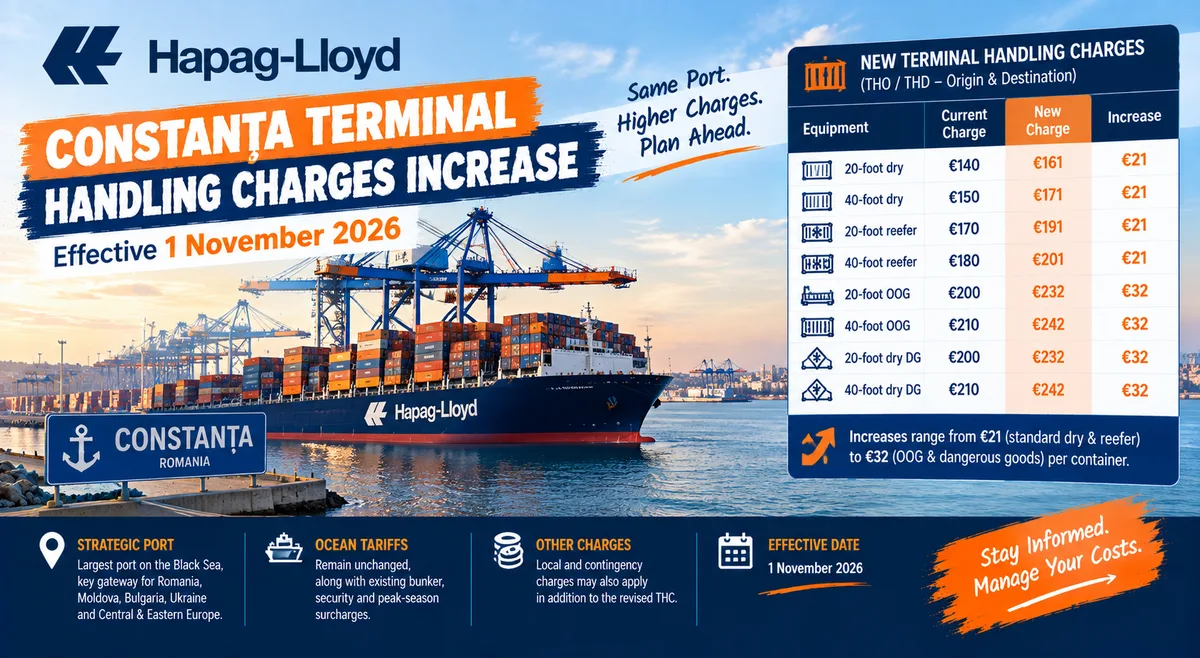
Hapag-Lloyd will increase its Constanta terminal handling charges for shipments moving to and from the Romanian port, effective 1 November 2026.
The revised Terminal Handling Charge Origin (THO) and Terminal Handling Charge Destination (THD) levels will apply from that date and remain valid until further notice. The same rates will apply at both origin and destination.
What Are the New Charges?
Here is the complete breakdown of current versus new charges, by equipment type:
| Equipment | Current Charge | New Charge | Increase |
|---|---|---|---|
| 20-foot dry | €140 | €161 | €21 |
| 40-foot dry | €150 | €171 | €21 |
| 20-foot reefer | €170 | €191 | €21 |
| 40-foot reefer | €180 | €201 | €21 |
| 20-foot OOG | €200 | €232 | €32 |
| 40-foot OOG | €210 | €242 | €32 |
| 20-foot dry dangerous goods | €200 | €232 | €32 |
| 40-foot dry dangerous goods | €210 | €242 | €32 |
The increases range from €21 per container for standard dry and reefer equipment to €32 per container for out-of-gauge (OOG) and dangerous goods shipments — meaning specialized and hazardous cargo faces a proportionally larger cost increase than standard containers.
What Stays the Same?
Hapag-Lloyd confirmed that its ocean tariff rates and previously announced bunker, security and peak-season surcharges remain unchanged with this update. However, other local and contingency charges may apply in addition to the revised THC — meaning shippers should not assume the terminal handling charge is the only cost affected, and should check for any other applicable local fees at Constanta.
Why Does Constanta Matter for Regional Shipping?
Constanta, located on Romania's Black Sea coast, is the largest port on the Black Sea and a key gateway for container traffic serving Romania, Moldova, Bulgaria, Ukraine, and parts of Central and Eastern Europe. For shippers moving goods into or out of this region, Constanta is frequently the primary or only direct container port option, making terminal cost changes here directly relevant to a wide swath of Eastern European trade.
How Does This Fit Hapag-Lloyd's Broader Pricing Pattern?
This Constanta increase is part of a steady stream of charge and tariff adjustments Hapag-Lloyd has rolled out across its network in recent weeks. The carrier has separately announced an ocean tariff rate increase from Pakistan to North Europe and the Mediterranean effective October 1, 2026, and a Far East-to-Europe ocean tariff increase covering North Europe, the West and East Mediterranean, the Adriatic, and the Black Sea, effective for sailings from October 19, 2026.
Taken together, these announcements show Hapag-Lloyd adjusting pricing across multiple dimensions — ocean tariffs on specific trade lanes, and terminal handling charges at specific ports — rather than a single blanket increase. Shippers should check updates for their specific ports and trade lanes individually rather than assuming one announcement covers their full cost exposure.
What Does This Mean for Shippers Using Constanta?
- Budget for the increase starting November shipments. Any booking with a terminal handling date on or after November 1, 2026, at Constanta will be subject to the new, higher charges — factor this into cost calculations for upcoming shipments.
- Specialized cargo faces the steepest increases. If you regularly move out-of-gauge or dangerous goods through Constanta, the €32 per container increase is proportionally larger than the standard container increase — review your cost projections for these cargo types specifically.
- Check for additional local charges. Since Hapag-Lloyd explicitly noted that other local and contingency charges may apply in addition to the revised THC, confirm with your carrier or forwarder whether any further charges affect your specific Constanta shipments.
- Ocean tariff rates are unaffected by this specific announcement. If you are tracking overall freight costs to or from Constanta, remember this increase applies only to terminal handling — any separate ocean tariff changes on your specific trade lane would be announced independently.
- Factor this into contract renewal negotiations. If your organization has volume agreements or contracts covering Constanta shipments, this THC increase is a legitimate cost factor to raise during renewal discussions with your carrier or forwarder.
Key Takeaways — October 6, 2026
- Hapag-Lloyd is raising Constanta terminal handling charges effective November 1, 2026.
- Dry containers: 20ft rises from €140 to €161; 40ft rises from €150 to €171.
- Reefer containers: 20ft rises from €170 to €191; 40ft rises from €180 to €201.
- OOG and dangerous goods containers see the steepest increases — €32 per container, reaching €232-€242.
- Same rates apply at both origin (THO) and destination (THD).
- Ocean tariff rates and existing bunker, security, and peak-season surcharges remain unchanged.
- Other local and contingency charges may still apply in addition to the revised THC.
- This follows separate Hapag-Lloyd ocean tariff increases on Pakistan-Europe and Far East-Europe lanes announced for October 2026.
This is a straightforward terminal-level cost adjustment rather than a broader network-wide change — but for shippers and freight forwarders regularly routing cargo through Constanta, the increase is worth building into cost calculations ahead of the November 1 effective date, particularly for specialized equipment types facing the larger increases.


Comments
No comments yet. Be the first to share your thoughts!