
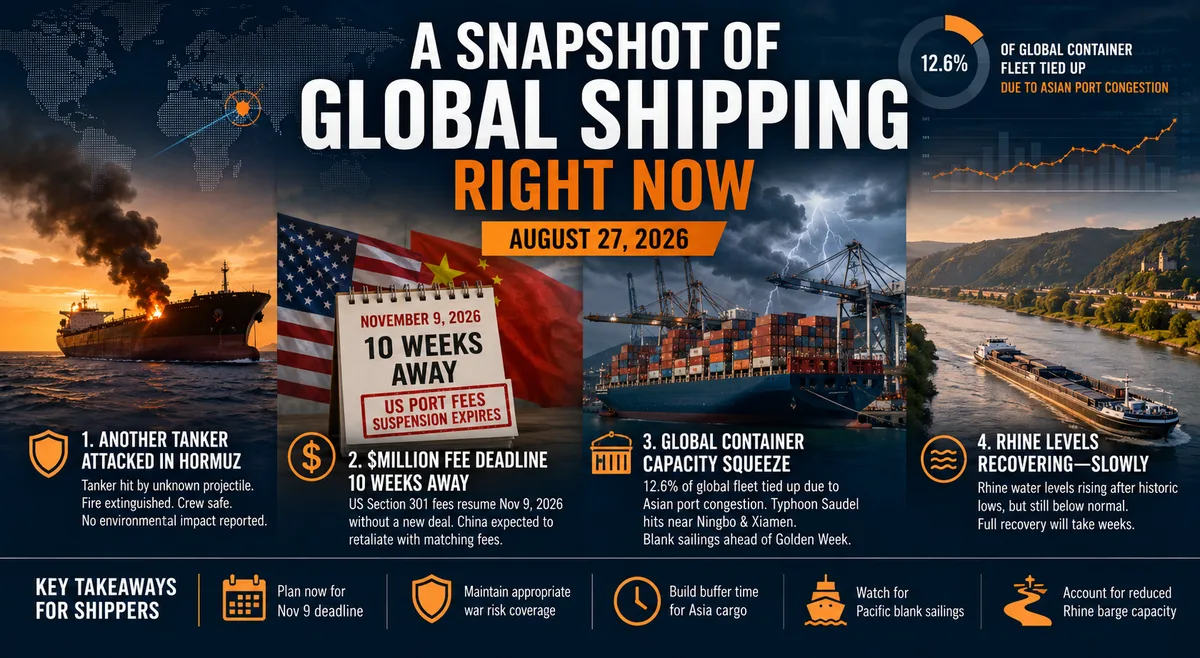
A Snapshot of Global Shipping Right Now
Every so often, a single week's worth of shipping news captures just how many pressures are hitting global freight all at once. Late August 2026 is one of those moments.
Industry analysts tracking global shipping have flagged four separate developments this week — a fresh attack in the Strait of Hormuz, a looming deadline on US-China port fees, worsening typhoon-driven congestion in Asia, and a slow recovery on Europe's most important river. Each one on its own would be significant. Together, they paint a picture of a global shipping system under strain from multiple directions simultaneously.
Here is what happened, and what it means for shippers and freight forwarders.
1. Another Tanker Attacked in the Strait of Hormuz
The UK Maritime Trade Operations (UKMTO) centre reported this week that a tanker in the Strait of Hormuz was hit by an unknown projectile, sparking a fire on the vessel. The fire has since been extinguished. All crew are reported as safe and accounted for, and there has been no report of environmental impact.
This is far from an isolated incident. The Strait of Hormuz has been a war zone since the US-Israel military campaign against Iran began on February 28, 2026, and attacks on commercial vessels have continued sporadically ever since — even as diplomatic talks between the US, Iran, and regional mediators continue.
Notably, this attack comes at a moment when there are signs of possible progress toward a resolution. Iran and Oman have been working on a proposed framework for a temporary shipping corridor through Hormuz, with Omani officials expressing hope that a temporary route and practical arrangements to restore safe navigation could be announced soon. But as this attack shows, the situation on the water remains volatile even as diplomacy continues in parallel.
2. The $Million Fee Deadline Is Now Just 10 Weeks Away
This is the detail that deserves the most attention from anyone shipping via Chinese-linked vessels — because it has been easy to lose track of amid everything else happening in global trade this year.
Back in October 2025, the US Trade Representative (USTR) implemented steep new port-entry fees on Chinese-owned, Chinese-operated, and Chinese-built vessels calling at US ports — fees that could run into the hundreds of thousands or even millions of dollars per vessel call, depending on tonnage and container count. China responded with matching retaliatory fees on US-linked shipping.
Both sides agreed to suspend these fees for one year, following a trade deal reached between the US and China in November 2025. That suspension runs until November 9, 2026 — meaning it expires in roughly 10 weeks from now.
Here is the critical point: the suspension was designed to create a window for a permanent agreement to be negotiated. As of today, no such agreement has been reached. If nothing changes, the fees are scheduled to snap back into effect automatically at the end of the suspension period.
Who Would Be Hit the Hardest?
Not every carrier is equally exposed. The fee structure specifically targets vessels based on ownership, operation, and where they were built — and in some cases, even the board composition of the owning entities. This creates uneven exposure across the industry:
- COSCO, OOCL, Matson, and Hede Shipping — significant exposure on Pacific trades due to Chinese ownership or operation structures
- CMA CGM (through its APL subsidiary) — exposure specifically on its Eagle Express 1 service
- Maersk — exposure on its TP7 service, which includes US-flagged vessels
- Other major carriers — have more flexibility to reduce their exposure by reshuffling Chinese-built or Chinese-linked vessels onto other trade routes that do not call at US ports
This uneven exposure matters strategically. Carriers with concentrated exposure on specific US-facing services have less room to maneuver than carriers who can simply redeploy vessels elsewhere in their global network.
What Happens If China Retaliates Again?
If the US allows its fees to resume in November, industry watchers widely expect China to respond the same way it did the first time: with matching retaliatory fees on US-linked shipping. Given that China took reciprocal action within days of the original US fees taking effect in 2025, a similar quick response should be expected if the situation repeats itself.
For shippers, this means the next 10 weeks are a critical window. If a new US-China agreement is not reached before November 9, the shipping industry could see a return to the fee structure and resulting cost pass-throughs that disrupted trade in late 2025 — this time potentially compounded by everything else already straining global capacity.
3. Global Container Capacity Squeeze Hits a New High
While the Hormuz and US-China stories represent geopolitical risk, this next development is a pure operational capacity problem — and it is getting worse, not better.
According to the latest data from shipping analytics firm Linerlytica, roughly 12.6% of the world's entire container fleet is currently tied up due to port congestion, primarily concentrated in Asia. This is being driven by a relentless sequence of typhoons that have battered China's east coast in recent weeks — Bavi, Noul, and Dolphin have already struck, and a fourth storm, Typhoon Saudel, has now made landfall along the coast between central Zhejiang and central Fujian provinces — the region that includes the critical ports of Ningbo and Xiamen.
Each new storm adds to a backlog that has not had time to clear from the previous one. Shanghai's vessel queue has swelled dramatically in recent weeks, and Ningbo has faced similar pressure. The cumulative effect is capacity that has now surpassed even the peak congestion levels seen during the Covid-era supply chain crisis of 2022 — though as a share of today's larger global fleet, the percentage impact is somewhat smaller than it was then.
The knock-on effects extend well beyond China. As congestion ties up capacity in Asia, some carriers have responded with blank sailings — cancelled voyages — to manage the imbalance. This pattern is reinforced by the arrival of the seasonal Golden Week downturn in Chinese export demand, which typically softens cargo volumes in early October. Carriers are already adjusting capacity in anticipation, with MSC among those announcing blank sailings on the Pacific trade to match reduced demand with the constrained capacity picture.
Why This Matters for Rates and Schedules
Container availability, vessel schedules, and freight rates are all interconnected. When over one-eighth of the global fleet is stuck waiting at anchor rather than moving cargo, the ships that ARE available become significantly more valuable — supporting elevated transpacific rates even as demand shows some signs of softening. Meanwhile, on Asia-Europe trades, the dynamic has been somewhat different, with rates facing downward pressure as carriers gradually resume Suez Canal transits, adding effective capacity back into that specific market even as North Asian port congestion continues.
This divergence — tight and elevated on transpacific, softer on Asia-Europe — is expected to persist for at least another month as the two trade lanes respond to different underlying pressures.
4. Rhine River Levels Are Recovering — Slowly
There is at least one piece of cautiously positive news this week. Water levels on the Rhine River — a critical inland waterway for European distribution, particularly for chemicals, coal, and industrial goods moving between German ports and inland manufacturing centers — have begun to rise after hitting historic lows.
The Rhine hit its lowest recorded level since measurements began in 1880 in mid-August, at the critical Kaub gauge point near Koblenz. Since then, levels have started climbing, offering some relief to barge operators and shippers who rely on the river for inland distribution.
However, the situation is not yet normalized. Water levels remain well below what is typical for this time of year, and forecasters have indicated it could take weeks of sustained rainfall for the river to return to fully normal navigable conditions. Until that happens, barges may continue to operate at reduced loading capacity, meaning more vessels are needed to move the same volume of cargo — adding cost and complexity to inland European logistics.
Putting It All Together: What Should Shippers Do?
- Mark November 9, 2026 on your calendar. If you use Chinese-linked vessels — or carriers with exposure to the fee structure, including COSCO, OOCL, Matson, Hede, CMA CGM/APL's Eagle Express 1, or Maersk's TP7 — start planning now for the possibility that fees resume. Ask your carrier directly how they plan to handle this exposure.
- Do not assume Hormuz risk is fully priced in. Diplomatic progress toward a temporary shipping corridor is encouraging, but recent attacks are a reminder that the situation remains genuinely dangerous. Maintain appropriate war risk insurance coverage for any Gulf-related routing.
- Build in buffer time for Asia-origin cargo. With 12.6% of global capacity tied up and a fourth typhoon having just made landfall, expect continued schedule disruption on shipments moving through Shanghai, Ningbo, and other affected North Asian ports through at least the next month.
- Watch for Pacific blank sailings. As carriers balance reduced capacity against the seasonal Golden Week demand slowdown, expect further blank sailing announcements. Confirm your specific vessel and voyage remain scheduled before finalizing downstream logistics.
- If you use Rhine barge transport, plan for reduced loading capacity for now. Even as levels recover, full normalization will take time. Factor this into inland European distribution planning for the coming weeks.
Key Takeaways — August 27, 2026
- Another tanker was attacked in the Strait of Hormuz this week — fire extinguished, crew safe, no environmental impact reported.
- US Section 301 port fees on Chinese-linked vessels resume November 9, 2026 — roughly 10 weeks away — unless a new agreement is reached.
- China is expected to reimpose matching retaliatory fees on US-linked shipping if the US fees return.
- COSCO, OOCL, Matson, Hede Shipping, CMA CGM's Eagle Express 1, and Maersk's TP7 face the most direct exposure.
- 12.6% of the global container fleet is currently tied up due to Asian port congestion — a new high, driven by four typhoons in recent weeks.
- Typhoon Saudel has made landfall near Ningbo and Xiamen, adding further disruption.
- MSC has announced blank sailings on the Pacific ahead of the seasonal Golden Week demand downturn.
- Rhine River water levels are rising after hitting a record low, but the situation is not yet normalized.
Global shipping in late August 2026 is being squeezed from every direction at once — geopolitical risk in the Gulf, a looming trade policy deadline, relentless typhoon disruption in Asia, and a slow recovery on European inland waterways. None of these pressures is new individually, but their convergence in a single week is a useful reminder of just how many moving parts shippers need to track right now.



Comments
No comments yet. Be the first to share your thoughts!