
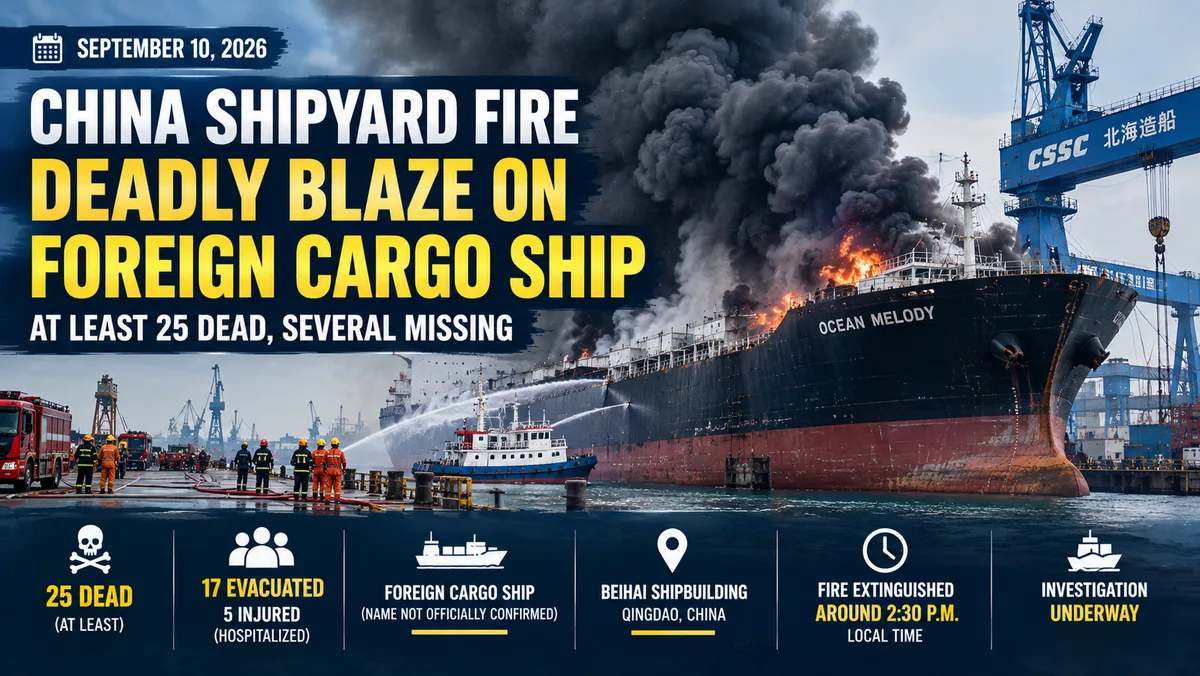
A fire broke out at approximately 11:15 a.m. local time on September 10 aboard a foreign-flagged cargo ship undergoing repairs at Beihai Shipbuilding Co., Ltd. in Qingdao, Shandong Province, according to Chinese state broadcaster CCTV and news agency Xinhua. Videos circulating online showed thick black smoke pouring from the vessel as workers aboard the ship and dockside crews attempted to fight the flames before larger emergency response teams arrived. The blaze was extinguished by around 2:30 p.m. local time, but not before causing heavy casualties among the crew and repair workers on board, in one of the deadliest shipyard accidents reported in China in recent years.
What happened
A total of 42 people were on board the vessel when the fire started. State media reported that 17 people were evacuated, including 5 who were injured and taken to hospital in stable condition. In the hours after the fire was brought under control, state broadcaster CCTV said 20 people had been found with "no signs of life," while 5 others remained unaccounted for. As search and recovery efforts continued through the day, authorities confirmed that all previously missing individuals had been located, and the confirmed death toll rose to 25, according to multiple state media reports citing Chinese officials.
The vessel involved has not been officially named by Chinese authorities, who have so far only confirmed that a "foreign cargo ship" was involved. However, shipping market information, AIS tracking data, and a photograph released by Xinhua all point to the Ocean Melody, a Liberian-flagged bulk carrier. According to vessel-tracking sites MarineTraffic and VesselFinder, the Ocean Melody is a 190-metre-long, 55,742-deadweight-tonne bulk carrier built in 2006, making it roughly 20 years old at the time of the fire. Records show the vessel arrived in Qingdao on August 31 and entered a repair berth at Beihai Shipbuilding shortly afterward, where it remained through the afternoon of September 10, spending just over a week in port before the fire occurred. The ship is managed by Yuyangkunpeng Shanghai Ship Management, with Huili Shipping Co Ltd listed as its registered owner. As of the time of reporting, the vessel's involvement has not been officially confirmed by Chinese authorities, and shipping news outlets say they are continuing to verify the identification pending authoritative confirmation.
Official response
Chinese President Xi Jinping issued instructions calling for intensified search and rescue efforts, proper treatment of the injured, support for those affected, a prompt investigation into the cause, and strict accountability for those responsible. Xi also urged all regions and relevant departments nationwide to "draw profound lessons from this incident" and to thoroughly investigate and rectify fire hazards more broadly, framing the accident as a reminder of systemic gaps in industrial fire safety.
Premier Li Qiang separately called for all-out rescue efforts and measures to prevent secondary disasters at the site, underscoring concern that fuel, gas cylinders, or other hazardous materials commonly present during ship repairs could trigger further incidents. China's Ministry of Emergency Management dispatched a working group to the scene to support the local response and begin gathering information for the investigation. Beihai Shipbuilding operates as a subsidiary of China State Shipbuilding Corporation (CSSC), the world's largest shipbuilder by output, whose main businesses span both new vessel construction and ship repair services.
Why it matters for the industry
Qingdao is one of China's premier maritime and industrial gateways, connected to more than 700 ports across over 180 countries and regions, and serves as a critical link in both regional and global logistics networks. It is also widely known as the hometown of Tsingtao beer, reflecting its long history as a major trading and industrial port city. The scale of casualties from this incident marks it as one of the deadliest shipyard accidents in recent memory, and it comes just weeks after a separate explosion and fire at a shipyard in Fujian province in August, raising fresh questions about safety enforcement across China's shipbuilding and repair sector, where regulations are sometimes described as inconsistently applied.
Vessel safety conventionally remains the ship master's responsibility even while a vessel is docked, but once a ship is handed over to a shipyard for repair work, local industrial fire codes and yard-specific safety protocols also come into play, creating overlapping layers of responsibility. Investigations into incidents like this typically examine several standard questions: whether proper "hot work" permits, required for any welding, cutting, or open-flame activity near flammable materials, were issued and followed; whether dedicated fire watches were maintained throughout the repair period; and whether emergency suppression systems on board and at the yard were adequate for the enclosed, compartmentalized spaces typical of a bulk carrier under repair. The precise cause of the Ocean Melody fire has not yet been determined, and officials have not indicated when a preliminary finding might be released.
Key takeaways
- A fire aboard the bulk carrier Ocean Melody at Beihai Shipbuilding in Qingdao has killed at least 25 people, with 17 evacuated including 5 injured.
- The vessel, a 55,742-dwt Liberian-flagged bulk carrier built in 2006, had been docked for repairs since August 31.
- Chinese President Xi Jinping has ordered a full investigation and called for stricter fire-safety accountability across the ship-repair sector.
- Beihai Shipbuilding is a subsidiary of China State Shipbuilding Corporation, the world's largest shipbuilder.
- The vessel's identity has not been officially confirmed by Chinese authorities, though shipping data and state media photographs point strongly to the Ocean Melody.
- The incident is likely to intensify scrutiny of hot-work procedures, fire watches, and contractor safety management across shipyards handling vessel repairs.
For the maritime and shipbuilding industry, this tragedy is a sobering reminder of the safety risks embedded in ship-repair operations, particularly during hot-work activities in confined spaces aboard aging vessels. The coming investigation is likely to influence fire-safety standards and contractor oversight at repair yards well beyond China, as owners, insurers, and regulators reassess how repair-period risk is managed industry-wide.




Comments
No comments yet. Be the first to share your thoughts!