
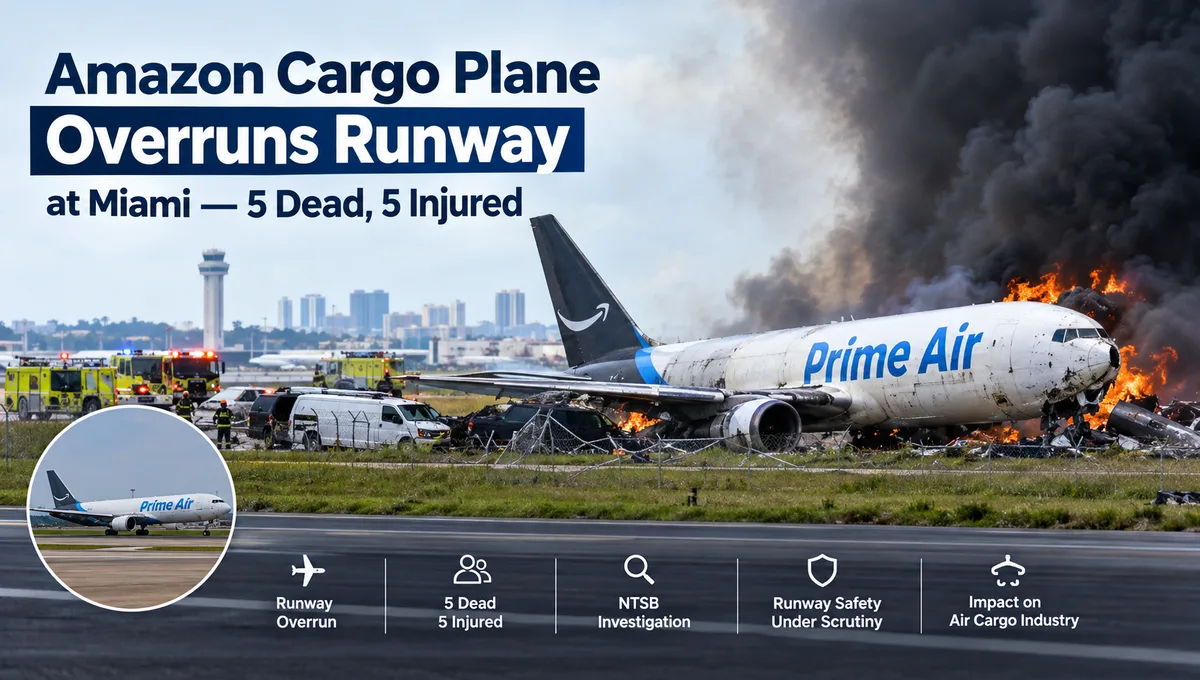
An Amazon-branded cargo plane overran the runway while landing at Miami International Airport (MIA) on the afternoon of September 6, killing five people and injuring five others. The aircraft, a Boeing 767-300 freighter operated by North Carolina-based carrier 21 Air as Flight 7598, was arriving from San Juan, Puerto Rico, on its third flight of the day after earlier legs from Cincinnati to Miami and Miami to San Juan. The two-person crew had already logged a full day of flying before the fatal landing attempt.
What happened
The aircraft overran Runway 30 at around 2:00pm local time while travelling at nearly 130 miles per hour, according to tracking data from Flightradar24. Video of the landing shows the 767 remained airborne well down the runway before finally touching down, its left rear landing gear bouncing along the pavement as the remaining runway surface rapidly disappeared ahead of it. By the time the aircraft reached the end of the runway, it was still moving at highway speed with no visible signs of slowing.
The jet, weighing more than 100 tons, crossed a grassy patch, tore through a chain-link fence topped with razor wire, and struck two vehicles, including a van belonging to Professional Ocean Service Corporation, a contract cleaning company for the airlines. It then caught fire and came to rest in a field beside the airport. More than 60 Miami-Dade Fire Rescue units responded to the scene, with one first responder heard on dispatch audio shouting, "Plane's on fire. Plane's on fire. Put your game faces on."
The five people killed were identified as Rolando Aleman Leon, 55; Yoel Rodriguez Narajo, 53; Julio C. Pineda, 75; Carlos Acosta Fajardo, 53; and Javier Reyes Quevedo, 47, all of whom were in the vehicles the plane struck. The aircraft's two pilots were treated for injuries and later released from the hospital. Of the five others injured, three remained hospitalized in critical or stable condition as of the following day, according to the Miami-Dade County Sheriff's Office.
What investigators have found so far
The National Transportation Safety Board (NTSB) has recovered the aircraft's flight data recorder, which held roughly 55 hours of information, along with its cockpit voice recorder. According to Chihoon Shin, the NTSB's investigator in charge, data shows the plane's throttles were set to full power just seconds before the crash, an action typically associated with aborting a landing rather than completing one. Investigators found no indication that speed brakes or thrust reversers, both systems specifically designed to slow an aircraft after touchdown, were deployed during the landing.
A review of air traffic control audio by CNN found that the pilots did not declare an emergency before the landing, leaving investigators to piece together why the aircraft touched down so far along the runway and why corrective action wasn't taken sooner. The investigation will also examine the aircraft's approach speed, braking performance, weather and wind conditions at the time, and its overall mechanical condition.
The Boeing 767-300 involved in the crash was originally delivered as a passenger aircraft in 1994 and was later converted by a third party for cargo use. Flightradar24 data shows the aircraft was 32 years old at the time of the accident, well within the operational lifespan for cargo freighters, which often fly for decades after their passenger service ends. NTSB Chair Jennifer Homendy described the scene at a press conference as "devastating, utter devastation."
Why it matters for the industry
Runway excursions, incidents where an aircraft leaves the usable surface of a runway during takeoff or landing, are the most common type of aviation accident worldwide, according to the International Air Transport Association. Aviation experts have also pointed out that Miami International Airport lacks a runway safety feature known as an Engineered Materials Arresting System (EMAS), a bed of crushable material installed at the end of runways specifically to stop aircraft that overrun the pavement before they reach surrounding roads or property. That gap is now under fresh scrutiny following the crash, with comparisons already being drawn to the 1999 overrun of American Airlines Flight 1420 at Little Rock National Airport, which killed nine people and led to broader runway safety requirements across the industry.
The incident briefly disrupted operations at one of the busiest airports in the United States. All runways and taxiways were closed and a ground stop was issued immediately following the crash, with one runway reopening later that day and flights resuming by early evening. Amazon Air operates a fleet of more than 100 cargo aircraft, including Boeing 737s and 767s and Airbus A330s, moving everything from general merchandise and parcels to dry ice, perishables, and medical shipments across its network. Boeing confirmed it is supporting the NTSB's investigation, and 21 Air CEO Keith Winters said in a statement that the company was "devastated by the accident," extending condolences to the families and loved ones of those who lost their lives.
Key takeaways
- An Amazon Prime Air Boeing 767-300, operated by 21 Air, overran the runway at Miami International Airport on September 6, killing 5 people and injuring 5 others.
- Flight data shows full engine power was applied seconds before the crash, with no evidence that speed brakes or thrust reversers were used.
- The NTSB has recovered the flight data and cockpit voice recorders and is examining speed, braking, weather, and aircraft condition.
- The aircraft was 32 years old, originally built as a passenger jet before conversion to a freighter.
- The crash has renewed scrutiny of runway safety infrastructure at Miami International Airport, including the absence of an EMAS system.
For the air cargo industry, this incident is a stark reminder of the safety margins involved in freighter operations, especially those flying multiple back-to-back legs in a single day. The investigation's findings are likely to shape broader discussions around aging aircraft, crew fatigue, runway safety systems, and operational procedures across the cargo aviation sector in the months ahead.





Comments
No comments yet. Be the first to share your thoughts!