
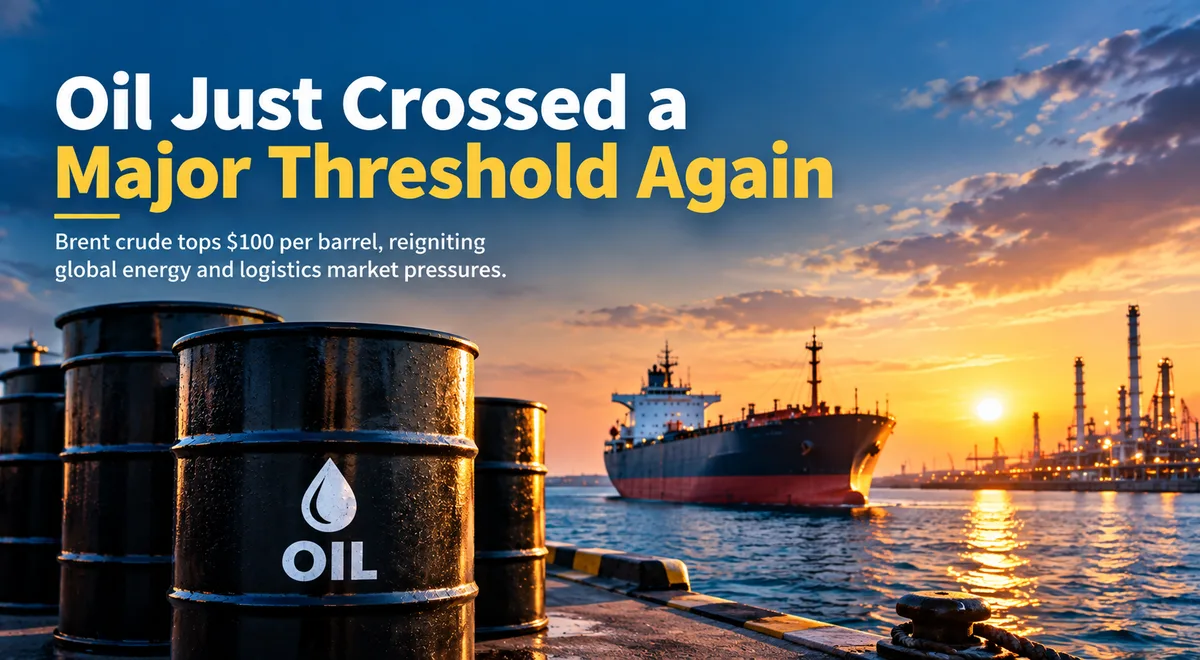
Oil Just Crossed a Major Threshold Again
Brent crude, the major trading classification and global price benchmark for light, sweet crude oil, reached more than $100 a barrel on Wednesday, September 9, 2026.
Trading Economics, which tracks the price of crude oil, recorded the price per barrel at approximately $100.76. Rigzone reported Brent hit $100.45 per barrel in early trading after two straight days of gains, following a close of $97.92 the previous day. By Wednesday's open, Investing.com showed Brent futures trading as high as $101.67.
Here is the detail that matters most for context: the last time Brent closed at $100 per barrel or above was on July 23, 2026, at $100.69 per barrel. So this is genuinely the first time oil has crossed this threshold again since that July milestone — a meaningful psychological and economic marker for global energy and freight markets.
How Fast Did This Happen?
The speed of this increase is what makes it especially significant. Brent's price per barrel has steadily increased over the past week, as the US and Iran trade strikes and the Houthis ramp up attacks on Saudi Arabia. The price stood at about $93 a barrel on September 2.
That means oil climbed from $93 to over $100 — roughly an 8% jump — in just one week. This kind of rapid movement typically reflects markets pricing in a specific, serious escalation rather than a gradual supply-demand shift.
What Triggered This Specific Spike?
Two separate but related developments pushed prices over the $100 mark:
1. US Strikes on Iranian Oil Tankers
The latest attacks followed US strikes on five Iranian tankers near Kharg Island, the Islamic Republic's main oil export hub. Iran responded by claiming to have attacked two American vessels and eight oil tankers in the Gulf, while warning shipping crews near Kuwaiti and Bahraini ports to "immediately abandon their vessels." Tehran also launched ballistic missiles toward Jordan as part of the broader response.
2. Houthi Attacks on Saudi Energy Infrastructure
Separately, Iran-backed Houthi militants targeted energy infrastructure in southern Saudi Arabia, including the 400,000-barrel-a-day Jazan refinery. Satellite images also showed a plume of black smoke rising from a Saudi Aramco oil refinery north of Abha, Saudi Arabia. Houthi leaders said the attacks were in response to more than 120 airstrikes Saudi Arabia carried out in Yemen over the last few weeks.
Combined, these two developments signal that the conflict is now directly threatening oil infrastructure and tanker operations on multiple fronts simultaneously — not just the Strait of Hormuz chokepoint that has dominated headlines since February.
Why Isn't OPEC+ Adding More Supply to Calm the Market?
Normally, when oil prices spike sharply, OPEC+ can step in and increase production to ease the pressure. That is not happening right now.
"OPEC+ has kept September required production levels unchanged for October, meaning the market is not receiving an immediate additional supply cushion from the group," said Tamas Varga, analyst at PVM Oil Associates.
Varga's assessment of what this means for oil investors was direct: "Oil investors are expressing their view about the impact of the latest bout of escalation in the Middle East in an unambiguous way. They are voting with their dollar, and this vote strongly indicates that unless the Strait of Hormuz re-opens, and oil starts flowing again uninterruptedly, supply will not be aligned with demand in the foreseeable future."
What Do the Supply and Demand Numbers Actually Show?
Behind the price movement are hard numbers from the International Energy Agency (IEA) that explain why the market is reacting so strongly:
- Global oil supply is forecast to decline by 4.3 million barrels per day in 2026, according to the latest IEA assessment.
- Third-quarter market deficit is estimated at 1.8 million barrels per day — meaning the world is using significantly more oil than is currently being supplied.
- Observed inventories had already fallen by 410 million barrels from the start of the Middle East conflict through July — a massive drawdown of stored reserves that were being used to fill the supply gap.
- Demand counterweight: the IEA also forecasts global demand declining by 1.6 million barrels per day this year as higher fuel costs and disrupted trade begin to reduce consumption.
This creates what analysts describe as a genuinely two-sided market. As Aslam of Zaye Capital Markets put it: "This creates a two-sided market where supply tightness supports prices, but demand destruction can cap the upside if crude remains elevated for too long."
An Unexpected Side Effect: China Buying More Non-Middle East Crude
One notable market shift emerging from this crisis: purchases from China supported prices for African, Canadian and Latin American crude as the country restocks its dwindling oil and fuel inventories after limiting imports of more expensive product this year due to the war in Iran.
In simple terms: China has been buying less Middle East oil during the conflict, and is now actively rebuilding its reserves by purchasing more crude from Africa, Canada, and Latin America instead — pushing up prices in those markets too, and reshaping global crude trade flows in the process.
Putting This Spike in Context — How High Has Oil Gone This Year?
To understand where today's price sits within 2026's broader trajectory, here is the timeline:
- Before February 28: Oil trading at normal pre-war levels.
- February 28, 2026: Joint US-Israeli strikes on Iran begin the kinetic phase of the war. Oil crosses $100 for the first time since 2022 shortly after.
- May 2026: Brent reaches as high as $114 a barrel during the height of the kinetic phase of the war.
- June-July: Prices ease somewhat as ceasefire talks and a memorandum of understanding create some optimism.
- July 23, 2026: Brent closes above $100 again ($100.69) as the Islamabad memorandum of understanding breaks down and the US and Iran trade strikes in the Strait of Hormuz.
- September 2, 2026: Prices had eased back to around $93 a barrel.
- September 9, 2026: Brent crosses $100 again — the level covered in this article — following fresh US strikes on Iranian tankers and Houthi attacks on Saudi energy infrastructure.
This pattern — spike, partial retreat, spike again — reflects how closely oil markets are tracking the on-and-off nature of the conflict rather than settling into a stable "new normal" price level.
What Does This Mean for Freight and Logistics Costs?
For every shipper, freight forwarder, and logistics professional, an oil price spike of this speed and scale has immediate, practical consequences:
- Fuel surcharges will rise again. Ocean carriers, airlines, and trucking companies all price fuel surcharges based on current oil and bunker fuel costs. Expect surcharge increases across all modes in the coming days as this $100+ price level gets incorporated into carrier pricing formulas.
- Diesel prices are already elevated. The most expensive diesel in America is found in California, where the statewide average has reached a staggering $7.51 — driven by the compounding pressures of the geopolitical conflict in the Middle East and global refinery squeezes. Trucking and last-mile delivery costs will feel this directly.
- Air cargo costs likely to climb further. Air freight is highly fuel-cost sensitive. With average air cargo spot rates already up sharply this year, a fresh oil spike adds more upward pressure on a market already tight due to AI hardware shipments and constrained freighter capacity.
- Volatility itself is a planning challenge. With oil swinging from $93 to over $100 within a single week, and a similar pattern of spikes and retreats seen throughout 2026, shippers should build flexibility into freight budgets rather than assuming any single price level will hold.
- Watch demand destruction signals. The IEA's own forecast of declining demand due to high fuel costs suggests the market itself expects some self-correction. If demand destruction accelerates, it could eventually cap further price increases — but this typically takes months to play out, not days.
What Should Shippers Do Right Now?
- Review fuel surcharge clauses in your contracts. Confirm how quickly your carrier contracts adjust to oil price changes — some update weekly, others monthly, which affects how fast you will feel this increase.
- Communicate with customers early about potential cost increases. If you pass fuel costs through to your own customers, get ahead of the conversation now rather than after surcharges are already applied.
- Monitor the Strait of Hormuz situation daily. As PVM's Tamas Varga noted, prices will likely remain elevated "unless the Strait of Hormuz re-opens." Any further escalation or de-escalation there will directly move oil prices and freight costs.
- Consider multi-modal flexibility. With both ocean fuel and diesel costs rising, review whether shifting some cargo between modes offers any near-term cost advantage given current relative pricing.
Key Takeaways — September 10, 2026
- Brent crude crossed $100 a barrel on Wednesday, September 9, 2026 — the first time since July 23, 2026.
- Oil jumped from $93 to over $100 in just one week (September 2 to September 9).
- Trigger: US strikes on five Iranian tankers near Kharg Island, plus Houthi attacks on Saudi Arabia's Jazan refinery and an Aramco facility near Abha.
- OPEC+ held production steady for October — no immediate supply relief coming from the group.
- IEA forecasts a 4.3 million barrel-per-day supply decline in 2026, with a 1.8 million bpd deficit this quarter.
- Observed inventories have fallen 410 million barrels since the conflict began through July.
- China is buying more African, Canadian, and Latin American crude to rebuild reserves — reshaping global trade flows.
- Expect fuel surcharge increases across ocean, air, and road freight in the coming days.
- Highest 2026 price point remains $114/barrel, reached in May during the height of the war's kinetic phase.
Oil crossing $100 again is not an isolated financial headline — it is a direct, near-immediate cost signal for every part of the logistics chain. With OPEC+ offering no supply cushion and the conflict showing no sign of resolution, shippers and freight forwarders should treat this as the start of another period of elevated fuel costs, not a one-day spike to wait out.




Comments
No comments yet. Be the first to share your thoughts!