
What Do the New Numbers Show?
China's export growth quickened last month, buoyed by strong overseas appetite for high-tech and AI-related products, providing vital support for an economy weighed down by sluggish domestic demand.
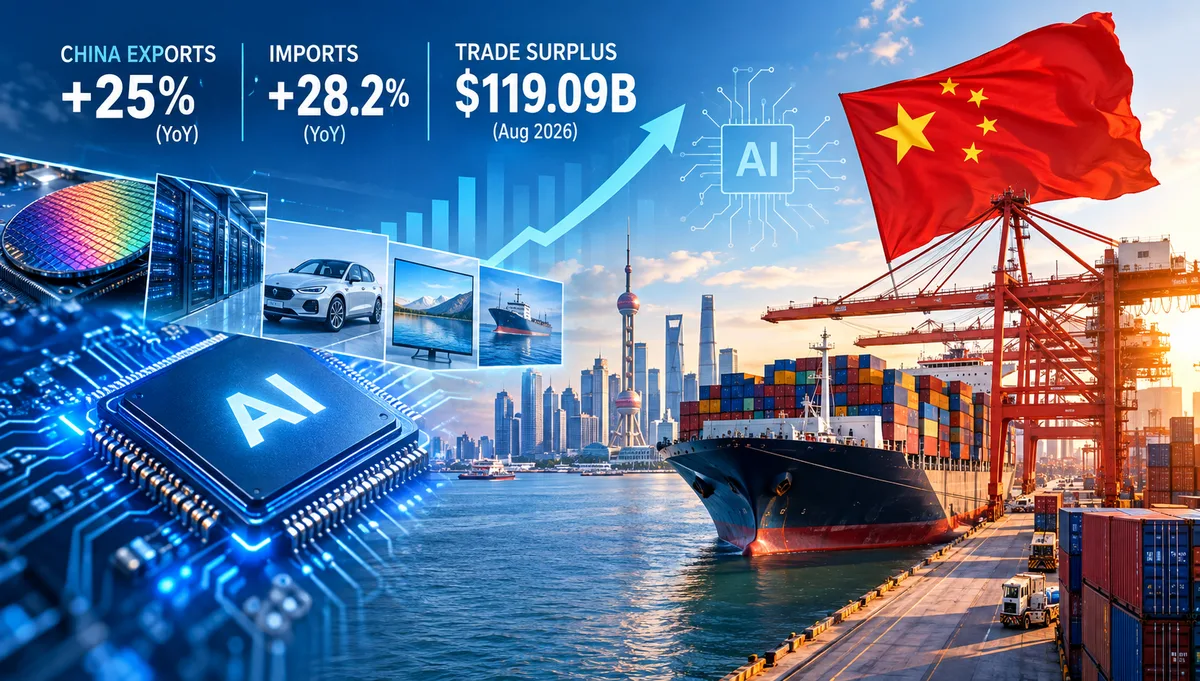
According to customs data released by China's General Administration of Customs on Tuesday, September 8, 2026, exports from the world's second-biggest economy surged 25% year-on-year in August in US dollar terms — matching forecasts and accelerating from the 23.9% growth recorded in July.
Imports jumped even faster, climbing 28.2%, compared with a 27.5% year-on-year increase in July. China's trade surplus rose to $119.09 billion in August, up from $112.5 billion the previous month.
These are not small numbers. China is the world's largest exporter, and a 25% jump in exports from a base this large represents an enormous volume of additional goods moving through Chinese ports and onto ships bound for markets around the world.
What Is Actually Driving This Growth?
The headline story here is not general consumer demand — it is a specific and powerful trend: the global race to build AI infrastructure.
After achieving a historic surplus in 2025, China's trade has continued to boom this year, thanks largely to heightened overseas demand for semiconductors, computing hardware and other products linked to the artificial intelligence boom.
China's push to dominate key technologies has turbocharged investor appetite for tech stocks, while surging AI-related demand is lifting a new generation of manufacturers. One clear example: chipmaker CXMT swung to a first-half profit in its maiden earnings report since listing, as soaring memory chip prices and strong demand for AI-driven computing lifted sales.
This directly connects to a story we have covered previously — the massive surge in AI infrastructure components moving through US ports. China's export data confirms the other half of that picture: the manufacturing and shipping origin point for much of that AI hardware boom.
Why Is This "Divergence" Important?
Economists are highlighting an unusual split in China's economy right now. The divergence between resilient exports and weak activity at home highlights Beijing's continued dependence on foreign demand, with policymakers struggling to revive consumption and investment as they pursue a 4.5%-5% GDP growth target this year.
In plain English: China's factories are extremely busy making things for export — especially tech products — while ordinary Chinese consumers are spending less, the property market remains depressed, and domestic investment is soft.
After growth cooled to 4.3% in the April-to-June period, economic data released last month showed industrial output and retail sales both slowed at the start of the third quarter, while fixed-asset investment recorded a sharper decline in the first seven months. The property market, once a major growth driver, is still in a years-long downturn.
Premier Li Qiang, the country's No. 2 leader, called in August for efforts to stabilise external demand while acknowledging insufficient domestic demand, hardships facing industries as well as rising uncertainties in the international environment.
What Is China Doing About the Weak Domestic Side?
Beijing has not been standing still on the domestic economy, even as exports carry much of the growth burden. The government has stepped up fiscal support for the economy, including deploying an 800 billion yuan ($119.21 billion) financing tool to shore up infrastructure investment.
Still, the strength in exports relieves some of the immediate pressure on Beijing to roll out larger stimulus measures — for now, external demand is doing the heavy lifting that domestic consumption is not.
What Do Economists Say About How Long This Can Last?
Lynn Song, ING's Greater China chief economist, offered a note of caution about the durability of this export-led growth: while external demand had significantly outpaced domestic consumption, "tariff risks and the durability of the tech investment cycle are the key factors to watch to see how long this can continue."
This is the central question for anyone tracking China trade data going forward. Two specific risks stand out:
- Tariff risk. Relying on outbound shipments to absorb industrial capacity also exposes China to risks of curbs from trading partners, as the US and the European Union have both demanded Beijing lower its trade surpluses. If tariffs increase or trade restrictions tighten, this export engine could slow quickly.
- AI investment cycle risk. The current export boom is heavily tied to a global capital spending cycle around AI infrastructure. If that spending cycle slows or matures faster than expected, the semiconductor and computing hardware demand fueling China's export growth could soften.
The Trump-Xi Meeting Adds Extra Significance
These trade figures are landing at a particularly sensitive diplomatic moment. China's imports and exports surged in August, helped by a global AI buildout that has fuelled demand for technology products and ahead of an expected meeting between President Xi Jinping and US counterpart Donald Trump.
As we reported last week, Xi Jinping is expected to visit Washington and meet with President Trump on September 24, 2026. Strong Chinese export numbers — especially strength in shipments to the US — give China a stronger negotiating position heading into those talks, even as the broader US-China relationship remains strained over issues including the recent COSCO spying allegations we also covered.
Which Products Are Driving the Surge?
While the August-specific product breakdown was still being analysed, recent months provide a clear picture of where China's export strength is concentrated. Export growth has been recorded across several key product categories, including integrated circuits, cars, CD flat panel display modules, and ships — with semiconductors and computing-related hardware showing the strongest gains tied directly to the global AI buildout.
Notably, rare earth exports have been a weaker spot amid ongoing export restrictions — a reminder that China's trade strength is not uniform across every category, but concentrated heavily in the technology and AI-adjacent sectors.
What Does This Mean for Freight Forwarders and Shippers?
For the logistics industry specifically, these numbers carry several direct implications:
- Container volumes out of China remain strong. A 25% export surge translates directly into more containers being packed, more vessel bookings, and continued pressure on capacity at Chinese ports — reinforcing trends we have already reported around Shanghai and Ningbo congestion.
- Tech and electronics cargo is an outsized share of growth. Freight forwarders specialising in electronics, semiconductors, and technology hardware shipments should expect this segment to continue outperforming general cargo categories through the rest of 2026.
- Import growth outpacing exports signals strong component flows too. China's 28.2% import growth suggests the country is also pulling in significant volumes of raw materials, components, and intermediate goods — likely tied to the same AI manufacturing supply chains — creating strong two-way freight demand.
- Watch the Trump-Xi summit for tariff signals. Given how directly tariff risk was flagged by economists as the key variable for this export boom's durability, any announcements coming out of the September 24 meeting could have immediate implications for shipping volumes and freight rates on China-US and other major trade lanes.
- US-bound shipments surging specifically. Reports note that shipments to the US have surged ahead of the Trump-Xi meeting — suggesting front-loading behaviour similar to previous tariff-anxious periods, which could mean a subsequent pullback in volumes once any new trade terms are settled.
Key Takeaways — September 8, 2026
- China's exports surged 25% year-on-year in August 2026, accelerating from 23.9% in July.
- Imports jumped 28.2% — faster than July's 27.5% growth.
- China's trade surplus reached $119.09 billion in August, up from $112.5 billion in July.
- Growth is being driven primarily by overseas demand for semiconductors, computing hardware, and AI-related products.
- Domestic demand remains weak — industrial output, retail sales, and fixed-asset investment all showing softness.
- China is targeting 4.5%-5% GDP growth for the year, relying heavily on exports to get there.
- Economists flag tariff risk and the durability of the global AI investment cycle as key uncertainties ahead.
- Data lands ahead of an expected Trump-Xi summit on September 24, 2026.
- For logistics: expect continued strong container volumes and elevated demand for tech/electronics freight capacity out of China.
China's export engine is running hot right now — but it is running on a very specific fuel: the global AI buildout. For freight forwarders and shippers, that means strong volumes for the moment, concentrated heavily in technology and semiconductor cargo, with two significant wildcards — tariff decisions from the upcoming Trump-Xi summit, and the durability of AI infrastructure spending — that could reshape the picture in the months ahead.





Comments
No comments yet. Be the first to share your thoughts!