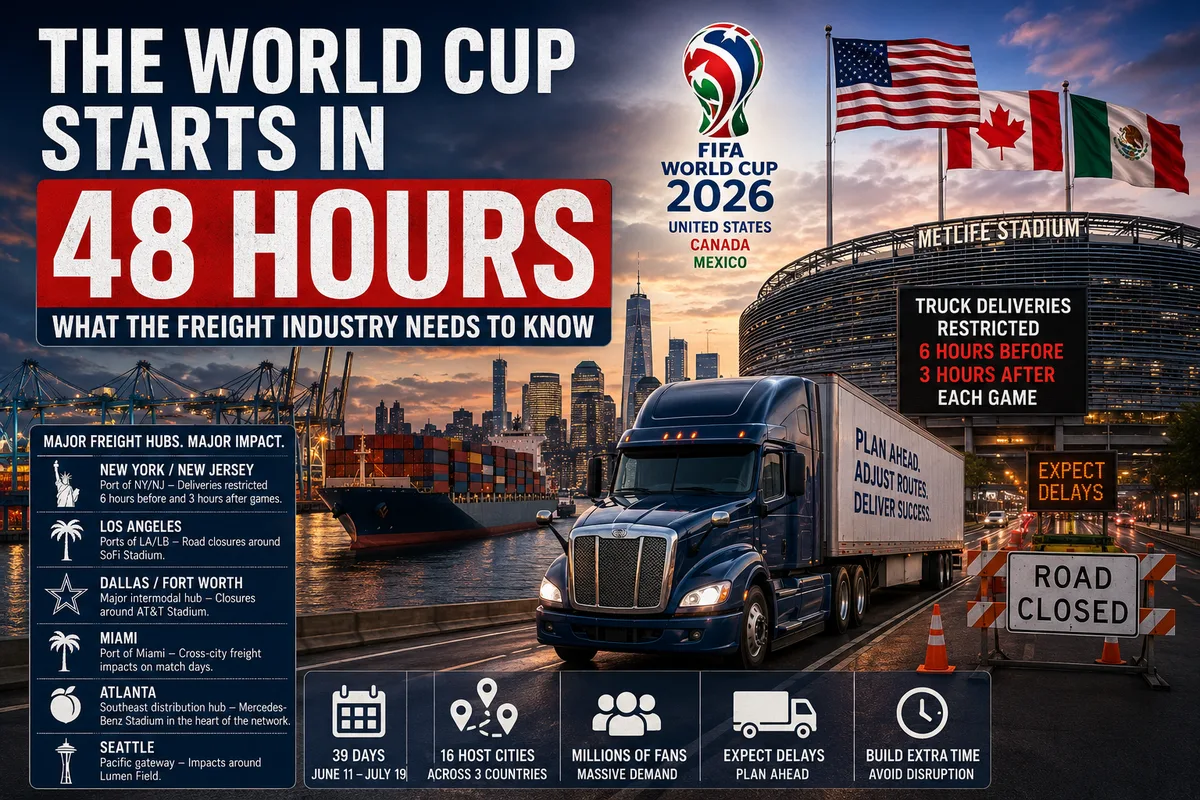
The World Cup Starts in 48 Hours — What the Freight Industry Needs to Know
The 2026 FIFA World Cup is the biggest sporting event in history. 48 teams, 104 matches, 16 host cities, across 3 countries — the United States, Canada, and Mexico — running from June 11 to July 19, 2026.
Here is the problem for freight: many of those host cities are also the most important freight hubs in North America. This is not a coincidence — FIFA chose major cities with large stadiums and millions of fans. But those same cities are where millions of tonnes of cargo move every single week.
The World Cup is going to put those two things in direct conflict — starting the day after tomorrow.
Which Freight Corridors Are Affected?
Here are the US host cities that are also major freight hubs — and what that means in practice:
- New York / New Jersey — Home to the Port of New York/New Jersey, one of the busiest container ports on the US East Coast. New York already confirmed: truck deliveries are restricted six hours before and three hours after each game at MetLife Stadium in East Rutherford, New Jersey. Every carrier routing freight through the New Jersey corridor — connecting the port to distribution centers across the Northeast — will feel this on match days.
- Los Angeles — The Port of Los Angeles and Port of Long Beach handle more container volume than any other US port complex. Road closures around SoFi Stadium will affect truck movements in one of the most congested freight areas in America — on days when the stadium hosts 80,000+ fans.
- Dallas / Fort Worth — A major intermodal hub connecting rail and truck freight across the South and Central US. Closures around AT&T Stadium in Arlington will add pressure to an already tight freight corridor.
- Miami — Port of Miami is a critical gateway for Caribbean and Latin American trade. Stadium-related closures on match days will affect cross-city freight movements.
- Atlanta — One of the busiest freight distribution hubs in the Southeast US. Mercedes-Benz Stadium sits in the middle of Atlanta's urban freight network.
- Seattle — A key Pacific gateway port. Lumen Field matches will affect freight movements around Seattle's port and rail terminals.
What Does "Restricted Deliveries" Actually Mean?
Road closures and enforcement checkpoints around stadium perimeters push outward well past the venues, and carriers routing through those corridors feel it whether their load has anything to do with soccer or not.
In practice, here is what a match day looks like for a trucker:
- Major roads within a 2-5 mile radius of stadiums may have reduced speed limits, police checkpoints, and limited access for commercial vehicles
- In New York, the confirmed 6-hour pre-game and 3-hour post-game restriction at MetLife means a total of 9 hours of disrupted freight movement around every single New York/New Jersey match
- Parking around stadiums is effectively taken over by event operations — truck parking areas disappear entirely on match days
- Traffic volumes around host cities on match days can be 3-5 times higher than normal — turning normal 1-hour deliveries into 3-4 hour ordeals even for routes that don't directly pass the stadium
The Match Schedule — Key Dates for Freight Planning
The group stage runs from June 11 to July 2, with multiple matches per day across different cities. Here are the key heavy-volume periods to plan around:
- Opening Weekend (June 11-15): Multiple matches across New York, LA, Dallas, Miami, Seattle, Atlanta simultaneously. This will be the most disruptive period for freight — every major US freight corridor affected at once.
- Round of 32 and 16 (June 30 - July 10): Higher-profile matches concentrated in fewer cities — but with bigger crowds and more severe traffic impacts.
- Quarter-finals, Semi-finals, Final (July 11-19): Concentrated in a smaller number of cities. The Final is at MetLife Stadium in New York on July 19.
Why This Is Worse Than a Normal Sporting Event
The World Cup creates freight disruption at a scale that is genuinely different from regular sporting events. Here is why:
- Three countries, three customs regimes. Shipping to the United States, Canada, and Mexico means dealing with different customs regulations, security requirements, import duties, and compliance frameworks. For companies supplying multiple host cities, this results in a substantial increase in operational complexity.
- Simultaneous matches in multiple cities. Unlike a Super Bowl or Champions League Final — which happens in one city on one day — the World Cup is happening across 16 cities over 39 days. The disruption is not a one-day event. It is a 6-week freight challenge.
- It is happening during peak shipping season. June and July are already the most congested months for US domestic freight — retailers are building holiday inventory, Amazon Prime Day preparation is underway, and ocean containers are arriving in record numbers. The World Cup is adding a massive new demand surge on top of an already stressed system.
- Fan travel creates additional freight demand. Millions of international fans traveling to the US, Canada, and Mexico means hotels, restaurants, and hospitality venues near host cities are simultaneously stocking up on supplies. When millions of visitors arrive in a region within a short period of time, demand increases across hotels, restaurants, transportation services, and retail stores.
- Truck parking is already a crisis. Truck parking in the United States is already at a crisis level. According to the American Transportation Research Institute (ATRI), truck drivers spend an average of 56 minutes per shift searching for parking. During the World Cup, parking near host city stadiums will be completely taken over by event operations — making an existing problem significantly worse.
The Opportunity — Not Just the Problem
The World Cup is not only a disruption story. It is also a business opportunity — one that some logistics companies have been preparing for since last year.
FIFA appointed Rock-it Cargo — a Global Critical Logistics (GCL) company — as the Official Logistics Provider of the FIFA World Cup 2026, providing customs and international freight forwarding, warehouse and distribution operations, on-site venue operations, and team equipment operations.
But beyond the official partner, there are significant commercial opportunities for freight and logistics companies in host cities:
- Fan merchandise and retail replenishment — stores near stadiums sell out of merchandise on match days and need rapid restocking
- Hospitality supply chains — hotels and restaurants within fan zones need reliable, time-definite delivery of food, beverages, and supplies
- Broadcast and media equipment — the tournament requires huge volumes of broadcast technology, cameras, cables, and communications equipment across all 16 cities
- Security and infrastructure equipment — crowd barriers, signage, temporary structures, security equipment all need to be in place before each match day
What Freight Professionals Should Do Right Now — Before Thursday
- Download and print the full World Cup match schedule for every host city you operate in. Identify exactly which dates have games in your key delivery areas. You have 48 hours to do this before the opening matches begin.
- Re-route scheduled deliveries on match days. If you have deliveries planned within 5 miles of a host stadium on a match day — reschedule them to the day before or the morning after. Do not plan on arriving or departing during the 6-hour pre-game window.
- Alert your customers and consignees now. If you have buyers, warehouses, or stores near World Cup venues — contact them today to discuss modified delivery windows during the tournament period.
- Brief your drivers. Every driver operating in New York, LA, Dallas, Miami, Atlanta, or Seattle in the next 39 days needs to know the match schedule and understand the delivery restrictions in place around stadiums.
- Identify alternative parking and staging areas. Truck parking near stadiums will be inaccessible on match days. Identify your backup parking and staging locations now — before you need them.
- Build extra time into your delivery promises. For any delivery in or near a host city from June 11 to July 19 — add a 2-4 hour buffer to your expected transit time. Match-day traffic will add time even to routes that don't directly pass stadiums.
Key Takeaways — June 9, 2026
- FIFA World Cup 2026 kicks off June 11 — in just 48 hours.
- 16 host cities include major US freight hubs: New York, LA, Dallas, Miami, Atlanta, Seattle.
- Truck delivery restrictions confirmed: 6 hours before + 3 hours after each game at MetLife Stadium, NY.
- Road closures extend well beyond stadium perimeters — affecting freight routes that don't go near venues.
- Tournament runs 39 days (June 11 - July 19) — during peak shipping season.
- Simultaneous matches across multiple cities make this different from any single-venue sporting event.
- Action needed TODAY: check match schedules, re-route deliveries, brief drivers, identify backup parking.
The 2026 FIFA World Cup is going to be the greatest sporting event in history. For the freight industry, it is going to be one of the most complex 39-day operational challenges of the year. The companies that prepared in advance will navigate it smoothly. The ones that did not are going to be making emergency calls to customers on June 11 explaining why their cargo is stuck in World Cup traffic.

Comments
No comments yet. Be the first to share your thoughts!
Join the conversation
You need an account to comment on articles.