
What Are Critical Minerals — And Why Does Logistics Need to Care?
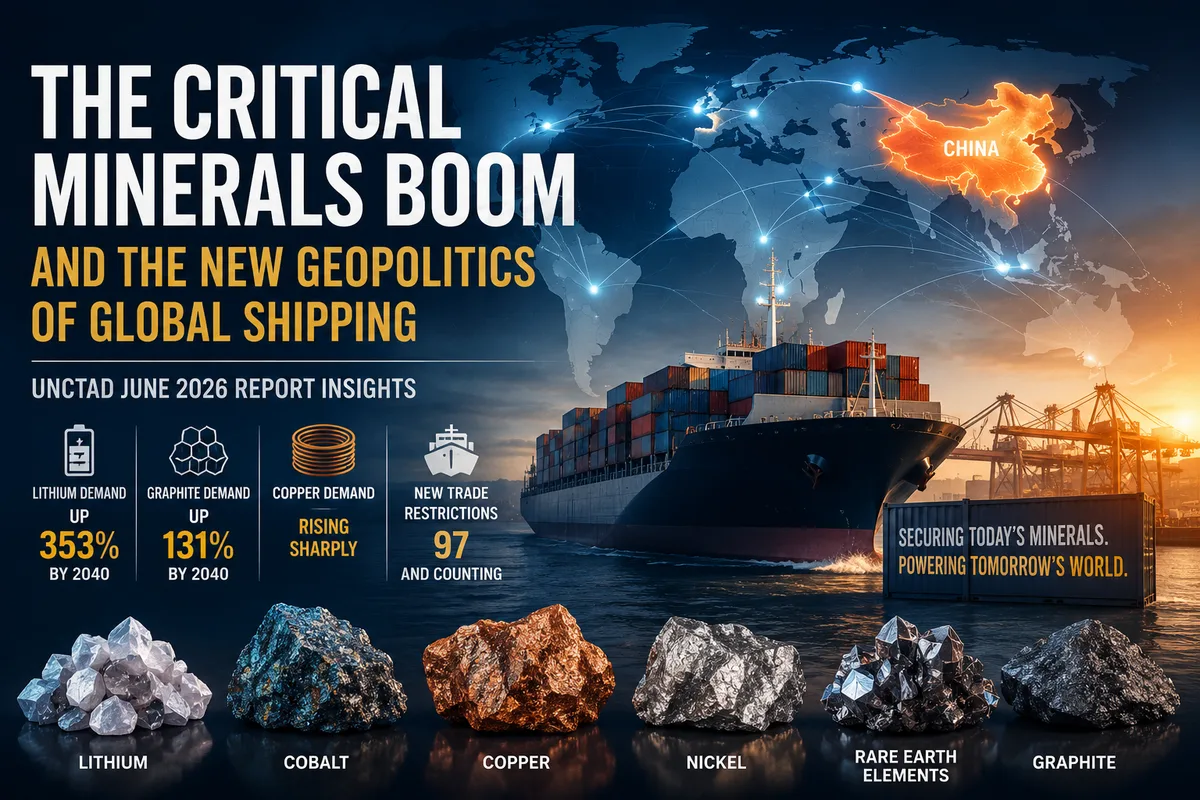
Critical minerals are the raw materials that power the modern world — and increasingly, the future world. They are found inside every electric vehicle battery, every solar panel, every wind turbine, every smartphone, every AI data center server, and every semiconductor chip.
The most important ones right now:
- Lithium — the key ingredient in every EV battery and energy storage system
- Cobalt — used in batteries, with 74% of global supply coming from one country: the Democratic Republic of Congo
- Copper — essential for electrical wiring in everything from EVs to data centers to renewable energy infrastructure
- Nickel — used in batteries and stainless steel
- Rare Earth Elements — a group of 17 metals essential for electric motors, wind turbines, and defense technologies. China processes approximately 85% of the world's supply.
- Graphite — used in EV battery anodes; China produces over 90% of the world's battery-grade graphite
For logistics professionals, these minerals matter for one simple reason: they all have to be mined somewhere, processed somewhere else, and shipped to factories all over the world. Every tonne of lithium from Chile, every container of cobalt from Congo, every shipment of rare earth elements from China — all of it moves on ships. And the scale of what needs to move is about to get much, much larger.
The UNCTAD Numbers — Published June 12, 2026
The global race to secure critical minerals is reshaping trade flows, industrial policy and supply chains, creating new opportunities and challenges for the shipping industry, according to the new June 2026 Global Trade Update from UN Trade and Development.
Here are the headline numbers from the report:
- Lithium demand up 353% between 2024 and 2040 — driven by EV batteries, energy storage, and grid electrification
- Graphite demand up 131% over the same period
- Copper demand growing sharply as AI data centers, EV charging infrastructure, and renewable energy all require enormous quantities of copper wiring
- Cobalt demand rising despite efforts to reduce it — battery technology still relies heavily on cobalt for energy density
These are not small adjustments. A 353% increase in lithium demand means the world will need to mine, process, and ship nearly 4.5 times as much lithium as it does today — within 14 years. That is an enormous logistical challenge.
China Controls the Supply Chain — And That Is a Problem
Here is the part of the UNCTAD report that is making governments in the US, Europe, and Japan most nervous.
China remains dominant across many critical mineral value chains, particularly in processing and refining, while countries including Australia, Indonesia, Chile and several African nations are seeking to expand their roles.
In plain English: you can mine lithium in Chile, cobalt in Congo, or nickel in Indonesia — but in most cases, you still have to send it to China to be processed and refined before it can be used in a battery. China has spent decades building the world's most complete critical mineral processing infrastructure, and no other country comes close.
The concentration problem is even more stark when you look at individual minerals:
- Democratic Republic of Congo: 74% of global cobalt supply — from a country with political instability, infrastructure challenges, and ongoing conflict in its mining regions
- China: ~85% of rare earth element processing — the magnets in every EV motor and wind turbine run on Chinese-processed rare earths
- China: 90%+ of battery-grade graphite production
- Chile + Australia: ~60% of global lithium supply — but most still goes to China for processing before reaching battery factories
This concentration means that any disruption — a trade war, an export ban, a political crisis — in one or two countries can interrupt the global supply chain for materials the entire clean energy and technology economy depends on.
Governments Are Already Restricting Supply — And It Is Getting Worse
The report highlights a growing shift away from traditional commodity trade patterns as governments and manufacturers increasingly focus on supply-chain resilience and reducing dependence on a small number of suppliers.
The policy response is already visible and escalating. According to the UNCTAD data:
- 37 licensing requirements introduced on critical mineral exports globally
- 31 export taxes imposed on critical mineral shipments
- 29 export bans on specific critical minerals from specific countries
- The Democratic Republic of Congo has introduced the highest number of new trade measures, followed by China and Indonesia
Indonesia banned raw nickel exports in 2020 — forcing battery manufacturers to build processing plants inside Indonesia if they want access to its nickel. The strategy worked: Indonesia now hosts some of the world's newest and most advanced nickel processing facilities. Other mineral-rich countries are watching and following the same playbook.
China, meanwhile, has been gradually restricting exports of rare earth elements and battery-grade graphite — the most recent restrictions announced in 2025 — as a geopolitical lever in its trade disputes with the United States and Europe.
What This Means for Shipping — New Trade Routes Are Opening
For the shipping industry, this trend is expected to create new trade corridors and boost demand for bulk commodity transportation, particularly as investment accelerates in mining projects and downstream processing facilities.
Here is what new critical mineral shipping looks like in practice:
- Australia → South Korea, Japan, Europe: Australia is the world's largest lithium producer and a major iron ore and nickel supplier. New trade lanes are developing as European and Asian battery makers try to source lithium from Australia instead of going through Chinese processing.
- Chile, Argentina → Global battery factories: South America's "Lithium Triangle" — Chile, Argentina, Bolivia — holds more than half of the world's known lithium reserves. Shipping lithium carbonate and lithium hydroxide from South American ports to battery factories in Europe, the US, and Asia is a rapidly growing trade lane.
- Africa → China, Europe, US: The Democratic Republic of Congo's cobalt, Zambia's copper, Zimbabwe's lithium, and South Africa's platinum group metals are all generating new bulk and containerized shipping demand.
- New port infrastructure required: Mining regions in remote areas of Africa, South America, and Central Asia often have inadequate port facilities. Billions of dollars in port infrastructure investment are being planned or underway to support critical mineral exports.
For bulk carriers — the ships that move loose minerals across oceans — this trend is a significant source of new demand. The Baltic Dry Index hitting 2.5-year highs this week is partly a reflection of exactly this dynamic: more minerals, more materials, more cargo moving by sea.
The AI Connection — Data Centers Are Driving Mineral Demand
Here is the link between critical minerals and the technology story that is dominating 2026 business news.
Governments are responding to surging demand for minerals essential to electric vehicles, battery storage, renewable energy technologies, semiconductors, and data centres.
Every AI data center being built right now requires:
- Enormous quantities of copper — for power cables, cooling systems, and server connections
- Rare earth elements — in the magnets of cooling fans and power systems
- Lithium batteries — for backup power systems that keep data centers running during outages
- Silicon and specialized metals — for the GPU chips that run AI computations
The AI infrastructure boom we covered earlier this week — CMA CGM deploying AI to 80,000 employees, DHL opening 7 million square feet of data center logistics warehouses — is directly driving demand for the minerals in UNCTAD's report. The cargo theft surge targeting copper and server components is also a direct consequence of the same demand explosion.
What Does This Mean for Logistics Professionals?
- New specialist shipping routes will open. If your company currently focuses on established Asia-Europe or transpacific trade lanes, critical mineral routes from Africa, South America, and Central Asia to battery factories in Europe, Korea, and the US represent a major growth opportunity in the next 5-10 years.
- Bulk carrier demand will stay elevated. The UNCTAD projections for mineral demand growth confirm that bulk shipping — already at 2.5-year highs — has structural long-term support. Invest in or contract bulk capacity accordingly.
- Compliance complexity will increase. With 37 licensing requirements, 31 export taxes, and 29 export bans already in place — and more coming — customs compliance for critical mineral shipments is becoming enormously complex. Freight forwarders and customs brokers with specialist expertise in this area will be in high demand.
- Supply chain risk is increasing. UNCTAD warned that supply-chain concentration and geopolitical tensions could introduce vulnerabilities to global trade, particularly as countries implement export controls, subsidies and other measures aimed at securing access to strategic resources. Companies that depend on single-source critical mineral supply chains need to urgently develop alternative sourcing strategies.
Key Takeaways — June 13, 2026
- UNCTAD released June 2026 Global Trade Update on June 12 — covering the critical minerals reshaping global trade.
- Lithium demand projected to rise 353% by 2040; graphite up 131%.
- China dominates processing of most critical minerals — a major geopolitical vulnerability for Western supply chains.
- DRC holds 74% of global cobalt supply — concentrated in one politically unstable country.
- 37 licensing requirements, 31 export taxes, and 29 export bans already in place globally — and growing.
- New shipping corridors forming: Australia, Chile, Africa to battery factories in Europe, US, and Asia.
- AI data centers are a key new driver of copper and rare earth element demand.
- Bulk carrier demand has structural long-term support from critical mineral trade growth.
Oil shaped the 20th century's trade routes, geopolitics, and shipping industry. Critical minerals are doing the same for the 21st century — and the race to control them is already underway. The UNCTAD report released yesterday is not a prediction about a distant future. It is a description of changes that are happening right now — in mining towns in Congo, processing plants in China, battery factories in Germany, and on bulk carrier ships crossing every major ocean. The logistics industry that adapts to this reality fastest will thrive. The one that ignores it will be left behind.



Comments
No comments yet. Be the first to share your thoughts!