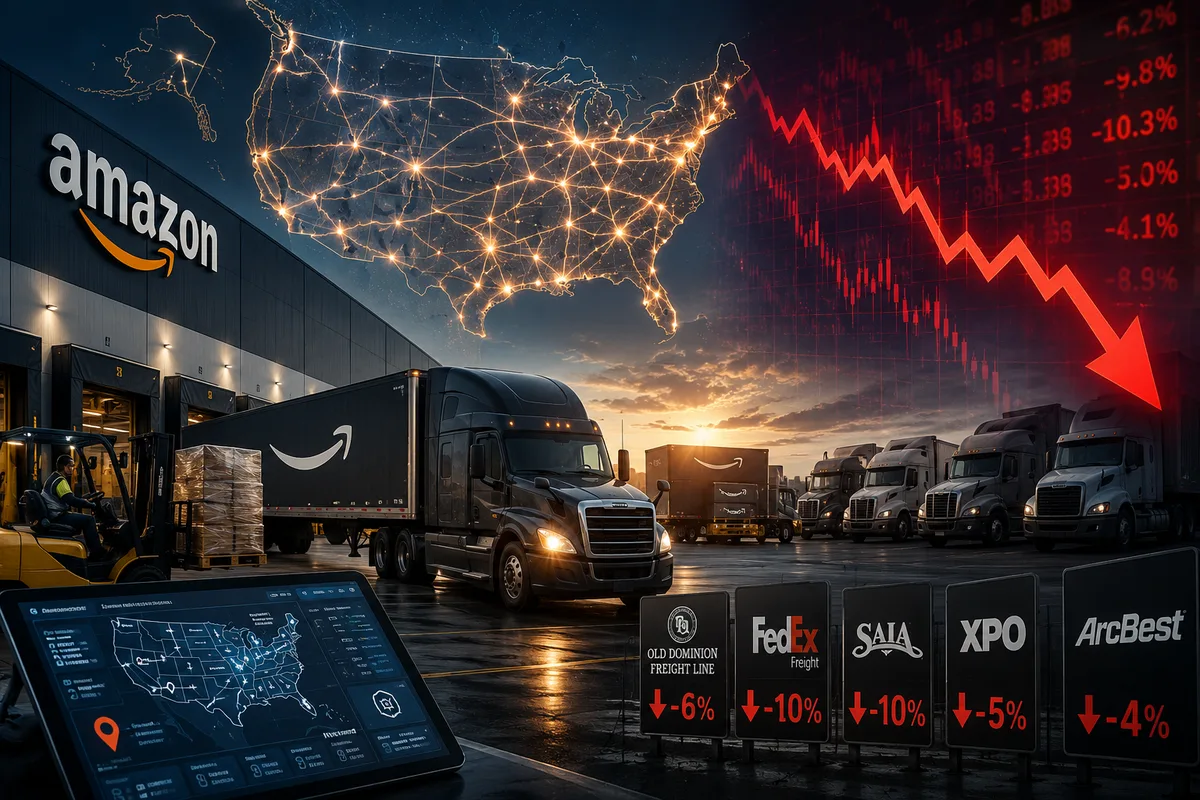
What Amazon Just Launched — June 10, 2026
Amazon's LTL service is officially open for all businesses to any type of destination, bringing the network, technology, and reliability of Amazon's supply chain to palletized shipments.
This is a direct expansion of Amazon Supply Chain Services (ASCS) — the platform Amazon unveiled on May 4, 2026. At that time, Amazon opened its freight, fulfillment, and parcel network to outside businesses. Yesterday's announcement adds the final piece: LTL freight for any destination in the US.
The expanded offering is now available through Amazon Supply Chain Services, its growing logistics business that gives outside companies access to the transportation and fulfillment network Amazon has built over nearly three decades.
What makes this different from what Amazon offered before? Previously, Amazon's LTL service only moved freight INTO Amazon fulfillment centers — inbound only. Now, the LTL freight service has been expanded beyond its previous inbound-to-Amazon use case to support shipments to any destination, including third-party warehouses, distribution centers, retail partners and distributors.
In simple English: before, Amazon only picked up your pallets and delivered them to its own warehouses. Now it will pick up your pallets and deliver them ANYWHERE — your warehouse, your customer's distribution center, a retail store, anywhere in the US.
What Does Amazon's LTL Network Actually Look Like?
Amazon is not building this from scratch. It has been quietly building one of the largest logistics networks in the world for nearly a decade. Here is what is behind Amazon LTL:
- 80,000+ trailers across its network
- 24,000 intermodal containers
- Terminals across all major US metro areas — built for Amazon's own parcel and freight operations over 30 years
- End-to-end real-time GPS tracking on every shipment
- A unified drop trailer pool supporting both LTL and full truckload shipments
- Technology visibility platform showing shipment status in real time
Jim Ruiz, Director of Amazon Freight, explained what drove the decision: "The feedback from Amazon selling partners using our LTL service was clear: the technology, visibility, and reliability were exactly what they needed — and they wanted to use it more broadly."
The Stock Market Reaction — Instant and Brutal
The market's reaction to Amazon's announcement was immediate and devastating for incumbent LTL carriers.
The announcement triggered a broad selloff among established freight carriers. Shares of Old Dominion Freight Line shed more than 6%, and both Saia and XPO Logistics gave up 5%. ArcBest stock sank 4%. At the start of trading, FedEx Freight and Saia tumbled about 10%, though both stocks clawed back a portion of those declines by later in the session.
Think about what these numbers mean. FedEx Freight (FDXF) only became an independent company 9 days ago — it started trading on June 1, 2026. And on June 10, just nine days after becoming public, its stock dropped 10% at open because of Amazon's announcement. That is an extraordinarily rough start for a newly independent company.
Here is the complete stock damage from June 10:
- Old Dominion Freight Line (ODFL): DOWN 6%+
- FedEx Freight (FDXF): DOWN ~10% at open
- Saia (SAIA): DOWN ~10% at open, partially recovered
- XPO Logistics (XPO): DOWN 5%
- ArcBest (ARCB): DOWN 4%
Combined, these carriers lost billions of dollars in market value within hours of Amazon's announcement.
Who Is Already Using Amazon LTL?
Amazon said Procter & Gamble, 3M, Lands' End and American Eagle Outfitters will be among the first shippers using the wider service.
These are not small companies. P&G, 3M, Lands' End, and American Eagle are major national shippers with enormous freight volumes. Their decision to use Amazon LTL sends a powerful signal to the industry: Amazon's service is ready, reliable, and competitive enough for large enterprise shippers — not just small businesses.
Is Amazon Actually an LTL Carrier — Or a Freight Broker?
Here is a nuance that the market reaction may have gotten wrong — and it is important for understanding who Amazon actually competes with.
Satish Jindel, the president of ShipMatrix and an experienced industry consultant, said Amazon appears to be operating more like a freight broker, not an asset-based LTL carrier. That means their competition would be with companies like C.H. Robinson and Echo Global Logistics. "They are trying to offer a brokerage service. They don't have drivers. They don't have trucks. They don't have terminals to sort and load and deliver and pickup," Jindel told FreightWaves. "They are looking to leverage their relationship as a large LTL inbound customer to offer lower rates for pickup and delivery of shipments that don't touch an Amazon facility."
This is a critical distinction. Amazon's LTL service appears to work like this:
- Amazon uses its buying power as one of the largest LTL shippers in the country to negotiate deeply discounted rates with carriers like Old Dominion, FedEx Freight, and XPO
- Amazon then resells access to those discounted rates to outside businesses through its platform
- The technology, tracking, and customer interface are Amazon's — but the trucks and terminals may belong to other carriers
If this is correct, then the real competitive threat is to freight brokers — not to asset-based LTL carriers. The stock market reaction may have overreacted to the news for asset carriers while underreacting to the threat for brokers.
The AWS Comparison — And Why It Matters
Amazon drew an explicit parallel to its AWS cloud computing unit, which was built for internal use before being opened to outside customers.
This comparison is not just marketing. It is a strategic roadmap. AWS started as Amazon's internal IT infrastructure — and when they opened it to outside businesses, it became the world's largest cloud computing platform and a $100 billion+ business. Amazon is openly saying: we built the world's most efficient logistics network for ourselves — and now we are monetizing it the same way we monetized our data centers.
For the freight industry, this is the most important strategic signal in years. Amazon is not just entering logistics. It is commoditizing logistics infrastructure — making its network available to anyone who wants to use it, at a price that uses Amazon's scale to undercut traditional pricing.
What Does This Mean for Shippers?
If you ship palletized freight anywhere in the United States, you now have a new option worth evaluating:
- Competitive pricing: Amazon is using its enormous buying power to offer rates that may be significantly below what smaller shippers can negotiate directly with carriers
- Technology and visibility: Real-time GPS tracking, status updates, and Amazon's customer-friendly interface — applied to LTL freight
- Reliability from scale: Amazon has moved millions of pallets through this network already — this is not an untested service
- Any destination: Warehouses, distribution centers, retail partners, distributors — not just Amazon facilities
The question every shipper should ask their freight forwarder today: "Can you show me a rate comparison between Amazon LTL and what we are currently paying?"
What Does This Mean for Carriers?
For Old Dominion, Saia, XPO, FedEx Freight, and other LTL carriers, the honest answer is: it depends on exactly how Amazon's network works.
- If Amazon is primarily a broker using their networks — carriers may actually benefit from Amazon bringing them new volume at scale
- If Amazon builds out its own asset-based LTL network over time — the threat becomes much more serious
- For now, the stock market has priced in the worst case — and reality may be less severe than the 6-10% price drops suggest
What Does This Mean for Freight Forwarders and Brokers?
This is potentially the most direct threat from Amazon's announcement. If Amazon is operating as a broker — leveraging its buying power to offer discounted LTL rates — then traditional freight brokers offering LTL services face a direct, well-funded, technology-superior competitor.
C.H. Robinson, Echo Global Logistics, Coyote, and other major brokers that generate significant revenue from LTL brokerage need to evaluate whether Amazon can undercut their pricing using its scale — and plan their competitive response accordingly.
Key Takeaways — June 11, 2026
- Amazon launched LTL freight service for ALL US businesses on June 10, 2026 — any destination.
- Part of Amazon Supply Chain Services — 80,000+ trailers, 24,000 containers, real-time GPS tracking.
- First customers: P&G, 3M, Lands' End, American Eagle Outfitters.
- Stock market reaction: ODFL -6%, FedEx Freight -10% at open, Saia -10% at open, XPO -5%, ArcBest -4%.
- Expert view: Amazon may be acting as a broker, not an asset carrier — real competition may be with C.H. Robinson, not Old Dominion.
- Amazon explicitly compared this to AWS — turning internal logistics infrastructure into a business.
- Shippers should request rate comparisons with Amazon LTL immediately.
- Freight brokers face the most direct competitive threat from this announcement.
Amazon entered cloud computing and changed IT forever. Amazon entered parcel delivery and changed last-mile logistics forever. Now Amazon has entered LTL freight — and the industry is right to take it seriously. Whether you are a shipper, carrier, broker, or freight forwarder, June 10, 2026 is a date that will be remembered as the day the US trucking industry's competitive landscape changed permanently.

Comments
No comments yet. Be the first to share your thoughts!
Join the conversation
You need an account to comment on articles.