
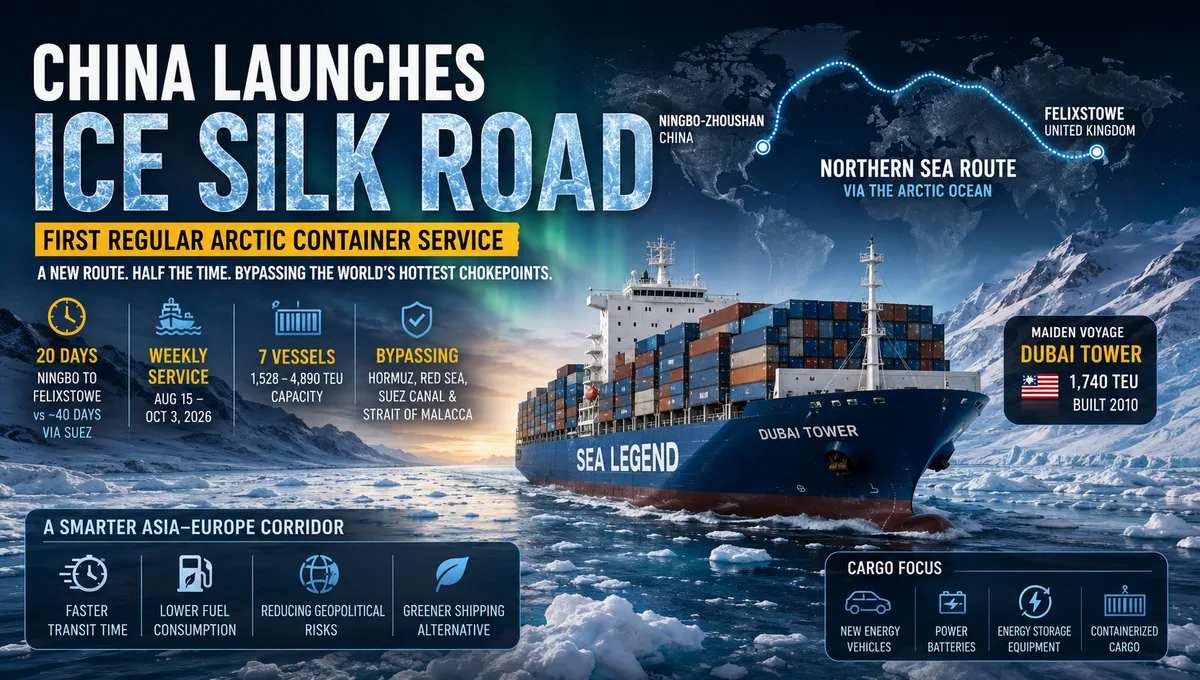
For decades, the Arctic has been discussed as a future shipping shortcut — a route that climate change and retreating sea ice might one day make commercially viable. This week, that future arrived. Chinese carrier Sea Legend Line launched the first regular weekly container service through the Arctic Ocean, sending its vessel Dubai Tower from Ningbo-Zhoushan Port toward Felixstowe in the United Kingdom via Russia's Northern Sea Route. The company has named the service the "Ice Silk Road" — a deliberate echo of China's ancient Silk Road trade network — and scheduled eight weekly sailings through October 3, 2026.
The timing could not be more significant. The route is entering a market where shippers are more aware than ever of geopolitical stress in the Red Sea and the value of alternative corridors. With Hormuz effectively closed since February, Bab al-Mandeb's safe-passage framework collapsed after the Tihamah attack on August 11, and the Suez Canal's northern approach threatened by the Damietta drone strike on July 29, the Arctic route's appeal is not just about speed — it is about bypassing every single one of the world's most disrupted shipping chokepoints simultaneously.
What Sea Legend Is Actually Operating
Sea Legend plans to operate eight weekly shipments from August 15 to October 3, 2026. A fleet of seven vessels with a capacity of 1,528 to 4,890 TEUs will provide weekly departures from the Ningbo-Zhoushan port complex on China's east coast. Cargo collection began at Ningbo-Zhoushan on August 12, with feeder shipments arriving from Dalian, Qingdao, Shanghai, Taicang, Fuzhou, and Nansha.
The maiden vessel, Dubai Tower, has a capacity of 1,740 TEU, was built in 2010, and is registered in Liberia. It is expected to reach Felixstowe in approximately 20 days. Subsequent voyages will be carried out by six additional vessels including the Istanbul Bridge (4,890 TEU), Riyadh Mukaab (2,872 FEU), Athens Odeon (1,829 FEU), and three Tiger-class vessels. The European ports of destination for the service are Felixstowe (UK), Rotterdam (Netherlands), Wilhelmshaven (Germany), and Gdynia (Poland).
The service will carry a range of cargo including new energy vehicles, power batteries and energy-storage equipment — exactly the categories of Chinese export that are under the most severe shipping capacity pressure right now, as NavilinkGlobal reported on August 15 in its coverage of China's auto export boom and the global car carrier shortage. Sea Legend has also confirmed cooperation agreements with terminals in Felixstowe, Rotterdam, Wilhelmshaven and Antwerp to facilitate berthing and reduce waiting times.
The Transit Time Advantage — And Its Limits
Depending on Arctic conditions, the voyage could reduce the normal roughly 40-day sailing time between Ningbo and Felixstowe to about 20 days. That is a significant reduction — roughly half the journey time of the conventional Suez Canal route. The 2025 trial voyage by Istanbul Bridge confirmed the 20-day transit is achievable under favourable conditions, completing the route from Ningbo-Zhoushan to Felixstowe before continuing to Rotterdam, Wilhelmshaven, and Gdynia.
But the "20 days" figure requires careful interpretation. It applies under direct-service conditions with favourable sea ice. The Northern Sea Route runs through some of the world's most unpredictable weather environments, and Sea Legend itself said weather conditions had forced it to adjust the schedule for the Dubai Tower's departure. This is not a route that operates with the schedule reliability of a Suez Canal transit. It is a route that operates with the schedule reliability of the Arctic — which is to say, approximately.
The transit time advantage is also context-dependent. Compared to the Suez Canal in normal conditions, 20 days versus 40 days is compelling. Compared to the Cape of Good Hope diversions that have become standard practice for Asia-Europe shipping since the Houthi campaign began, the comparison is even more dramatic — Cape of Good Hope transits from China to Northern Europe typically run 30-35 days. Against that benchmark, a 20-day Arctic transit, when it works, represents a 35-50% reduction in transit time.
What the Route Bypasses — The Geopolitical Advantage
The geographic routing of the Northern Sea Route is as important as its transit time. Sea Legend's service sails north from China, passes through the Bering Strait, and continues westward along Russia's Northern Sea Route before reaching European ports. That routing bypasses four of the world's five most disrupted shipping chokepoints simultaneously:
- The Strait of Hormuz: Effectively closed since February — the Arctic route does not touch the Persian Gulf at any point
- The Bab al-Mandeb: Safe-passage collapsed after the Tihamah attack on August 11 — the Arctic route bypasses the Red Sea entirely
- The Suez Canal: Dependent on both Bab al-Mandeb access and Red Sea security — irrelevant to the Arctic routing
- The Strait of Malacca: Not currently a crisis point, but a perennial chokepoint — the northward Arctic routing bypasses it as well
For cargo that needs to move between China's east coast ports and Northern Europe — particularly the UK, Germany, Netherlands, and Poland — the Arctic route offers something no currently operating alternative can: a path that is genuinely free of every active geopolitical disruption currently affecting Asia-Europe shipping. That is not a small thing in August 2026.
The Constraints — Why the Arctic Is Not Replacing Suez
ChatGPT's recommendation specifically warned against overstating this route — and that caution is correct. The Northern Sea Route has severe constraints that prevent it from being treated as a general-purpose alternative to established Asia-Europe corridors.
Seasonality is the fundamental constraint. The Northern Sea Route remains highly seasonal. Sea ice still limits navigation, and the current service is planned around the summer and early autumn navigation window. Sea Legend's eight sailings run from mid-August to early October — a window of approximately seven weeks. The Suez Canal route operates 365 days a year. Any supply chain strategy built around the Arctic must account for nine to ten months per year when the route is unavailable.
Russian control is a geopolitical risk of its own. Russia's Rosatom has been appointed by the Russian government to manage the entire Northern Sea Route and has established it with 28 unique sections. All transiting ships require permits from Russian authorities, and Russia has used access to the route as a geopolitical tool in the past. For Western shippers and carriers, routing through Russian-controlled waters while Western sanctions on Russia remain in force raises compliance questions that are not trivial.
Ice conditions are unpredictable. Even within the navigation window, ice conditions vary significantly year to year and week to week. The 20-day transit time is achievable — the 2025 trial proved it — but it is not guaranteed. Late-season sailings face higher ice risk than August departures. Equipment damage, schedule delays, and insurance complications are all more likely on Arctic routes than on established shipping lanes.
Vessel size is constrained. Sea Legend's fleet for the Ice Silk Road service ranges from 1,528 to 4,890 TEU. The ultra-large container vessels (ULCVs) that dominate Asia-Europe trade — ships carrying 20,000 to 24,000 TEU — cannot navigate the Northern Sea Route without icebreaker escort and significant operational modification. The Arctic route is a viable option for mid-sized vessels and certain cargo types; it is not a solution for the bulk of Asia-Europe container trade volume.
The Cargo Types That Fit — And Those That Don't
Sea Legend is targeting new energy vehicles, power batteries and energy-storage equipment — manufacturers and other businesses that place a premium on delivery times. That targeting is commercially astute. Chinese EV exports to Europe are growing rapidly — as NavilinkGlobal reported on August 15, China is on track to export 10 million vehicles in 2026, with BYD's EU registrations more than doubling in H1. Speed-sensitive, high-value cargo that fits within the vessel size constraints and tolerates schedule variability is the natural target market for the Ice Silk Road.
General consumer goods, bulk commodities, and time-critical perishables are poor fits for the current Arctic service — either because the volume requirements exceed current Arctic capacity, because the seasonal limitation creates supply chain gaps, or because the insurance and compliance complexity adds costs that erode the transit time advantage. The route is a premium lane for specific cargo categories, not a volume solution.
What This Means for the Asia-Europe Logistics Landscape
- The Arctic is now a third option, not a theoretical future. Sea Legend's service is operating today, in 2026, carrying real cargo. The question for logistics operators is no longer "will the Arctic become viable?" but "does it fit my specific cargo requirements and supply chain constraints?" Those are different questions with answers that depend on cargo type, season, volume, and risk tolerance.
- For Chinese EV and battery exporters, the timing is excellent. Car carrier capacity is fully booked years in advance (NavilinkGlobal, August 15). Hormuz is closed. Bab al-Mandeb is dangerous. An Arctic service specifically targeting new energy vehicles and power batteries — available now, bypassing every active disruption — is directly addressing the right problem for the right customers.
- Watch whether other carriers follow Sea Legend. Sea Legend is first — but it is unlikely to be last if the 2026 season proves commercially successful. The question is whether the 2026 voyages establish that the route is reliably profitable, or whether ice conditions, delays, and compliance complexity reveal constraints that prevent meaningful scale-up.
- Russian route control remains the wild card. Every vessel on the Ice Silk Road requires a Russian permit. In the current geopolitical environment — with Western sanctions on Russia, ongoing Ukraine conflict, and US-Russia relations at a historic low — the durability of Russian access for Chinese-operated Western-registered vessels is a risk that shippers and forwarders cannot ignore in their multi-year planning.
Key Takeaways — August 16, 2026
- Sea Legend Line launched the first regular weekly container service through the Arctic — the "Ice Silk Road" — with the Dubai Tower departing Ningbo-Zhoushan this week, expected to reach Felixstowe in approximately 20 days.
- Eight weekly sailings are planned from mid-August to October 3, 2026, using seven vessels ranging from 1,528 to 4,890 TEU. European destinations include Felixstowe, Rotterdam, Wilhelmshaven and Gdynia.
- The route bypasses Hormuz, Bab al-Mandeb, the Suez Canal and the Strait of Malacca simultaneously — the only currently operating Asia-Europe shipping lane that avoids all four active disruption points.
- The 20-day transit versus 40 days via Suez (or 30-35 days via Cape of Good Hope) is a genuine and proven time advantage — but only available for approximately seven weeks per year during the Arctic navigation window.
- Key constraints: seasonal operation only (August-October), Russian route control and permit requirements, vessel size limitations ruling out ULCVs, and schedule variability from ice conditions.
- Primary cargo targets: Chinese new energy vehicles, power batteries and energy-storage equipment — high-value, time-sensitive cargo that fits the route's capacity profile and justifies the premium over conventional lanes.
Comments
No comments yet. Be the first to share your thoughts!