The Surprise Driving Peak Season — AI Infrastructure Is Booming
Container shipping rates are hitting peak season highs comparable to June 2025 — but this time the driver is not consumer goods, retail inventory, or holiday season preparation. It is AI data centers.
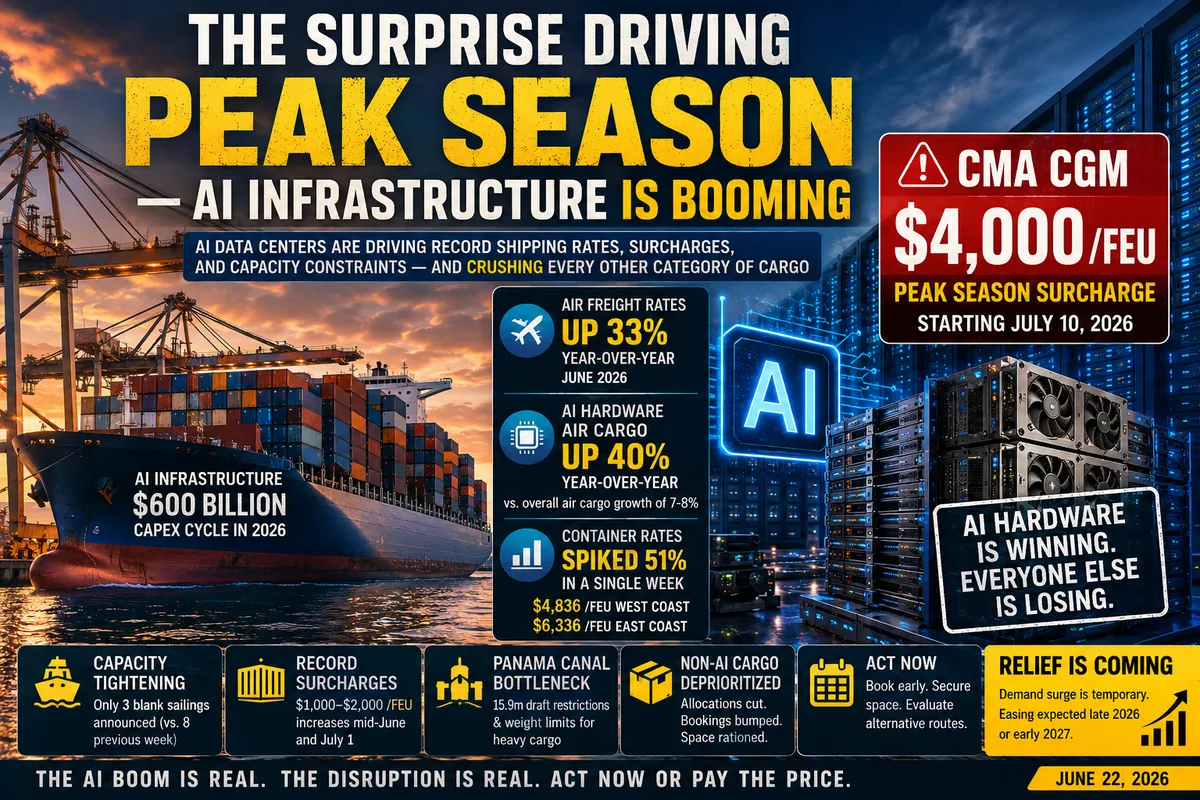
Global hyperscale data center capital expenditure in 2026 is tracking at $600 billion. This is not a small market segment — it is a structural mega-trend that is reshaping global logistics demand.
AI infrastructure requires massive quantities of specialized hardware: GPUs (graphics processing units), high-end servers, networking equipment, power distribution systems, cooling components, and data center infrastructure. All of this hardware is manufactured primarily in Asia — China, Taiwan, Vietnam — and needs to be shipped to data center construction sites across North America, Europe, and Asia-Pacific.
The specific numbers from air cargo markets tell the story:
- Air freight rates up 33% year-over-year in June 2026 — primarily driven by AI infrastructure hardware
- AI hardware air cargo growing 40% year-over-year — significantly outpacing overall air cargo growth of 7-8%
- Air cargo from Vietnam surged — electronics exports for data center equipment are the primary driver
This is a new freight category that did not exist at this scale two years ago. And it is overwhelming the shipping market right now.
What Are Ocean Carriers Doing? Record Surcharges and Rate Hikes
Carriers are responding to this demand surge with unprecedented pricing power. Here are the confirmed announcements from June 2026:
CMA CGM — $4,000/FEU Peak Season Surcharge Starting July 10
CMA CGM announced an additional $4,000 per FEU peak season surcharge (PSS) on all transpacific container shipments, effective July 10, 2026.
To put this in perspective: a year ago, typical peak season surcharges were $500-$1,500 per container. A $4,000 surcharge is extraordinary. This is roughly equivalent to doubling the base ocean freight rate for a single month.
Mid-June Rate Increases — $1,000-$2,000/FEU Additional
Carriers announced mid-month increases (effective mid-June) ranging from $1,000/FEU to $2,000/FEU above current rates on Asia-Europe lanes. Additional increases as high as $2,000/FEU higher than mid-June levels are planned for July 1.
One analyst at Freightos noted: "Carriers have announced mid-month increases ranging from $1,000/FEU to $2,000/FEU above current levels for Asia–Europe lanes, with additional increases as much as $2,000/FEU higher than anticipated mid-June levels planned for the start of July."
Spot Rate Spikes — Up 51% in a Single Week
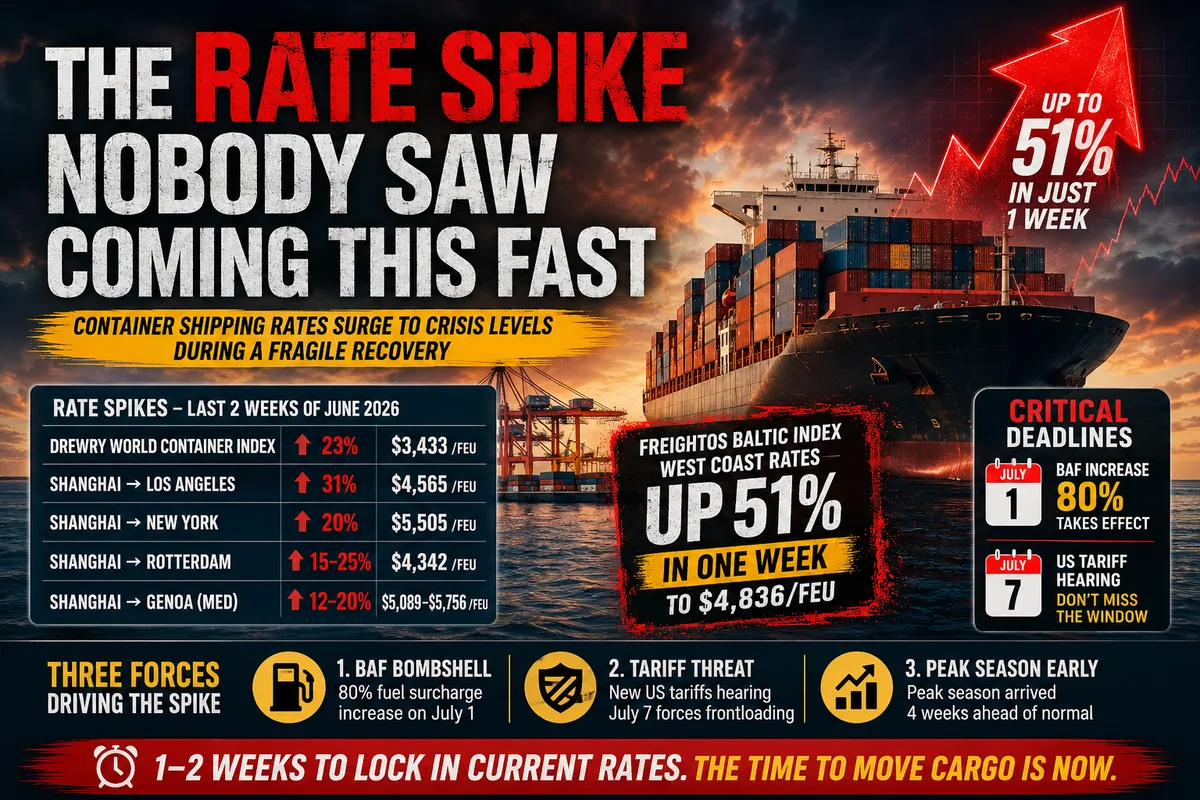
Container rates on Asia-US West Coast routes spiked 51% in early June 2026, reaching $4,836 per FEU. East Coast rates jumped 25% to $6,336/FEU.
These are the most pronounced single-week jumps since tariff-driven demand surges in June 2025.
Capacity Constraints — Carriers Are Prioritizing AI Hardware
With limited container availability, carriers are making strategic choices about which cargo to prioritize. AI infrastructure hardware is winning.
According to Drewry's Container Capacity Insight, only three blank sailings were announced on the trans-Pacific for the week ending June 15. This is "significantly fewer" than previous weeks — carriers had blanked eight sailings the week before.
What does this mean? Fewer blank sailings = more ships sailing = carriers see demand so strong they are deploying every available vessel.
For shippers in other categories — consumer goods, general electronics, manufacturing inputs — this is bad news. Space is tightening. Allocations are being reduced. Carriers are literally rationing capacity.
J.M. Rodgers, a major freight broker, reported:
"Capacity remains extremely tight, particularly on East Coast and Gulf Coast services from China and Vietnam. Heavy cargo restrictions and surcharges are being introduced by carriers, including MSC and Maersk. Southeast Asia and China origins continue to face booking pressure, rolling risks, and allocation constraints."
The Panama Canal Is Now a Bottleneck
Here is another crisis developing in parallel: the Panama Canal.
Going into a potential drought season, the Panama Canal has implemented draft restrictions of 15.9 meters. Because vessels are fully loaded with high-value AI cargo, carriers have reintroduced weight restrictions for containers routing via the Canal to the East Coast and Gulf.
If your cargo is heavy — say, data center cooling equipment, power systems, or dense server racks — you may face limited routing options. The carrier may refuse to allow your heavy container on the trans-canal service.
This is creating a secondary routing crisis: some shippers are forced to reroute via the Cape of Good Hope (adding 2-3 weeks) or divert to US West Coast ports and then reroute overland.
Who Is Getting Hit Hardest?
Every shipper except AI infrastructure companies is losing:
- Retailers preparing for summer and fall sales: Your container is being bumped to make room for GPU shipments. Space is "booked solid through the end of June" according to industry reports.
- Manufacturers needing production parts: Your allocation is being reduced. Carriers are "reducing allocations for contracted shippers" to free up capacity for spot shipments of high-value cargo.
- Textile and apparel companies: Your seasonal demand is being deprioritized. Carriers would rather carry a single GPU worth $10,000 than 50 units of apparel worth $8,000 total.
- Electronics companies (non-AI): Your goods are competing with AI chips, servers, and networking equipment. You are losing the capacity war.
- Shippers with heavy cargo: The Panama Canal weight restrictions mean your options are limited. You are facing either weeks of delay or significantly higher costs via alternative routing.
What Should Shippers and Freight Forwarders Do Right Now?
- Book space immediately for July and August. Peak season demand is peaking in June — meaning July may see softer demand and lower rates. But with CMA CGM announcing a $4,000/FEU surcharge starting July 10, you need to book before that effective date.
- Secure contracted space now. If you have long-term contracts with carriers, leverage them aggressively. Spot market pricing is out of control. Staying on contract rates may be your only option.
- Evaluate alternative routings. If you can tolerate 2-3 weeks of extra transit time, Cape of Good Hope routing may cost less than fighting for Panama Canal capacity.
- Check carrier weight restrictions. Before booking, confirm that your cargo weight is acceptable for the routing. If carriers are rejecting heavy shipments for trans-canal service, you need to know before you commit to the booking.
- Consider air freight for critical cargo. Yes, air is expensive — but if your cargo is genuinely time-critical and the ocean delays are pushing you past your deadline, air freight at current rates may be justified.
- Build strategic reserve inventory. If you can, shift peak season ordering earlier (April-May) to avoid the June-July crunch. The shippers who booked in May are paying significantly less than those booking in June.
The Silver Lining — Why This Could End Quickly
There is one reason to be optimistic: this demand surge is temporary.
The AI infrastructure super-cycle is real — but it is also front-loaded. Companies are racing to build data centers while GPU supply is tight and capacity is scarce. Once the initial buildout phase completes (expected by late 2026 or early 2027), this surge will ease.
One analyst noted: "If the peace deal hastens a broad carrier return to the Red Sea, that downward pressure will be even stronger. Given this drawn out timeline for oil and fuel recovery however, this easing will come too late to make much of a difference for container rates this peak season."
Translation: relief may be 4-6 months away, but it is coming.
Key Takeaways — June 22, 2026
- AI data center construction is driving a $600 billion CapEx cycle in 2026.
- AI infrastructure cargo growing 40% year-over-year — outpacing overall cargo growth.
- Container rates spiked 51% week-on-week in early June, reaching $4,836/FEU West Coast, $6,336/FEU East Coast.
- CMA CGM announced $4,000/FEU peak season surcharge starting July 10, 2026.
- Additional $1,000-$2,000/FEU increases announced for mid-June and July 1.
- Only 3 blank sailings announced (vs. 8 previous week) — carriers deploying every ship.
- Capacity tightening: allocations reduced, bookings bumped, non-AI cargo deprioritized.
- Panama Canal weight restrictions limiting heavy cargo routing options.
- Peak demand likely in June; July may see easing, but only after July 10 surcharge takes effect.
The AI boom is real. The data center building spree is real. And right now, it is crushing every other category of cargo in the shipping market. If your goods are not AI infrastructure, you are competing in a market where the rules have changed — and the prices have tripled. The shippers who understand this and act now are the ones who will survive the next 4-6 weeks with their supply chains intact.

Comments
No comments yet. Be the first to share your thoughts!