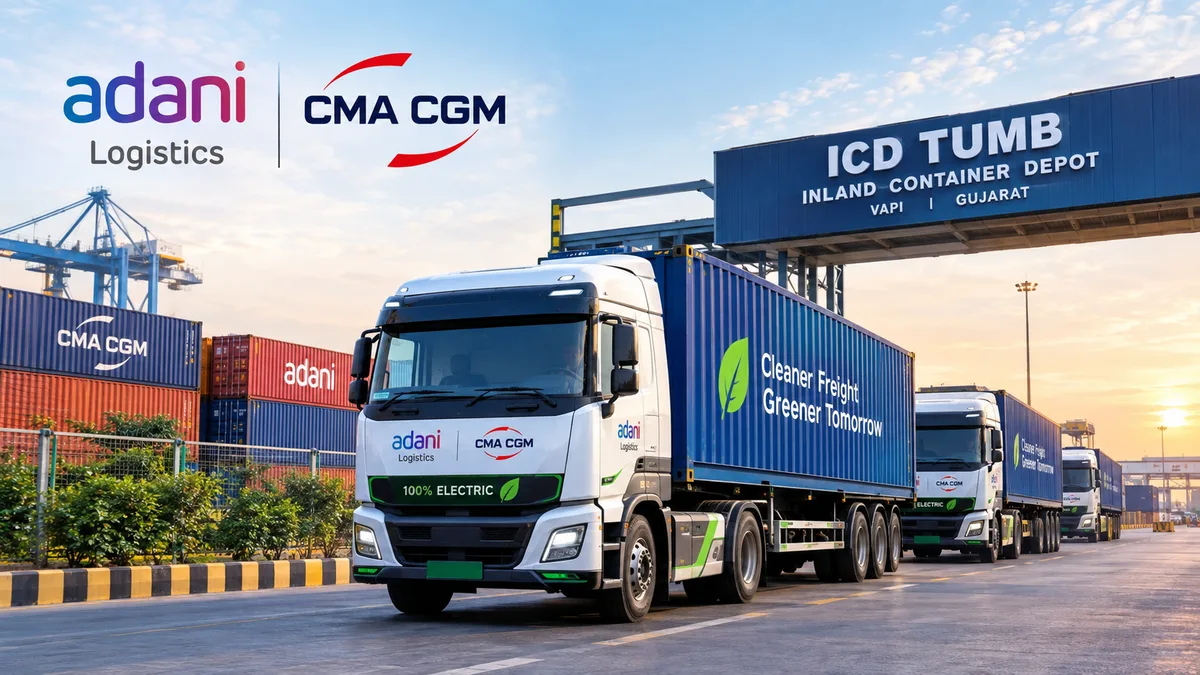
Adani Logistics, in partnership with global shipping and logistics major CMA CGM, has flagged off India's largest electric truck fleet dedicated to container movement at the Inland Container Depot (ICD) Tumb, near Vapi in Gujarat. The launch, announced on October 13, 2026, is being described as a significant step for electric mobility in India's logistics sector and a clear signal that cleaner freight is moving from pilot projects into real, everyday operations.
What's happening
The new electric trucks will move containerised cargo inland, strengthening connectivity between ports, inland container depots, warehouses, and manufacturing centres. By bringing electric vehicles into everyday container haulage, the initiative aims to lower carbon emissions, promote cleaner transportation, and support a more sustainable supply chain network. The companies have not publicly shared the exact number of trucks in the fleet.
The deployment is also part of the wider decarbonisation push at Adani Ports and Special Economic Zone Limited (APSEZ), the parent group of Adani Logistics, which has been working toward a cleaner and more sustainable logistics network across its operations. The electric fleet follows earlier efforts to strengthen ICD Tumb's rail connections, including the first double-stacked container train between ICD Tumb and ICD Patli in June 2025, which improved links between the Jawaharlal Nehru Port gateway and the Delhi-NCR region.
Why ICD Tumb is a strategic location
ICD Tumb is one of the largest inland container depots in India, with a handling capacity of around 0.5 million TEUs. Adani Logistics acquired the facility from Navkar Corporation in 2022 for an enterprise value of ₹835 crore, as part of its strategy to build an integrated, door-to-door transport network across the country.
The depot sits in the middle of one of India's busiest industrial belts, surrounded by industrial units in Gujarat and Maharashtra. It serves both Hazira Port and Nhava Sheva Port and connects to the Western Dedicated Freight Corridor. That mix of rail access, nearby ports, and a dense manufacturing hinterland makes it a natural place to test and scale cleaner trucking solutions.
Why electric trucks matter for container logistics
Road transport remains the backbone of first-mile and last-mile container movement in India, and it is also one of the most emission-heavy parts of the supply chain. Electric trucks can reduce tailpipe emissions and cut dependence on conventional diesel vehicles. Their impact is strongest when fleets are used efficiently and supported by reliable charging infrastructure.
Short, repeatable routes between an ICD and a gateway port are well suited to electric vehicles. Trucks can follow predictable schedules, return to base for charging, and run on defined corridors, which removes much of the range uncertainty that makes long-haul electrification difficult. This makes container shuttle movement one of the most practical early use cases for electric freight.
A partnership between shipping and logistics
The initiative also shows the value of cooperation between logistics operators and global shipping companies. Adani Logistics brings inland logistics capability, while CMA CGM adds its global shipping network. Together they aim to better integrate container transport across the wider supply chain, from the ship to the factory gate.
The two groups already work together beyond this project. APSEZ and CMA CGM have previously signed an agreement to operate a terminal at Mundra Port, one of India's largest container gateways. The electric truck launch extends that relationship from the port into the inland leg of the journey.
For shipping lines, cleaner inland legs help reduce the overall carbon footprint of the cargo they carry, something many customers and regulators increasingly track. For logistics operators, partnerships like this offer a way to scale new technology faster than going alone.
Part of a bigger shift in Indian logistics
The launch reflects the broader transformation underway in India's logistics ecosystem, where technology, alternative-fuel transport, and multimodal connectivity are gaining importance. With a strong national focus on lowering logistics costs, improving operational efficiency, and reducing emissions, projects like this can contribute to a more resilient and environmentally responsible freight network. Rail, road, and port operators are all being pushed to work as one connected system rather than separate links.
What it means for shippers and forwarders
For importers, exporters, and freight forwarders, greener inland transport is becoming a practical consideration rather than just a sustainability slogan. Large buyers increasingly ask for emissions data on their cargo, and operators that can offer electric haulage on key corridors may gain an edge. Forwarders working on cargo through Gujarat and the Western corridor should keep an eye on how this fleet performs and whether similar services expand to other depots.
Key takeaways
- Adani Logistics and CMA CGM have flagged off India's largest electric truck fleet for container movement at ICD Tumb, near Vapi, Gujarat.
- The trucks will support container transport between ports, inland depots, warehouses, and manufacturing hubs.
- ICD Tumb has a capacity of around 0.5 million TEUs and serves both Hazira and Nhava Sheva ports.
- The initiative is part of APSEZ's broader decarbonisation journey and follows earlier rail upgrades at the depot.
- Electric trucks can lower tailpipe emissions and reduce diesel dependence, especially on short, predictable container routes.
- The partnership shows how shipping lines and inland logistics operators are collaborating on cleaner freight movement.
For freight forwarders, importers, and exporters in India, this is a development worth watching. As green logistics options expand, sustainable inland transport may soon become a bigger factor in how shippers choose their logistics partners.


Comments
No comments yet. Be the first to share your thoughts!